Editor’s note: Jay Waters is senior vice president and chief strategy officer at Luckie & Co., a Birmingham, Ala., advertising agency.
For the past three years in March, when the nation is awash in bracketology, Luckie has joined the frenzy with our annual America’s Favorite Family Brands tournament. The 64 brands we chose three years ago, based on their leadership in key categories purchased and by the size and scope of their marketing efforts, have remained the same. We have lots of interesting results in this year’s bracket, but first, here’s a quick overview of how we measure popularity of the brands.
Background
The Luckie Family Panel is a monthly national survey of American parents that we use to keep our finger on the pulse of the daily lives of families in the U.S. We ask questions about how often they eat at home together, about their social media usage and about health care too. We now have feedback from parents on over 350 topics, broken out by age, sex, marital status and political affiliation (Republican or Democrat).
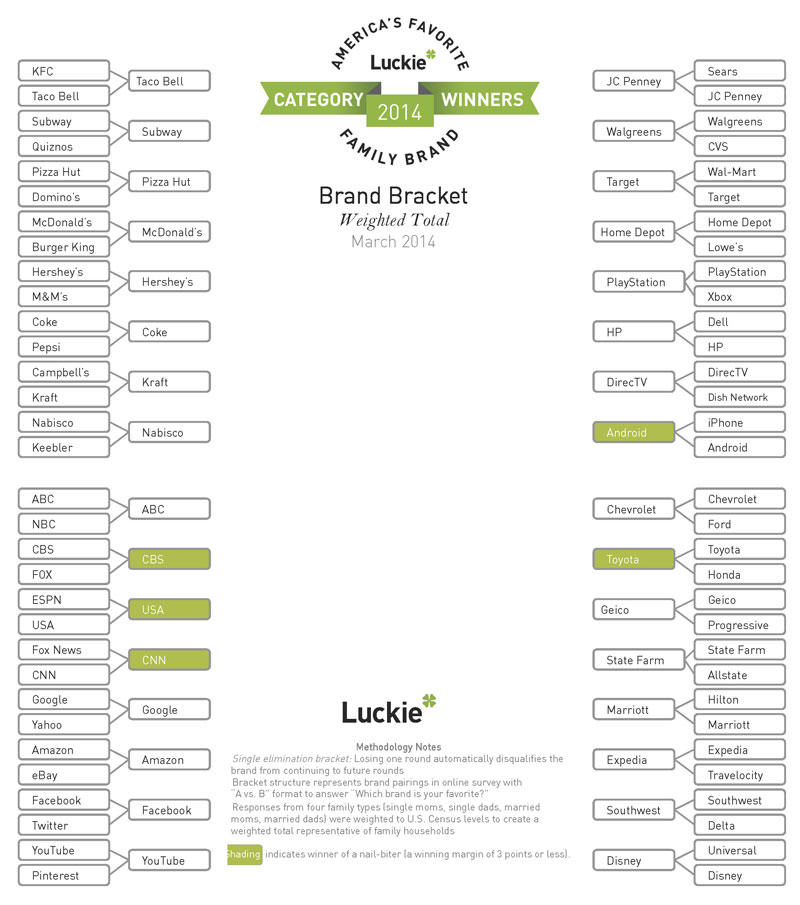
For the annual brand bracket, our premise is pretty straightforward. In our Luckie Family Panel monthly survey, we ask the respondents to fill out a bracket populated by 64 of America’s best-known brands in a variety of categories (fast food, packaged goods, technology, cars, retail, travel, etc.). The instructions are simple: For each matchup between two brands, pick the brand you like best to advance to the next round.
Luckie chose brands based on the following criteria:
- national brands that are major marketers;
- leading brands in their categories;
- brands in categories that are important to families; and
- brands that appeal to both men and women.
In the first round, each brand is paired head-to-head with a competitive brand. Winning brands advance to a second-round matchup with a winning brand from a similar but broader category.
The further a brand advances in the bracket, the more it begins to compete with brands from different categories.
The eight “sub-regionals” brand categories were:
- QSR (KFC, Taco Bell, Subway, Quiznos, Pizza Hut, Domino’s, McDonald’s, Burger King)
- Packaged food (Hershey’s, M&M’s, Coke, Pepsi, Campbell’s, Kraft, Nabisco, Keebler)
- Television (ABC, NBC, CBS, Fox, ESPN, USA, Fox News, CNN)
- Web (Google, Yahoo!, Amazon, eBay, Facebook, Twitter, YouTube, Wikipedia)
- Retail (Sears, JCPenney, Walgreens, CVS, Walmart, Target, Home Depot, Lowe’s)
- Tech (PlayStation, Xbox, Dell, HP, DirecTV, Dish Network, iPhone, Android)
- Auto (Chevrolet, Ford, Honda, Toyota, Geico, Progressive, State Farm, Allstate)
- Travel (Hilton, Marriott, Expedia, Travelocity, Southwest, Delta, Universal, Disney)
Note: Although we have kept the same brands in the bracket for three years, the results this year – both in the bracket and in the marketplace – are leading the selection committee to rethink who gets invited to the tourney next year.
Here’s how the 2014 matchups played out.

First-round matchups
All of the first-round matchups featured some of America’s most pitched brand rivalries: Coke vs. Pepsi, Target vs. Walmart, Disney vs. Universal.
The full results of the first-round matchups are noted in the graphic above but here are four of the most interesting.
iPhone vs. Android
In our 2012 bracket, iPhone won this head-to-head matchup and made it all the way to the final eight. In 2013, iPhone again won and made it all the way to the final four group of brands, losing out to the eventual overall bracket champion, Disney. 2014 was a much different story, with Android beating iPhone in a first-round squeaker.
At first blush, this might seem to be a story about one brand overtaking another in the marketplace but the fact is that Android in 2012 and 2013 already had more market share than iPhone. To me, this result is more about the Android brand overtaking Apple as the preferred smartphone operating system, since the question asked in this survey was “Which of these two brands is your favorite?”
CBS vs. Fox
In 2012 and 2013, Fox defeated CBS in their head-to-head first-round matchup but in 2014, CBS squeezed out a win. Again, this is likely the result of a long-term trend in the marketplace, as CBS has been regularly winning the prime-time viewing battle most nights and overall. That said, this seems to be another example of a brand losing steam. Fox won the television network battle in each of the past two years, overcoming CBS in the first round and then defeating the ABC/NBC winner (ABC) in both years.
But the major question is whether Fox is still relevant to American families. American Idol, one of its franchise properties, has seemingly passed its peak. Last year during the last week in March, of the 25 highest-rated programs with adults ages 18-to-49, four were Fox programs, with American Idol coming in fourth. This year, Fox has only two shows in the same top 25 list, with American Idol coming in 20th.
JCPenney vs. Sears
The soap opera that has been the JCPenney marketing story for the past few years, at least for those in the advertising business, seems not to have had much impact on how consumers feel about the brand. For the past three years, JCPenney has beaten out Sears in their head-to-head matchup. Last year, at the height of their marketing issues, they edged out Sears by less than 3 percentage points. This year, the margin widened, indicating that the JCPenney brand is moving back into favor with families.
The story here really is what Sears thinks about these results. Long claiming to be where America shops, Sears has a much broader line of products for the whole family, a stronger group of house brands and little of the marketing drama associated with JCPenney. JCPenney can’t brag too much. It hasn’t made it past the second round in our bracket for the past two years, being surpassed each time by Walgreens.
Chevrolet vs. Ford
This is a battle that has gone back and forth over the past three years. Chevrolet beat out Ford in their head-to-head battle in 2012, with Ford surpassing Chevrolet in 2013. In 2014, Chevrolet won the head-to-head matchup.
What’s interesting is what has happened in the second round each year. In 2012 and again in 2014, Chevrolet not only beat out Ford but also beat out Toyota, three-time winner of the head-to-head matchups with Honda. However, in 2013, when Ford won the head-to-head matchup with Chevrolet, Ford couldn’t get past Toyota and move into the third round. Does this mean Chevrolet is the domestic brand with the biggest edge over import brands? If so, this would be ironic since my perception has been that Ford (unlike other domestic brands) has clearly targeted imports as its primary competition.
On April 14, Luckie & Co. announced the 2014 winner but we won’t spoil the fun if you want to read on and see how the brand bracket played out. Check out Waters’ follow-up blogs, “Our Final Eight Brands,” “Final Four in the 2014 Luckie ‘America’s Favorite Family Brands’ Bracket” and “And the Champion Is…”.