
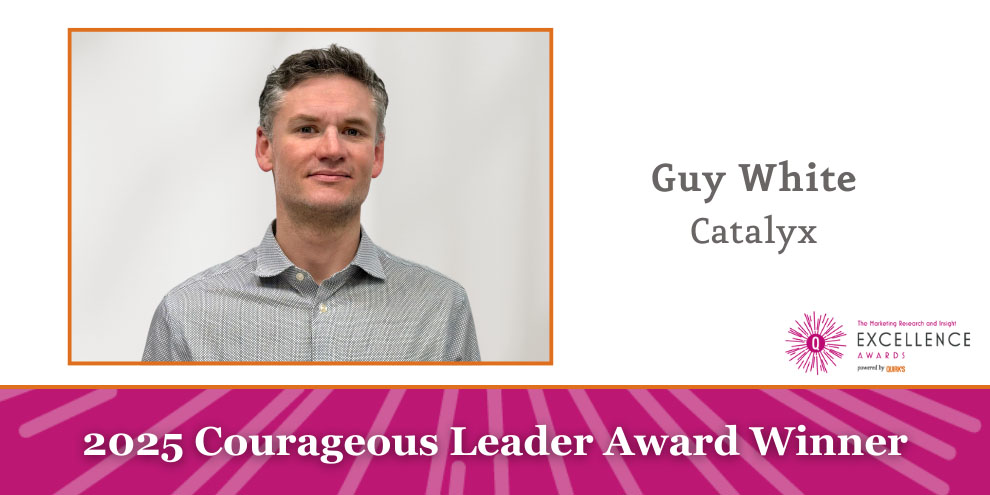
Q&A with the 2025 Courageous Leader award winner, Guy White
Editor’s note: Guy White is the winner of the Courageous Leader award, a category in the Marketing Research and Insight Excellence Awards. The award winners were announced during a virtual celebration on November 19, 2025. To learn more about the awards, visit https://www.quirksawards.com/.
The Marketing Research and Insight Excellence Awards’ Courageous Leader award goes to a researcher who is a proven risk-taker, someone making a significant difference in their organization through marketing research and insight. The 2025 Courageous Leader award was given to Guy White, CEO and founder of Catalyx.
White created an organization that has been recognized three years in a row as a top European growth company. His consumer-centric approach aims to reduce waste and potentially save £1.2 trillion annually in innovation failures.
Through a “50% helicopter, 50% train” leadership style, White fosters innovation through unique processes and a focus on data storytelling.
Find out more about White’s leadership style and career in this Q&A.
How did you get your start in the insights industry?
I began my career client-side as a marketer at Procter & Gamble. While I enjoyed the role, it quickly became clear that my strengths lay less in creative development and more in working with data and identifying patterns.
I found I could diagnose naturally what it was about an innovation or campaign that consumers found interesting – or not – and could spot patterns across large volumes of feedback.
In 2012, at the age of 29, I left P&G to set up Catalyx.
My original ambition was simple: to move away from decks filled with slide after slide of data and instead provide clearer synthesis and more decisive recommendations. That approach resonated strongly with clients.
It took me some time to realize that what we were really doing was insights. In many ways, I accidentally found myself fully immersed in the insights industry.
What tips do you have for individuals looking to improve their collaboration skills?
Collaboration isn’t simply about listening to other points of view. It’s about creating an atmosphere where people feel safe to speak honestly and where healthy debate and exploration is welcomed and encouraged.
At Catalyx, we run what we call an “Elevation Workshop.”
This is a melting-pot meeting where insights are most likely to surface. Job titles are left at the door, a semi-structured approach is used, and light facilitation helps teams explore early field findings together. It’s in these sessions, where patterns and unspoken truths emerge, that the real “aha” moments happen.
These meetings can be messy. They can get feisty, take detours and require U-turns. But they almost always end with a group of people excited by having discovered something genuinely new.
For individuals, there are a few key takeaways from this process.
Firstly, collaboration works best in person, when you know the others and trust them. That is far harder behind a computer screen. It doesn’t have to be all the time, but in person meetings and office time are so valuable. The more people you have genuine connection to, the more people you have around you that will support and work with you.
Secondly, recognizing when you’re stuck and asking for help is key. In a remote or hybrid work environment, it’s easy to forget that there are many other people around who are happy to support. Just reaching out is the first step to creating connections.
At Catalyx we are lucky that we have a culture of support. Absolutely everyone will find the time to support each other the minute someone asks.
Finally, learning a whole range of presentation and facilitation skills. This is something that I was lucky enough to be taught early on and helped me invaluably in my career.
At University I was the person with a 200-word slide reading from the projector. But since then, I have been taught by some outstanding facilitators and have learned a range of models and frameworks that I now regularly draw on. I would encourage everyone to seek out facilitation and workshop training, regardless of their role.
As you become more senior, problems get messier and solutions less obvious. These foundational skills give you a tool kit to help you bring a group of smart people together into a room and work together to find better solutions than you would find on your own.
How do you balance vision and hands-on work to grow Catalyx?
It may sound cliché, but the starting point is surrounding yourself with brilliant people you can trust. People that you know complement your skill set and are experts in their field. This allows you to step out of the day to day.
In my experience it takes a long time to achieve that great team, but once you have it, things start to click.
Creating a shared vision is also critical. For us, that’s an annual lift with quarterly check-ins, anchored by a longer-term “north star” we are striving for. Just as important though is ensuring the ambition is realistic for the resources available. Otherwise, you end up with an ambition that cannot be realised and a recipe for frustration.
At Catalyx, we use the OGSM framework, objectives, goals, strategies and measures. I’ve tried others, but I find OGSM works best for cascading a clear corporate vision through an organization.
Once that structure is in place, I find my role is to support, coach and track progress. Acting as the canary in the coal mine to spot when we drift off track and then to pull the right people into the room to adjust.
If the right people are in the right roles, my job is often to step out of the way and let them get on with it. If there are gaps, that’s when I roll up my sleeves.
Increasingly, leadership for me is about creating the right structure, resource and atmosphere to enable others to do their job rather than being in the weeds myself. I’m definitely still learning this, and I can get too involved at times, but this is certainly the aspiration!
What does courageous leadership mean to you?
“Courageous leadership” feels like a big title and a big award! My British modesty feels a bit uncomfortable with the words if I’m honest. I cannot be a leader without a team and much of our success at Catalyx is down to them.
The insight industry is in a real state of flux right now. That’s exciting, but it’s also challenging and demands adaptability and resilience. I’m not sure I’m courageous but I do know that I never give up. And I’m surrounded by people with exactly the same mentality. Hard working, smart and creative people that have a real passion for what they do and a genuine excitement to help our clients create innovation that wins. It is far easier to be a leader when you have a team that is as motivated as the Catalyx team.