
Synthetic data is the biggest buzz in market research since online panels. The idea is compelling: answers in minutes, at a fraction of the cost. But the science is clear about the limits, and synthetic alone is not enough. Insight has to be synthesized from what real people said and refreshed with new human conversations, not made up by a model. That is what we call synthesized insights.
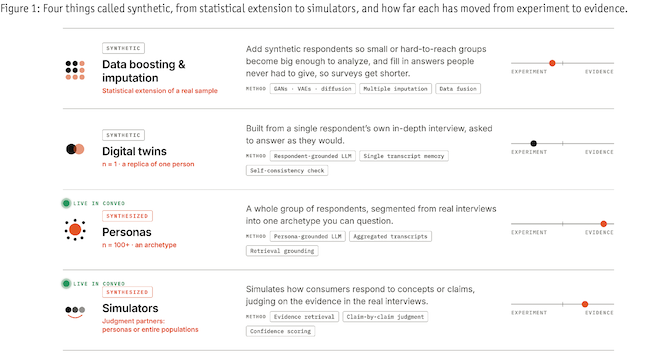
Ask 10 researchers what they mean by synthetic data and you will hear 10 answers: a survey sample stretched to fill its gaps, a digital twin answering for a real person, archetypes built from a hundred interviews or those archetypes reacting to a concept. Most of the debate disappears once we name which one we mean.
One word, many meanings: synthetic versus synthesized
Synthetic approaches replicate a person and predict how they would answer: data boosting fills survey gaps with modeled responses, digital twins let a model speak for one interviewed person. Synthesized approaches take many real people and compound their attitudes, behaviors and values into aggregated insight. Personas, built from a hundred or more real interviews, are one example. Simulators, which judge a stimulus against everything a body of real consumers has said or shown, are another.
The most important questions about synthetic data are: How many real people stand behind it and how recently were they asked? A twin stands on one, a persona on a hundred or more, a simulator on the whole corpus, with a confidence level attached.
Mind the edges: what the science says
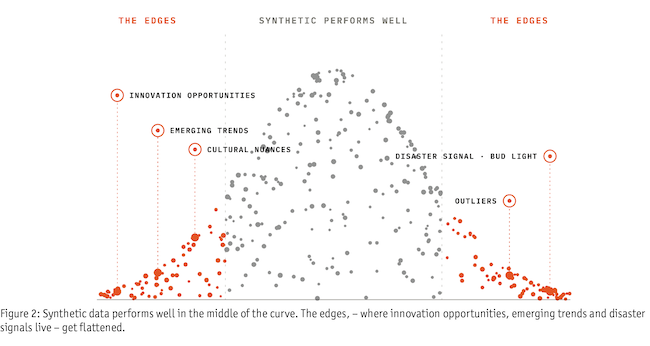
The published evidence is remarkably consistent (Argyle et al., 2023; Santurkar et al., 2023; Bisbee et al., 2024). Language models reproduce the mainstream well; at the edges, they drift (Figure 2). They compress variance, so a synthetic distribution can match the human mean while staying too narrow (Kutzner et al., 2026). Yet the tails are where researchers earn their keep: weak signals, emerging trends, cultural nuance and the unknown unknowns that become next year’s growth story or crisis. Bud Light in 2023 is the textbook disaster signal: a cultural reaction at the edge of the distribution, invisible to any model of the average drinker, that cost the brand its position as the best-selling beer in the United States.
This is why researchers recommend using silicon samples alongside human respondents, not instead of them (Sarstedt et al., 2024), and why the most accurate synthetic models were not built from demographics and survey answers. When Stanford researchers built digital twins of a thousand people, the input that made them accurate was two-hour in-depth interviews (Park et al., 2024; see also Toubia et al., 2025); persona descriptions recover only half to two-thirds of real between-person variation, while a record of what people actually did restores it (Pourtaheri and Zareei, 2026). In other words, deep qualitative data is the gold standard for building and tuning synthetic models and it is exactly what Conveo generates every day: one AI-moderated video conversation yields dozens of discoveries across values, behaviors, needs, emotions and occasions, in the consumer’s own words. That asset is why we have been part of the synthetic discussion with our clients from the beginning and why we built our own capabilities to complement it.
Why humans are hard to model
There is a deeper reason the edges are difficult. A language model knows too much to be irrational. People have bounded rationality (Simon, 1955); models are not fully rational but have vast recall that is not tied to a situation or lived experience. A model has no body, no friends and nothing to lose. It cannot be scared, bored, vain or in love, and those states drive much of what we buy. Two human biases make the point. Social proof, the herd instinct: a Stanley steel cup launched in 2016 was the driver to a $750-million-a-year business by 2023 because everyone else had one on TikTok. And the IKEA effect, a form of effort justification: people who assembled a plain storage box themselves would pay 63 percent more for it than for an identical pre-assembled one (Norton, Mochon and Ariely, 2012).
A model can define every one of these biases. But understanding a bias is not the same as having it. A real person feels the loss of a $20 discount more sharply than the gain of $20, and that feeling fires at the shelf, without reasoning. A model has no such moment. The largest study of digital twins to date finds they correlate with their humans at only r = 0.20 and names hyper-rationality as one of five systematic distortions (Peng et al., 2026).
This is the conclusion we draw: synthetic is not enough. A model that invents a consumer answer has learned nothing about your market; it has recombined what it already knew. Accurate decisions need two things instead: information synthesized from real conversations, with every claim traceable to people who said it, and a fresh consumer perspective added continuously, because last year’s consumer is not the one you are deciding about today.
Decide by use case, not by ideology
The debate becomes productive once we move from “synthetic, yes or no” to “synthetic for what.” A simple rule: synthetic where speed or a gut check matters, real humans where the stakes are high. Fast claims screening and hard-to-recruit niche audiences suit pure synthetic methods. Ideation, concept evaluation and ad testing suit synthesized approaches built on aggregates of real people. Front-end innovation, foresight, brand health and anything with high stakes stay fully human for now.
Why the corpus is never finished
Grounding a model in real people is not a one-off exercise. Any body of knowledge is a snapshot of the moment it was collected and there are four reasons to keep adding fresh primary data. Things change: new products, prices and shocks reset behavior, as the uptake of GLP-1 weight-loss medication showed. Cultures differ: model defaults lean towards English-speaking and Protestant European values (Tao et al., 2024) and twins are more accurate for richer, more educated people (Peng et al., 2026). Attitudes shift: synthetic output reflects what people used to say, not which fringe view is becoming mainstream. And models collapse without fresh input: trained on their own output, they lose the tails first (Shumailov et al., 2024). Theory building becomes, in Puntoni and Schillewaert’s words, "an 'always-on' living grounded theory, perpetually re-exposed to incoming data" (Tomaino et al., 2026).
Personas and simulators: two jobs, one foundation
In our work the synthesized layer takes two forms. A persona is an archetype of a hundred or more real people who share values, behaviors and needs. It is built by more than 50 specialized AI readers we call lenses: each reads every interview for one thing, such as occasions, barriers or emotions, the way a researcher coding transcripts would, and clusters what people express into shared meaning. Every new interview adds a real person, so the persona evolves with the market instead of sitting in a PDF.
A simulator does a different job. It sits on top of all the consumer data, independent of any persona, as a general consumer judge. Give it a concept, a claim or an ad and it returns a score, the reasons, how consumer types react and a confidence level scaled to the evidence.
In action: The New Health Hierarchy
The New Health Hierarchy, one of many Conveo syndicated studies, puts synthesized insights to life on the concept development and evaluation use case. Since May 2026, AI-moderated video interviews in six markets have probed how people define being healthy and what they will trade for it. A new wave fields every two weeks and the corpus stands at 2,579 conversations, so the personas move with the market and the simulator judges against conversations weeks old rather than years.
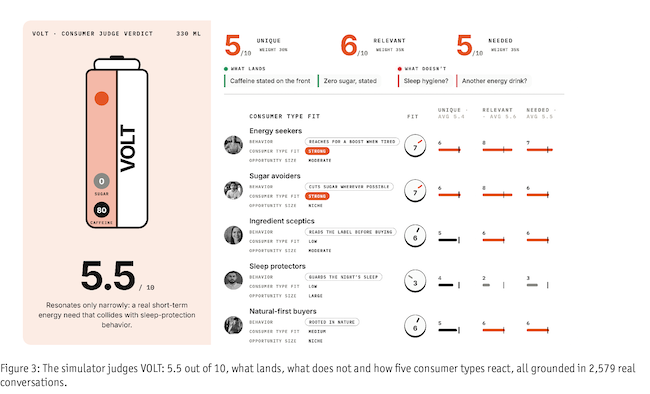
We used the conversations and personas to find unmet needs, pain points and jobs to be done, each grounded in a concrete occasion, producing more than 30 concept springboards. One is VOLT (Figure 3), a zero-sugar sparkling drink for the afternoon energy dip, co-designed with the personas whose needs it answers. The second step has a different purpose: the simulator judges the concept not against the personas that inspired it but against the full body of grounded evidence from consumers, their behaviors, attitudes, preferences and the trends they are adopting. That is what makes the verdict independent and universal. VOLT scored 5.5 out of 10: the caffeine dose and zero-sugar promise land, but it collides with people protecting their sleep by cutting afternoon caffeine. Sleep protectors scored it three out of 10, with medium confidence because the data supports the tension but cannot judge the recipe.
That is the point. Ideation and concept evaluation are exactly where speed matters and the loop from need to judgment took hours, not weeks. But every line traces back to a real person and the verdict says how far to trust it. Synthesized insights deliver the speed that makes synthetic data attractive, without giving up the ground truth.
What this means for insight teams
Research that used to end in a report becomes a living asset and the human interviews that ground it become more valuable, not less. Five lessons travel well. Synthetic is not enough: synthesize what real people said, never make it up and keep adding a fresh consumer perspective. Mind the edges, because the insights that change a business live in the tails. Human behavior is hard to model: a model can explain a bias without ever having it. Decide by use case: speed and sense checks go synthetic or synthesized, high stakes go human. And keep the work alive with every new conversation. The future of insights belongs to those who keep listening at the edges.