
 Ask someone how their dishwasher performs, and they'll likely say "fine." Ask them to film a real load before and after a cycle and an entirely different story emerges – one of wet plastics, towel-dried containers and quiet compromises that never surface in a survey or a recall-based qualitative study.
That gap between claimed satisfaction and lived reality is what traditional research struggles to capture. And it is precisely where AI-led ethnography is proving its worth.
The study: real loads, real kitchens, real behavior
We recently completed a mobile ethnographic video study with 91 U.S. households on Conveo’s end-to-end AI-led insights platform. The design was deliberately simple: participants were filmed loading a real dishwasher load, narrating their choices, concerns and product use. After the cycle completed, they returned on camera to evaluate the results – cleaning, drying and what happened next.
No in-home interview. No lab. Just an ordinary day or evening, captured on a smartphone and guided by an AI interviewer that could smartly probe, follow up and remember context across both sessions. The sample skewed female (76%), with ages ranging from 21 to 79 years old.
The ethnographic lens here is important: a dishwasher load is not just a mechanical task. It is a social and material performance. The approach also represents a meaningful evolution in how ethnographic research can be conducted.
Where traditional in-home studies require weeks of fieldwork coordination, observer training and travel budgets, this AI-led model completed 91 two-part video diaries in a fraction of the time – without sacrificing the contextual richness that makes ethnography valuable.
What a "successful run" really needs to deliver
Applying a jobs-to-be-done framework to the dishwashing cycle revealed that cleaning is necessary but not sufficient. While cleaning topped the jobs list at 95%, right behind it, "dry enough to put away" appeared at 78%, followed by "clear kitchen and free up space" at 70%, "convenience and save time" at 67% and "fit schedule" at 66%.
This reframes the entire value proposition. The dishwasher is not just a cleaning machine. It is a household coordination device and the jobs it fails to complete ripple through daily routines in ways that only in-context observation can reveal. 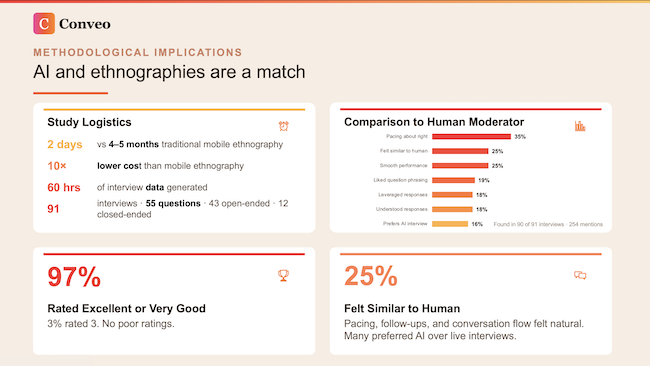
What the method uncovered: the drying problem nobody reports
The machine cleaned. It rarely finished the job. Conveo’s “talk to your data” module revealed four underlying themes: front-end labor (the persistent question of "Do I have to rinse or scrape?"), fit and geometry constraints (awkward items and rack layout limitations turning workarounds into standard operating procedure), end-state reliability gaps (drying failures driving post-wash fixing behaviors) and household coordination ("the right way" rules creating interpersonal conflict and reloading behaviors, adding a social layer to a mechanical task).
These findings were striking – and commercially relevant for anyone in the dishwashing ecosystem, from appliance manufacturers to home care brands to retailers. Due to space restrictions, we focus on the drying issue here. The dishwashing machine does not earn its keep when it comes to drying – and our data exposed a striking paradox. Six out of 10 households needed post-wash remediation, yet eight in 10 still rated results "as expected." Consumers have learned to expect imperfection and built repair routines to compensate. As one participant put it: "Fine means I only had to hand-dry a few things."
Yet only one in five households used a rinse aid, the one additive proven to meaningfully improve drying. The fix exists but consumers are not reaching for it. This finding points to an opportunity for bundling detergents with rinse aids – just to name one example. 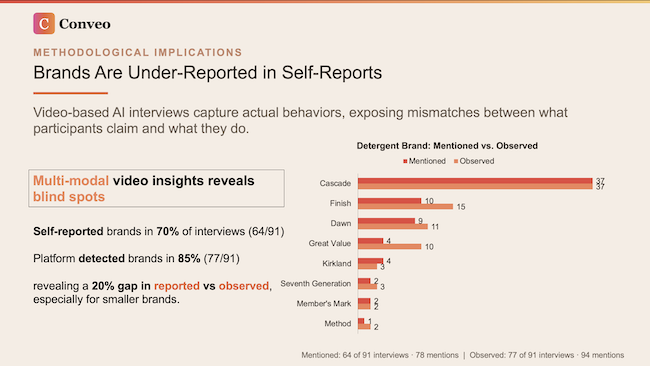
Why this matters methodologically: the challenges AI addresses
For researchers and insights leaders evaluating AI's role in qualitative work, this study offers a practical proof point – one grounded in the real limitations of traditional ethnographic research.
Traditional ethnographies in the field face several challenges: access and recruitment (getting into the actual kitchen is a hurdle from the start), the observer or Hawthorne effect (participants clean up before visits, hiding natural kitchen behavior), time, cost and occasion constraints (behavioral dynamics often occur outside the observation window), data overload (video, audio, notes and photos make it hard to distill clear themes), interpretation bias (ethnographic interpretation depends heavily on the individual researcher), limited generalizability (10 to 20 households yield deep insight but not prevalence), difficulty capturing tacit behavior (automatic habits are hard to articulate or observe) and translating insights (rich narratives need to become decisions, not just observations).
Our AI-moderated ethnography approach addresses each of these systematically. The study completed in two days what traditional mobile ethnography takes four to five months to deliver, at one-tenth the cost. It generated 60 hours of interview data across 91 interviews, with 55 questions per interview – 43 open-ended and 12 closed-ended – producing both the contextual richness of qualitative research and the quantifiable patterns of survey data. This is what we call a "quantified why" – a scalable and replicable method that remains authentic and in-context.
Participant feedback validated the approach. Ninety-seven percent rated the AI interviewer as excellent or very good. The AI-interview even holds against human moderation with a quarter of participants saying the experience felt similar to talking with a human moderator, citing natural pacing, thoughtful follow-ups and smooth conversation flow. Many actually preferred the AI interview format over live interviews. 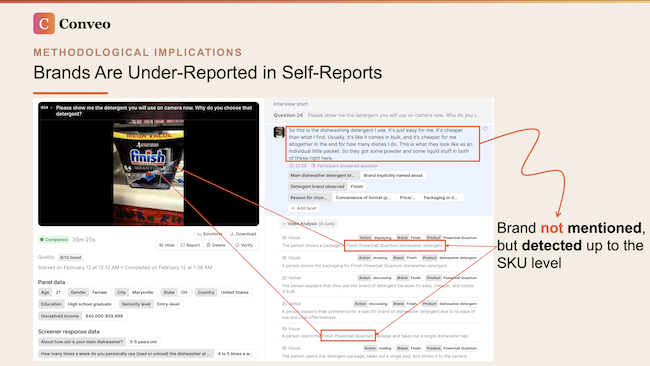
Video insights reveal what self-reports miss
Perhaps the most methodologically significant finding was about SKU and brand measurement. Self-reported brands appeared in 70% of interviews (64 of 91), generating 78 mentions. But Conveo’s unique multimodal AI video analysis – which scans what appears on screen, not just what participants say – detected brands in 85% of interviews (77 of 91), generating 94 observations. That is a 20+% gap between reported and observed brand presence, with the underreporting concentrated among smaller brands.
Cascade showed near-perfect alignment between what participants claimed and what cameras observed (37 mentioned, 37 observed) – a marker of dominant brand salience. Great Value, by contrast, showed four mentions versus 10 observations, a 150% uplift from verbal to visual, suggesting private-label use is significantly underreported in traditional research. Finish revealed 10 mentions but 15 observations, with the platform detecting not just the brand but the specific product down to the SKU level – Finish Powerball
Quantum – even when participants did not name it. None of these dynamics would have surfaced from transcripts alone.
This capability matters for brand strategists because it reveals which brands have genuine salience (consumers name them unprompted) versus habitual presence (used regularly but not top of mind). Finish, for example, showed strong observed usage but weaker unaided recall, leaving it potentially vulnerable to switching.
The broader shift
The promise of generative AI in consumer insights has been evolving rapidly. Early applications focused on automating moderation or scaling qualitative sample sizes – useful but incremental improvements. What this dishwashing study illustrates is something more fundamental:
AI as a method that makes previously impractical research designs practical.
A 91-household, two-part video ethnography with adaptive AI interviewing, multimodal video analysis and integrated quantitative-qualitative measurement would have been prohibitively expensive and logistically complex even three years ago. Today, it runs in days, not months, and produces insight layers – behavioral, emotional, contextual – that compound with each other.
For the ethnographic research tradition specifically, this is not a replacement narrative. It is an expansion of what ethnography can achieve when freed from the constraints of human observer bandwidth. The human insight advantage does not diminish with AI – it scales.