
A clear view to success
Editor's note: Mike Deinlein is vice president, CX solutions, at Burke, Inc. He can be reached at mike.deinlein@burke.com. Eric Scheer is senior vice president, brand solutions, at Seed Strategy. He can be reached at escheer@seedstrategy.com. Neil Leyshock is vice president, data solutions, at Burke, Inc. He can be reached at neil.leyshock@burke.com.
In today's rapidly changing economic landscape, brands face numerous challenges that can impede growth. A 2024 survey of marketing executives by the CMO Council revealed economic uncertainty was considered a top growth inhibitor for 2025. In such situations, initiatives that fuel growth, like expansion, innovation or reorganization, often take a back seat to maintaining revenue. However, it’s been shown that brands that maintain these growth measures despite economic unrest come out stronger in the end.1
To remain on a growth path, internal teams must first be aligned to a unified vision. Yet, with entrenched obstacles like departmental silos, differing team cultures and disconnected data, cross-functional collaboration and alignment can seem impossible – and too complicated to remedy.
The collaboration paradox
Cross-functional collaboration supports specific skills that make brands resilient yet nimble. Studies show that multidisciplinary teams are more effective at solving complex problems and that teams made up of members from diverse backgrounds (gender, age, ethnicity, socioeconomic, experience, professional specialties) are more creative and perform better, compared to more homogeneous teams.2
Collaboration not only promotes innovation and creativity, it also elevates employee engagement and productivity. When teams share information, goals and credit, they create a workplace culture that fosters trust and inclusion. This translates to higher emotional well-being and productivity. Research from the University of Warwick supports the notion that happy employees are 12% more productive than their less-satisfied peers.3
The paradox emerges when, despite agreement that collaboration and cross-functional alignment are top enablers for growth, very few CMOs report that effective collaboration is happening. Salesforce recently reported that 86% of executives attribute business failures to ineffective collaboration. Furthermore, a separate survey by the CMO Council and KMPG revealed that only 22% of CMOs and CFOs are “very willing” to collaborate. Furthermore, the same survey highlighted that data-driven decision-making is the most important area for marketing-finance alignment. Read another way, the reluctance to collaborate is simply a lack of faith in a shared data strategy.4
The paradox exists because key obstacles commonly emerge that stop people from creating a shared data ecosystem:
- Silo mentality – departments prioritize their own KPIs and guard data as proprietary.
- Lack of clear roles – teams struggle with ambiguity about who owns what information and which group should take action.
- Cultural differences – teams may operate under different norms or assumptions.
- Insufficient tools – without a tech stack that facilitates access and analysis of information, groups may have access to pieces of information that support their objectives but fail to reveal the whole truth.
These obstacles are deeply engrained in organizations – which is why top-down directives, like task forces or corporate communications, aren’t effective in facilitating change.
Data: The key to a unified vision
Establishing a unified vision is one critical component of a collaborative culture, helping to guide teams and individuals to act independently but also in sync. Data plays a key role in supporting a unified vision, providing a common foundation and language that encourages teamwork and collaboration as well as promoting accountability through common metrics. The most effective collaborative organizations exhibit four overarching components regarding their data.
Established data enablers. Data enablers are individuals or teams within an organization who are responsible for facilitating the access, quality, usability and governance of data across departments. They act as the bridge between data producers (like engineers) and data consumers (like analysts, marketers, product managers) to ensure that data is accessible, reliable and actionable. Companies like Apple, Tableau and Ford Motor Company all employ dedicated data product managers to ensure that each dataset is useful, documented and consistent but tailored to unique departmental business needs.
Common data language. A common data language is a standardized set of terms, definitions and data formats that are shared and consistently used across an entire organization. It provides a unified way of describing, storing and interpreting data, ensuring that everyone – from executives to engineers to marketers – is speaking the same “data dialect.” Uber created a company-wide metrics store called uMetric which ensures that all teams use the same definitions for KPIs such as "rides per active user" or "driver churn” to support consistent business intelligence across regions and functions.
Uniform data standards. Uniform data standards put in place a consistent, organization-wide framework for collecting, formatting, storing and accessing data across all departments and systems. These standards ensure that data is structured and interpreted the same way regardless of where it originates. By eliminating discrepancies in data formats, labels and definitions, uniform standards help organizations reduce redundancy and improve data quality.
For example, Spotify uses uniform templates to record customer events and standardized data-logging practices for product analytics. This allows various teams – from engineering to marketing – to track user behavior in the same way, enabling consistent insights across the company.
Team autonomy. While ensuring consistent logging, use and interpretation of data is key to effective data democratization, organizations must remain adaptive and innovative at the same time. A shared data infrastructure can enable departments to operate independently while remaining strategically aligned.
After adopting uniform data governance standards, Walmart consolidated vast streams of operational, customer and supply chain data into one platform – Data Café – to enable teams across merchandising, marketing and logistics to access real-time insights.
These four keys to democratizing data are critical in allowing an organization’s insight ecosystem to grow cohesively rather than disjointedly. In turn, this allows for more collaboration between teams while also making it easier to connect research data to the operational, behavioral, logistical and marketing data points that exist within an organization.
Brand and CX insights: A collaborative microcosm
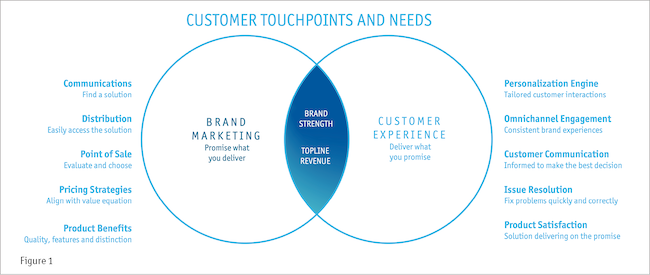 One opportunity to break the collaboration paradox exists in the way brand and CX strategies are devised, executed and measured. Specifically, insights teams in support of brand and CX are often misaligned or disconnected, frequently organized around customer experience insights, marketing insights, innovation insights and then further compartmentalized by product teams, organizational structures and lines of business. This causes data silos to proliferate, making collaboration all but impossible.
Research details like how a question is asked, the sample used and the screening criteria may differ even slightly between teams, resulting in wildly different interpretations of the same KPI. For instance, imagine a CX team striving to create a more frictionless experience, while the marketing team’s advertising tells customers the brand provides an immersive experience. They both have data to support their individual positions but the misalignment between the promise and delivery causes the customer to be disappointed when the actual experience is different than their expectation.
By creating democratized data systems to foster a unified vision – based on clear data – across marketing and CX, brands can ensure that the promises made through advertising are consistently delivered through customer interactions, leading to a more trustworthy and reliable brand image.
A simple way to start
While breaking down silos and changing the ways things are done can seem like daunting goals – especially during times of economic uncertainty – there are simple ways to begin the process.
For experience-focused brands, customer retention offers a compelling benefit for aligning marketing and customer experience. Studies suggest that acquiring a new customer is five-to-seven times more expensive than retaining a current one.5 Increasing customer retention by 5% can increase profits by 25% to 95%. If the goal of marketing is to spur growth in an uncertain economy, elevating the customer experience to meet the expectations set by marketing in order to maintain customers is vital to a brand’s near- and long-term success. But this is only possible if marketing and CX teams have the vision and tools that support their cross-functional collaboration.
To develop integrated marketing and CX strategies, teams need to answer questions such as:
- How strong is our brand and customer experience relative to the competition?
- How can CX improvements build stronger customer connections to our brand?
- How can our customer experience better deliver on our marketing promise?
- What is the optimal allocation of resources across marketing and customer experience initiatives?
Answers to these questions are critically important and Burke’s experts advise beginning with understanding your organization’s brand strength relative to the competition and then model how improvements in CX can close the gap or increase differentiation from your competition. By merging these data pursuits with a unified vision of strengthening the brand, teams can spend less time debating data interpretations and instead focus on taking action.
This modeling approach between marketing and CX can then show how the activities of one affects the other and vice versa. With heightened knowledge of the ways marketing and CX reinforce each, both teams can be empowered with the information to act independently. Now they can begin to predict the total effects of their actions on touchpoints that are owned by the complementary function. This also reduces response time to competitors and macro-environmental factors.
Delivering on the brand promise: A case study
Recently, one of our clients – a leader in the auto insurance industry – wanted to empower its marketing and CX teams with tools to enable more strategic and adaptive messaging and CX delivery. Our work sought to achieve this by obtaining a better understanding of the connection between their brand marketing and customer experience. They had two foundational studies – a brand tracker and a competitive customer experience tracker. While the insights from the two studies reinforced each other, we wanted to formalize this link and ensure that what the brand team promised to the market was embedded in the experience the customer had with the brand.
Our solution was to leverage the wealth of insight in the two foundational studies but also include a module that would allow us to model the effect marketing and CX have on each other. The result would help the brand unify its vision and promote collaboration by providing a single source of free-flowing data with a uniform understanding.
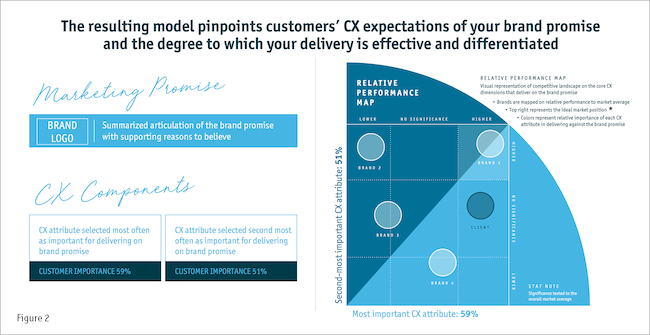
As such, we added just one module to our competitive experience tracker. We started with the brand promise and then carefully constructed experiential attributes that covered the touchpoint landscape and spoke to the brand promise. We then surfaced the promise to respondents and asked which of the attributes were most important to deliver and, finally, how each competitor performed on each of the experiential attributes. This allowed us to create a marketing and CX relative performance map, as shown in Figure 2.
For our client, this allowed us to home in on the CX attribute they most needed to improve to effectively deliver on their brand promise. In this example, they delivered exceptionally on the most important attribute but had some work to do to close the gap to the market leader on the second-most important.
However, this also opened another avenue for a more unified marketing and CX vision. Our research revealed this brand had a particular CX strength in its self-service tools; furthermore, this CX strength was distinct from the competition. However, the brand’s marketing did not promote this strength. We recommended evolving the marketing promise to incorporate the best-in-class self-service tools so our recommendation would allow the marketing and CX visions to work together, reinforcing one another.
In both scenarios, marketing and operations teams had a single source of truth and a unified action plan to support their brand message and experience delivery. Operations walked away with specific focus areas to improve the customer experience, while marketing knew what messaging tweaks could help support the experiential differentiators, unique to the brand. There was a unified language, a unified vision and a unified action plan.
A key enabler
As with the insurance industry example, free-flowing data with a unified vocabulary can be a key enabler of cross-functional collaboration, resulting in an organization that is more strategic, adaptive and innovative. But democratizing data demands standards that ensure accurate interpretation: access facilitated by data enablers and a unified vision supported by a common data language. These components are essential for establishing a system that encourages uniform understanding, which is the foundation for collaboration.
Within your own organization, consider starting with departments that have clear communication gaps such as aligning marketing and customer experience. Build or incorporate systems that use data to model relationships between the groups, giving them a single source of truth for monitoring performance relative to a single vision. By adopting these strategies, organizations can create a culture where data empowers action, aligns teams under a unified vision and makes collaboration a competitive advantage – even in the face of disruption.
References
1 Krammer, S. M. S. (2022). “Navigating the new normal: Which firms have adapted better to the COVID-19 disruption?” Technovation, 110, 102368. https://doi.org/10.1016/j.technovation.2021.102368
2 Laughlin, P. R., Hatch, E. C., Silver, J. S., and Boh, L. (2006). “Groups perform better than the best individuals on letters-to-numbers problems: Effects of group size.” Journal of Personality and Social Psychology, 90(4), 644–651. https://doi.org/10.1037/0022-3514.90.4.644
3 Oswald, A. J., Proto, E., and Sgroi, D. (2015). “Happiness and productivity.” Journal of Labor Economics, 33(4), 789–822. https://doi.org/10.1086/681096
4 CMO Council and KPMG LLP. (2024). “Marketing and finance: Fueling innovation or falling behind?” CMO Council. https://www.cmocouncil.org/thought-leadership/reports/marketing-and-finance-fueling-innovation-or-falling-behind
5 Gallo, Amy. (2014) “The value of keeping the right customers.” Harvard Business Review, October 29, 2014. https://hbr.org/2014/10/the-value-of-keeping-the-right-customers