What does your vote say about you?
Editor’s note: Ryan Baum is CEO of Psyclone, a New York-based market research firm.
Eric and I go way back. We met in kindergarten, grew up in the same Cleveland suburb and later ended up as college roommates at Ohio State. Back then, we were just two clueless kids surviving on late-night pizza, energy drinks and blind optimism. At one point, we even shared a toothbrush for several weeks without realizing it. I still blame him – mine was blue, his was red. It wasn’t the most minty-fresh chapter of our lives.
These days, we’re both raising families in and around New York City, catching up when we can between soccer practices and work meetings.
Our lives have followed nearly identical tracks, and if you asked us about the big questions facing the country, I’m confident we’d agree on just about all of them.
And yet, when it comes to politics, we almost never vote the same way. Just like those old toothbrushes, Eric’s politics are red, and mine are blue. He’s voted Republican for as long as I’ve known him. I’ve consistently voted Democrat. In the last election, Eric cast his ballot for Donald Trump. I voted for Kamala Harris.
That divergence has always puzzled me. How is it that two people with such similar histories, identities and perspectives end up voting so differently, not just once but again and again?
Earlier this year, our team at Psyclone partnered with Gazelle Global Research on a post-election study to better understand what drives voting decisions. One finding nearly leapt off the page: 90% of both Trump and Harris voters said they chose their candidate because that person reflected their personal values.
That insight made me pause and think more deeply about why Eric and I keep voting for different candidates, even though we agree on most issues. I started to suspect the real difference isn’t what we believe, but which beliefs matter most to us. Put another way, maybe it’s not our values that divide us, but the way we rank them.
And that raised a deeper, more elusive question, one that sits at the heart of modern politics: When Americans say they vote based on their “values,” what does that actually mean? It’s something voters say all the time, yet few can clearly articulate what those values are or where they came from.
To help unpack that, it’s worth turning to the work of Emily Falk.
Falk is a psychologist, neuroscientist and professor at the University of Pennsylvania. Her lab explores how messages and communication shape the way we think, feel and behave.
Her team has found that messages tied to our sense of identity, or those that speak to who we are, activate a region of the brain called the medial prefrontal cortex. This area is closely linked to self-reflection. When it’s active, it’s often a better predictor of real-world behavior than what people say they’ll do.
It’s a powerful insight, especially in the world of politics, where campaigns constantly try to win hearts and change minds. Falk’s research points to a simple truth: If a message doesn’t connect with who we are or who we aspire to be, it’s unlikely to move us. But when it does? That’s when the magic happens.
Her research helps explain why values play such a central role in how we vote. If a candidate reflects how voters see themselves, or who they hope to become, it creates a cognitive and emotional connection that tends to stick.
Which deeply held values matter most to voters?
Inspired by this idea, we launched a follow-up study at Psyclone, surveying 1,508 participants to dig deeper. If political messages are most persuasive when they align with a person’s identity, then the key question becomes: Which deeply held values matter most to voters? To find out, we asked Americans to describe in their own words what truly guides their choices at the ballot box, not just in a single election but across the span of their lives.
What surfaced from open-ended responses wasn’t a list of partisan talking points. Instead, it was something more personal: a set of deeply held values rooted in identity. These values go deeper than surface-level issues like immigration or tax policy and reflect what Americans care about most at a foundational level, beyond any single issue or stance.
From this set of responses, we distilled 17 core identity-based values that that showed up consistently across the political spectrum: country first, economic stability, fairness, global cooperation, humanitarianism, national security, personal freedom, preserving structure, progress, religious values, rule of law, scientific values, self-reliance, strong leadership, tradition, truth and honesty and unity (Figure 1). 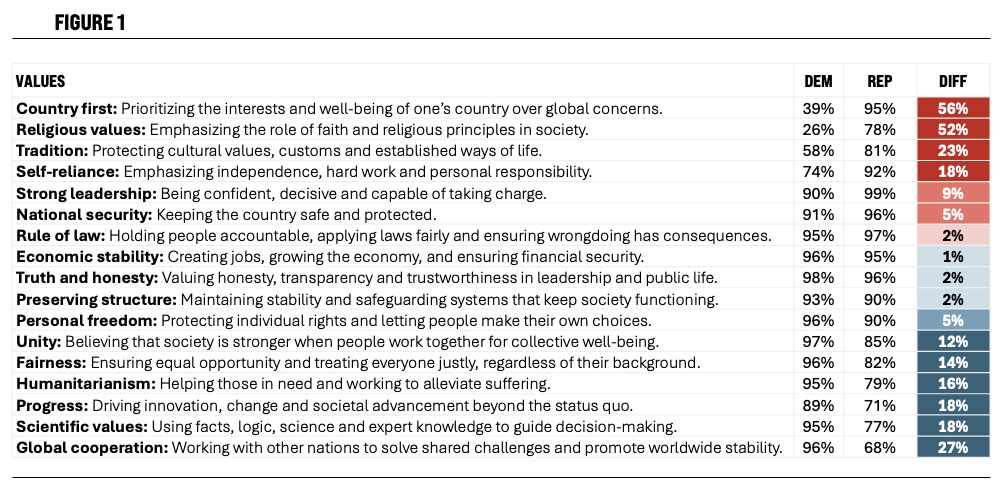
While all 17 identity-based values resonate broadly across both parties, how people prioritize them tells a more nuanced story – one that reveals a striking partisan divide. Not all values carry the same weight for everyone, and how individuals ranked them closely mirrored their political leanings.
Democrats, for instance, tend to elevate collectivist values such as humanitarianism, global cooperation, scientific principles, fairness, progress and unity. These ideals reflect a belief that our country thrives when it works alongside others. By supporting one another, nations can accomplish more together than they could alone.
Republicans, by contrast, place greater emphasis on parochial values like putting country first, religious faith, tradition and self-reliance. This reveals a more individualistic worldview, rooted in the belief that our country does best when it focuses on its own goals and takes care of itself first. In this view, every country should be responsible for its own success.
And yet, there’s more to consider. It’s not merely the values that distinguish the two sides; it’s also about whom those values are meant to serve. Each party views cooperation through a distinct moral lens, shaped by beliefs about who should be prioritized.
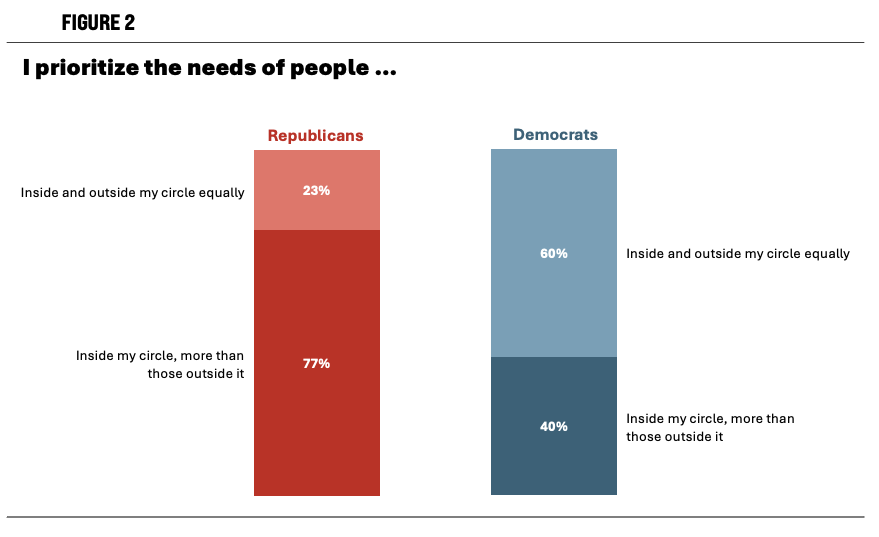
Republicans tend to apply cooperation more selectively. Their parochial mind-set places emphasis on those closest to them: family, community or nation, before it extends outward. In our study, 77% of Republicans said they prioritize the needs of people within their group over those outside of it.
Democrats, on the other hand, tend to extend their cooperative circle more broadly. Their collective mind-set leads them to extend concern and empathy more equally across all people, regardless of group boundaries. Their moral circle extends beyond neighbors and kin to include strangers, foreigners and marginalized communities. According to our data, 60% of Democrats said they prioritize the needs of both in-group and out-group members equally (Figure 2).
What shapes our moral math
The divide between collectivist and parochial worldviews runs deeper than questions of whom to prioritize. It reflects fundamentally different assumptions about how the world works.
At the heart of this difference lies a simple but powerful question: Is cooperation a force that expands opportunity, or a risk that threatens it?
Think of cooperation like a pie. The way someone envisions that pie – whether it can grow or is fixed – reveals a lot about their underlying worldview.
Democrats are more likely to see cooperation through a positive-sum lens. In their view, working together grows the pie: collaboration creates new opportunities, and everyone can walk away with a bigger slice.
Republicans, on the other hand, are more inclined to view the pie as fixed. From this zero-sum perspective, gains for one group often come at the expense of another. If someone else gets a bigger piece, there’s less left for you.
These competing perspectives show up clearly in our data. When asked if helping others through government support takes anything away from them, 87% of Democrats said no. But only 51% of Republicans agreed. Nearly half of Republicans (49%) felt that such help might come at their expense.
These worldviews reinforce a broader pattern: Democrats gravitating toward collectivism, Republicans toward parochialism.
But this divide isn’t as simple as one side being generous and the other being guarded. Both mind-sets stem from deeper beliefs about how help should be given – and to whom. What may look like universal compassion from Democrats is often rooted in a sense of fairness, not blanket generosity. And what may appear as insularity from Republicans is more about loyalty and duty than hostility or indifference. To understand the real difference, we need to look beyond the stereotypes and examine the logic behind each orientation.
For Democrats, the impulse to help is frequently misrepresented as a desire to provide universal handouts. But that’s not what the data show. In our study, both Republicans (82%) and Democrats (78%) overwhelmingly favored equality of opportunity over equality of outcome. That’s a crucial distinction. Helping others doesn’t mean guaranteeing the same results for everyone. It means leveling the playing field so that success is still earned through effort and personal responsibility. No free rides. Just a fair shot.
Likewise, the parochial mind-set often attributed to Republicans is frequently misunderstood. It’s not rooted in hostility or distrust. It’s rooted in prioritization. Republicans tend to concentrate their energy and resources on those closest to them, such as family, community and country. This focus doesn’t stem from a rejection of outsiders, but from a strong sense of duty to those within their immediate circles.
In fact, when it comes to basic attitudes about others, Republicans and Democrats are more aligned than people might assume. Two-thirds of Democrats and 52% of Republicans said they trust people they don’t personally know. And when asked whether strangers are generally well-intentioned, the gap nearly disappears: 75% of Democrats and 71% of Republicans said yes. In short, most people, regardless of party, believe others mean well, even if their actions occasionally fall short of their intentions.
Which brings us to the inevitable question: which mind-set serves us best? Is it better to think collectively, or to focus closer to home?
The truth is, both are essential, and the right approach often depends on the context. Sometimes, looking out for your inner circle is a wise and self-protective move. In other moments, reaching beyond that circle is what allows us to thrive as a society.
It’s not either-or. It’s both-and.
It’s not just politics – it’s personal
It’s easy to assume that political beliefs follow a predictable formula. Know someone’s gender, zip code, church attendance and marital status, and you might think you can guess their politics. And to some extent, that’s true. These sociodemographic signals can offer clues, but they rarely tell the full story.
Take a male churchgoer in a rural town. On paper, he fits the mold of a conservative voter. But when we ran the numbers, the probability that he’s a Republican was only 52%. That leaves a one-in-three chance he’s a Democrat, and about a one-in-eight chance he’s an Independent. That’s not exactly a slam dunk.
So, what’s going on?
Political identity isn’t shaped solely by where we live, who we marry or how often we go to church. It takes form gradually – through dinner table debates, the media we consume, the neighborhoods we grow up in, the financial tides we ride and the emotional ups and downs of everyday life. These aren’t just background details in our political journey – they are the journey.
To predict political leanings with more precision, we have to dig deeper than surface traits. We must ask what people believe at their core. Our research shows that identity-based values – the principles individuals consider most important – hold the key. When we asked people to name their single most important value, and then choose the political party that best reflected it, the picture came into focus. In nearly every case, people aligned with the party they believed most strongly championed their top-ranked value.
So, where does this leave Eric and me?
When I asked Eric which identity-based value on our list resonated with him most, he chose “country first.” Interestingly, the country he had in mind wasn’t the United States – it was Israel. Eric and I are both ethnically Jewish, though we differ in religious observance. He’s fairly religious, while I’m not religious at all. In fact, the value I chose was “scientific principles.”
These differences in how we rank our values explain why we vote differently. In our study, not a single Democrat selected “country first” as their top value. Not a single Republican chose “scientific principles.” That divergence alone speaks volumes.
Eric and I share a strong commitment to supporting Israel. But for him, it’s the defining issue – the lens through which he makes all his voting decisions. I care deeply about Israel, too, but the value that tops my list is scientific integrity. First and foremost, I want the leaders I support to be grounded in science; because science, at its core, is a disciplined search for truth. For me, truth-seeking is the backbone of sound governance. Everything else flows from that.
That said, I recognize that science alone isn’t enough. It needs a moral companion – one that prioritizes human well-being and seeks to reduce suffering. That’s why the second value on my list is “fairness,” which we define as ensuring equal opportunity and treating everyone justly, regardless of their background.
Ultimately, what drives our political choices isn’t just the hot-button issues of the moment. As my childhood friend Eric illustrates, we can agree on many political issues and still vote differently. The deeper differences lie in the values we hold most dear – and how we prioritize them. These values shape our identities. And once we start seeing the world through the lens of those core values, our positions on day-to-day issues tend to fall into place.
This also explains why voters often line up on issues that seem unrelated – like gun control and climate change. These are wildly different topics. But when someone, for example, holds religious tradition as their highest value and regularly engages with media that affirms that value, they may end up adopting conservative stances across the board – even on issues they haven’t thought much about. A single anchoring value can draw a constellation of opinions into alignment.
That’s how bias forms – not necessarily from careful analysis of each issue, but through the gravitational pull of a single deeply held belief.
Once that core value fuses with identity, it becomes sacred. It can override other considerations, including honesty, competence or moral character. Voters aren’t necessarily blind to a candidate’s flaws. But when a candidate reflects their deepest values, they often remain loyal. It’s not about agreeing on every issue – it’s about feeling seen. And when identity is on the line, truth and moral integrity can become negotiable.
So, what should candidates do to win voters over? Speak to values. Speak to identity. Policies and platforms matter, but they’re filtered through something deeper. Voters aren’t just looking for someone who’s “right on the issues.” They’re looking for someone who feels right. Someone who mirrors who they are – or who they aspire to be.
Eric and I are proof of that. We agree on plenty. But we part ways at the ballot box because the order in which we prioritize our core values leads us down different political paths. And that, more than party labels or policy arguments, is what shapes the political world we live in.
It’s not just about left or right. It’s about what matters most.