

Gallup’s Lydia Saad covered the poll results in a November 14, 2013, release for Gallup Economy:
The latest average spending estimate is based on a November 7-10 Gallup poll with 1,039 national adults. Twenty-six percent of Americans say they will spend $1,000 or more on Christmas gifts, down from 30 percent in November 2012. Accordingly, a somewhat higher percentage this year than last – 31 percent vs. 27 percent – intends to spend less than $250, including 8 percent this year who do not intend to purchase Christmas presents.
Gallup’s October measure of Americans’ holiday spending intentions came in slightly higher than consumers’ November 2012 estimate, pointing to a respectable 3.7 percent to 4 percent increase in holiday retail shopping over 2012. That is roughly what industry reports show occurred last month: In October, retailers tracked by Thomson Reuters reported 3.7 percent growth, on average, and U.S. chain store sales were up by 4.1 percent. However, according to Gallup modeling of the trends, consumers’ new scaled-back plans for 2013 suggest overall holiday spending – defined by the National Retail Federation as holiday shopping that occurs in November and December – now may be relatively anemic, increasing by only 1.7 percent to 2.4 percent over 2012.
Adults living in upper- and middle-income households have scaled back their Christmas gift-buying plans this year, with the average estimated total spending of those making $75,000 or more down $87, similar to the $80 decrease among those earning between $30,000 and $74,999. Lower-income households spending estimate has increased by $82, to $467.
However, there may still be a silver lining as the holidays draw nearer:
Consumers’ estimates of their Christmas spending often increase between November and December. Consequently, retailers can hope that if this pattern continues, it will be by enough to push spending closer to the 4 percent increase suggested by Gallup’s October holiday spending figure and Americans’ current assessment of their relative spending.
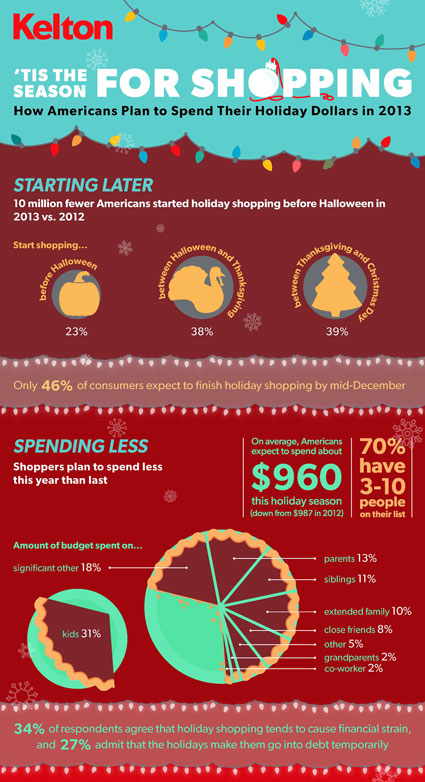
In a separate study, New York research consultancy Kelton also found that holiday shoppers plan to spend less than last year but more than what Gallup anticipates ($704 total projected spend vs. $960) (see infographic).
Of course, only time will tell if, at the moment of truth, consumers stick to their budgets or splurge.
What do you expect this holiday season to look like for retailers? What can retailers do to encourage shoppers to spend above and beyond what they expect? Are the holidays an excuse to overspend or another opportunity to showcase some savvy spending (or saving)?