
Navigating a flawed hiring ecosystem
Editor’s note: Randy Adis is Insights Career Network’s director of research on research, and SVP at RTi Research. Brian Fowler is Insights Career Network’s senior executive director. Kahren Kersten is Insights Career Network’s VP of research on research, and founder of Experience Insights. This is the third part of a series on hiring in the insights industry. Don't miss Part 1 and Part 2.
The insights industry has always prided itself on empathy. Empathy is a core tenet of our profession, along with curiosity and integrity. And we can see researchers’ empathy turn into action in our community as people in search of new roles are actively supported on LinkedIn by insights professionals who share colleagues’ profiles, give endorsements and make connections happen.
While the job market continues to be stuck, demand for job seeker support is at an all-time high. Spending five minutes a day helping others can start a positive chain of events for hundreds of people. The Insights Career Network (ICN) has seen this empathy at work over the last three years and encouraged that community-powered support wherever possible. We are stronger together, and we each have networks that can be leveraged for good. Plus, doing good can feel great. The Art & Science of Joy’s research work, spearheaded by Andrew Cannon and Debbie Schlesinger-Hellman, suggests that serving others brings us deeper purpose and joy.
But how are people on the other side of the hiring equation doing in this industry shift? To put it simply, they are challenged. Our most recent wave of ICN’s Hiring Study found a less-acknowledged reality: hiring managers, recruiters and talent acquisition leaders are carrying their own emotional weight in today’s newly flawed hiring ecosystem.
Job seekers often describe the process as exhausting and demoralizing. What surprised us in 38 interviews with hiring-side professionals was how deeply many of them share that same sense of frustration and fatigue.
Bingeing on resumes, starving for fit
The word we kept hearing from hiring managers regarding the process of finding and selecting insights talent today was “challenging.” As one told us, “We had over 500 applicants, and I’d say 480 of them had no real connection to the job description. It’s just clutter – people apply without really evaluating if it’s the right role.”
It’s both a paradox of plenty and a classic needle-in-a-haystack problem. Too many applications, too few that actually fit. More resumes do mean more choice, but not necessarily a better choice. Managers told us they spend hours sifting, second-guessing, circling back again. Instead of being left with clarity and confidence, they’re left feeling tired, frustrated and wondering if they closed the job too soon because they were overwhelmed.
AI promised relief for hiring managers, but delivered doubt
Technology was supposed to make hiring easier. Instead, it’s become another source of stress.
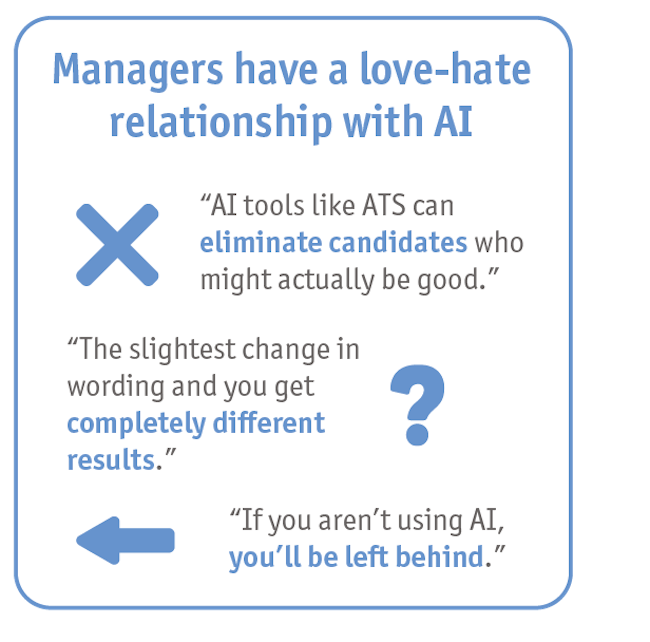
Managers told us they have a love–hate relationship with AI. One recruiter warned, “AI tools like ATS can eliminate candidates who might actually be good.” Another added, “The slightest change in wording and you get completely different results.”
Another called out the disconnect: “We did a LinkedIn webinar where the presenters said, ‘this is the greatest tool ever.’ Then all the recruiters chimed in: ‘I don’t get good results.’ There’s a big gap between the promise and what we actually see.”
At the same time, others admitted the pressure to keep up, “If you aren’t using AI, you’ll be left behind.”
That about sums it up. They don’t trust it, but they can’t really ignore it. AI takes some busywork off their plate, but it adds doubt. Managers told us they end up rechecking decisions, worried the right people are slipping through the cracks. And looking at the talent out there struggling to break through, they’re probably right.
Hiring managers face fatigue
Every step in the process seems to wear managers down – too many hoops, too much second-guessing. Strain appears everywhere along the way. In our interviews, three kinds of fatigue came up again and again:
- Decision fatigue. Stakeholders can't align on the ideal candidate, so searches stall out. Teams spin their wheels.
- Process fatigue. Too rigid, too cookie-cutter. Junior roles don’t need VP-level rounds of interviews.
- Risk fatigue. The drive to reduce risk stretches timelines to the breaking point. More assessments. More rounds. More anxiety. And teams are still left second-guessing themselves.
As one participant put it, “It’s a hiring manager’s market, but with more pressure to minimize cost.” The pressure is not just about budgets. It's the emotional weight of every single decision. Another described how the new system makes that weight heavier: “Within a week, we probably had a couple hundred applicants. A ton were data analysts or engineers – completely wrong for research roles. That takes a huge cut, but it still leaves way too many to sift through.”
The shift away from search firms and headhunters toward AI tools and high-volume applicant flows promised efficiency. Instead, it delivered more resumes and fewer signals. More quantity, less quality – with hiring managers stuck in the middle, sorting through the noise. The challenge peaks at large corporate companies where stakeholders feeding into hiring decisions are siloed and typically receive the highest volume of applications.
Hiring challenges create ripple effect
Why does the weight that hiring professionals carry matter? Because it doesn't stay contained. It ripples outwards. Burned-out managers mean searches drag on and hiring managers, seeking to limit risk, are more likely to fall back on outdated biases and their current networks.
Hiring through personal networks – and even identifying a candidate before a job description is released – is making a major comeback. For businesses of any size, hiring someone familiar feels less risky, although it can give undue preference to candidates who turn out to be a mismatch. We’ve seen this play out multiple times. Familiarity does not guarantee an effective hire.
Adding to the hiring challenges already discussed is the pace at which companies are shifting direction. With each pivot comes the need to reevaluate what talent is truly needed. Even candidates who successfully navigate long, complex hiring processes may find themselves laid off after yet another strategic shift – restarting the exhausting cycle of hiring and job seeking all over again.
Furthermore, the market is flooded with searches for so-called “unicorn” candidates who often don’t exist. The skill sets demanded have evolved so quickly that our insights community hasn’t had time to catch up.
As searches become more complicated, opaque and lengthy, candidates with options disengage. Companies lose top talent to freelancing and to other industries – anywhere that feels less exhausting.
There’s also the potential hit to reputation to consider. Maya Angelou famously said, “People will forget what you said, people will forget what you did, but they will never forget how you made them feel.” A hiring manager echoed that in our study, “Candidates remember how your company made them feel during the process.”
Companies that hire, typically, are companies that sell. All impressions and relationships matter, and job applicants may have an unappreciated power. How many of your rejected and dejected applicants are future customers or partners?
Impressions made during the recruiting, application and evaluation phases ripple through our tight-knit industry. The word on the street gets around.
Hiring for impact
So, what is the path forward? We need to reframe what success looks like. Efficiency and risk reduction may be the priorities du jour in the hiring process, but they aren’t the priorities that restore confidence or reflect better outcomes.
Hiring for impact will mean:
- Align early. Get stakeholders to decide on what success really looks like, not just what sounds good in a job description. Be up front and explicit about the risks and opportunity costs that delay and indecision bring.
- Right-size the process. More is not always better. For junior roles? Probably two rounds max. For senior execs? Sure, more rounds make sense.
- Use AI as a support tool. Let it help with some of the busy work and heavy lifting. But don’t let it replace good judgment and honed instincts. Only a human will recognize that certain special something in a candidate.
- Let candidates be real. Don’t let a rigid, by-the-numbers process stifle a candidate’s ability to shine. Give them room to show who they authentically are, not just check boxes against keywords.
- Prioritize character. Technical skills can be learned but qualities like discipline, determination, proactiveness and a prosocial mind-set are harder to instill and more predictive of long-term success. Be open to candidates from diverse backgrounds. Building teams with varied skill sets and perspectives is how innovation happens and how organizations evolve.
- Set candidates up for success. Job searching is stressful. When we reduce uncertainty, we enable candidates to optimize their performance. Share clear, detailed information about upcoming interviews – what to expect, the types of questions and how candidates will be evaluated.
- Be transparent and communicate often. In a climate of constant change, clarity is a competitive advantage. When priorities shift or timelines slip, proactively inform candidates. If someone isn’t moving forward, tell them. Whenever possible, offer feedback that helps them grow. This isn’t just about being kind; it’s about building trust, strengthening your employer brand and uplifting the talent ecosystem.
These aren’t just process tweaks. They’re about empowerment and lightening the load. Giving hiring managers back some control, a bit more clarity – and a real shot at landing the right people.
Challenges and flaws of the hiring process
The hiring process has never been perfect. It's always had its challenges and flaws. But how things have evolved has created new problems on both sides of the table. For job seekers, the toll is obvious and well-documented. For hiring professionals, it's quieter, less visible, but just as real.
We're in the empathy business. Understanding people is what we do. But we've overlooked the people doing the hiring and the weight they're carrying. Acknowledging that weight is where we start. Only then can we finally build something that works. For business and the bottom line, of course, but also for people.
Methodology
This article draws on ICN's 2024 Hiring Study, our second round of research into what's happening in hiring today. The study was fielded using human-moderated 30-minute in-depth interviews. We conducted over 70 interviews with job seekers and hiring professionals between June and September 2024.