
At first blush, a book about pitching ideas may not seem germane to marketing researchers. After all, researchers are not ad or design agency workers trying to land new accounts with brilliant summations of their companies’ capabilities. But when it’s time to present the findings from the latest round of product research, for example, they are similarly aiming to persuade or convince a potentially skeptical audience of the validity of their ideas, whether it’s a too-busy-for-this C-suiter or a product manager who’s sure your data is about to kill their pet project.
A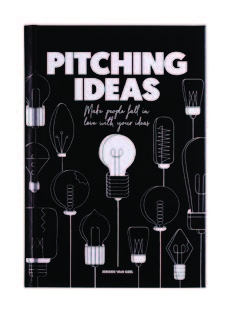
Van Geel is co-founder of Oak & Morrow, a Netherlands-based strategic design studio, and he writes with humor and a welcoming style that instructs and commiserates with the reader at the same time.
The six chapters are organized around the process of defining, developing and delivering the pitch. Early on he talks about the importance of language in presenting and framing situations as opportunities rather than problems, such as these two ways of communicating the same idea: “We’re not getting enough kids aged between 10 and 12 into our museum” versus “Kids aged 10 to 12 love learning new stuff in a playful way and our museum is filled with exciting material. Let’s do more to get them in!”
Those kinds of semantic gymnastics can get a little precious and if you get too vague or touchy-feely you may lose the room right off the bat but that’s where knowing your audience is so important. Maybe that exec you’re speaking in front of is all about the positive spin and he or she will respond well to a rah-rah approach. Or maybe they’re all business and need you to get to the point, dammit, so they can get on with their day.
He acknowledges this in his chapter on understanding your stakeholders, diving into a little Jungian theory to look at some psychology types (sensation versus intuition, thinking versus feeling, extraversion versus introversion, etc.) and how they affect your audience’s response to your ideas.
Also helpful is his take on the stakeholder map, with which you can chart the stakeholders involved and determine if their influence will tip the balance toward a negative or a positive outcome for you. Are they decision makers, influencers or just interested parties? And will they be opposing, neutral or supporting what you are presenting?
In addition, he gives snapshots of the various audience members (CEOs, project managers, engineers), looking at what he calls their “natural behavior” and their vocabulary to offer guidance on how to (and how not to!) communicate with them.
Elsewhere, practical tips like how to dress, how to structure your presentation (end with a call to action!), where to position yourself in relation to your audience and what to do when you get a difficult question in the middle of your pitch help ground his advice in the real world.
He also offers what he calls a Core Idea Sheet, which is a quick way to encapsulate a goal by breaking it down into its main idea, three unique aspects that make it stand out and then what’s needed to make it happen. Simple stuff, to be sure, but as the book so deftly communicates, sometimes the simplest ways are the most effective, especially when it comes to pitching ideas.