
May AI have your attention, please?
AI is playing a critical role in the work of many market researchers and some believe that market research with “human interaction may soon become a thing of the past” (Bohne 2025). With these shifts, we are witnessing the rise of companies touting capabilities for AI-moderated qualitative research. And researchers have embraced AI qualitative interview moderation to achieve what some refer to as “qual at scale,” a term that captures the benefits of reduced costs, larger samples and faster results.
Just as market researchers did their due diligence in the 1990s when shifting from computer-assisted telephone interviews (CATI) to online fieldwork, due diligence is needed now with the adoption of AI tools across market research (McDonald 2026 forthcoming). By conducting this comparative analysis, we seek to provide key considerations for employing AI moderation in qualitative research. Further, we hope these findings and recommendations will inspire greater collaboration between the research and commercial technology communities. Such collaboration is essential to maximizing the benefits of AI moderation while mitigating the harm and risk that can emerge from unexamined usage.
Methodology
Our analysis documents observed differences in video footage and transcripts derived from AI and human-moderated interviews. The topic of brand trust, one commonly explored in market research contexts, was the focus of these interactions.
We conducted 34 online qualitative interviews, comparing AI-moderated and human-moderated approaches. The interviews were divided between human social scientist moderators and AI moderators.
Recruitment occurred with Sago, and respondents were given a monetary incentive. The sample was split between self-identifying Afro-descendant and Latine respondents over the age of 18, including English-speaking and Spanish-speaking participants. Screening used conventional market research questions to recruit respondents across gender, employment, age, brand decision-making, income, race, ethnicity, language, education, marital status and geography.
We have focused this research on constituents from Afro-descendant and Latine populations for two reasons. The Afro-descendant and Latine populations in the U.S. are increasing, while the white non-Hispanic population is shrinking – making the former of considerable importance for growth-focused businesses. Secondly, many AI tools have been created by teams that lack the diversity present in modern society and have often been trained on open-source data that predominately reflects sources written in English with white, male, heterosexual perspectives (see Atari et al, 2023; McDonald 2026 forthcoming). This gap necessitates the intentional inclusion of underrepresented participant groups when evaluating the application of AI tools. Because scalability, efficiency and profitability are attractive to us, we examined carefully where AI helped and where it risked undermining data quality and participant care.
This research leveraged AI-moderators from two companies (Table 1). We use pseudonyms (K and L) as we desire to encourage healthy improvements in AI-moderation across the market research industry – not to endorse or denounce any specific vendor as they evolve.
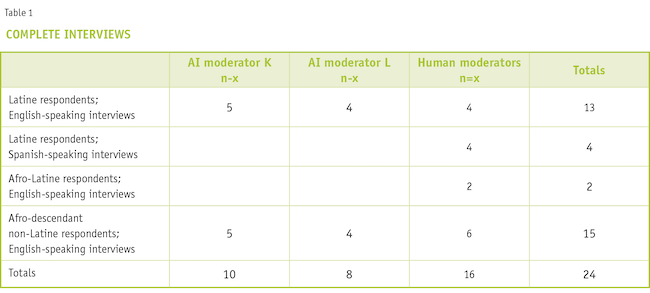
AI and human moderators used the same semi-structured discussion guide with a prescribed, 20-minute limit to complete each interview. Questions were asked regarding which brands are trusted or not trusted, why or why not, feelings associated with brands and how a brand’s relationship with the participant’s community factors into trust. Both human and AI moderators were permitted to prompt beyond the provided questions.
An analyst coded de-identified transcripts without knowing the comparative nature of the study or who the moderators were. In addition to human coding, AI-assisted evaluation of transcripts was conducted using a large language model (LLM) to assess nuance, coherence, depth of insight, market research effectiveness and interview length. LLM matching of transcript excerpts to conclusions was checked by a human researcher who reread transcripts to confirm correct matches by the LLM.
The sample structure does not allow us to draw conclusions related to gender, geography, country of origin, acculturation, technological proficiency, socioeconomics and the languages spoken among research participants. In addition, this structure does not enable an evaluation of street-race or phenotype matching as factors in human-moderated interviews.
 Findings
Line of questioning and probing
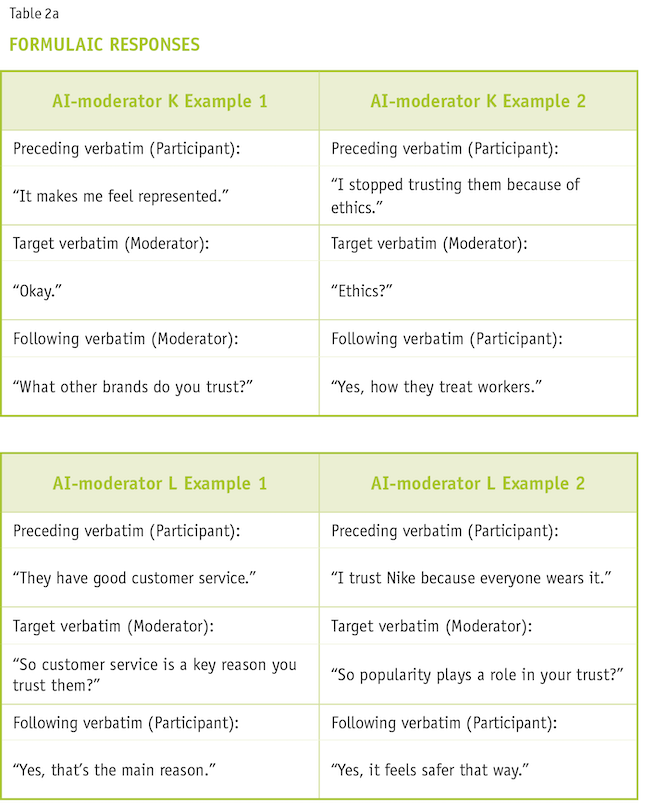
AI-moderated interviews followed a more standardized sequence of questions demonstrating limited flexibility. This ensured consistency across interviews, but constrained probing and clarifications. AI interviews slightly extended participant responses beyond initial statements and often interpreted pauses as completion, advancing to subsequent questions before participants had expressed their ideas fully. AI-moderator responses typically echoed the participant’s statement or provided formulaic responses (e.g., “Okay,” “I understand”). As a result, participant contributions were more likely to remain surface-level – a pattern observed across both Afro-descendant and Latine interviews.
Human-conducted interviews elicited more nuanced and detailed responses (Table 2a). Human moderators demonstrated flexibility in adapting to participants’ answers through probing, follow-up and clarifications, encouraging reflection and elaboration. AI interactions were efficient at producing responses that were concise, consistent and closely aligned with the questions asked.
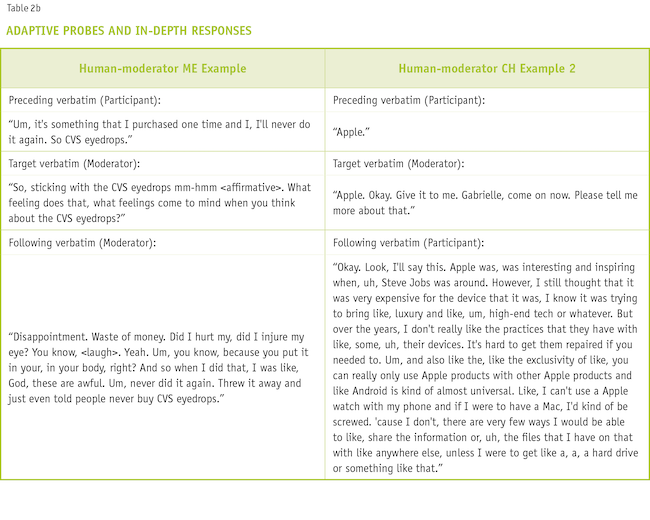
By contrast, more adaptive probing of human-moderation fostered depth and narrative breadth – producing data that captured subtleties in participant experience and stories (Table 2b). AI-moderation, while efficient, limited elaboration and narrative surfacing.
Variability vs. consistency
The interview transcripts show high consistency across AI interviews, alongside significant variability across the five human moderators in this study. Data from video and interview transcripts show human moderators, who are each trained social scientists, making intentional behavioral and linguistic pivots in real-time to adjust for the specific comments, demographics, language and communication style of the study participants.
As evidenced by the observed thematic differences (Table 3), these human adjustments resulted in greater depth of understanding, which is conducive for developing breakthrough insight and highly relevant indicated actions. These observations highlight important considerations for qualitative research design, particularly when detailed, contextually informed insights are required. The need for consistency differs in qualitative contexts versus when the aim is survey-style data collection.
Engagement and nonverbal behavior
In AI-moderated interviews, participant engagement was lower and visible markers of irritation were higher (Table 4). When participants attempted to interrupt the AI (for example, asking “Can you repeat that?” or elaborating after a pause), the system often ignored the cue, advanced prematurely or repeated the same wording, sometimes leading to visible annoyance or requests to end the interview.
Afro-descendant participants displayed behaviors such as eyerolling, skeptical glances, turning away from the screen and visible multitasking (Table 4). These behaviors signaled skepticism and annoyance, with the AI moderator as a partner. Among Latine participants, participants frequently showed reduced eye contact, gestures of frustration and less-expressive communication once it became clear that the AI system was not highly responsive (Table 5).
This is extremely important because in collectivist and relationally-oriented traditions common among Afro-descendant and Latine communities, trust and disclosure emerge through relational cues such as eye contact, gaze management, warm facial expression and culturally attuned back-channeling rather than the neutral, efficiency-oriented style more typical of white, middle-class interview norms (Larivière et al. 2025) in the U.S. Taken together, these patterns suggest that in this sample AI struggled to build and sustain rapport with Afro-descendant and Latine respondents, while human-moderators were better able to recognize and respond to culturally patterned verbal and nonverbal signals, supporting more open and nuanced conversation.
Exploring sensitive topics
These differences in nonverbal cues became even more apparent when participants discussed racism, community tensions or family stress. The AI moderator accepted these accounts without acknowledging their weight, often mis-sequencing follow-ups and failing to rephrase confusing or culturally specific questions, contributing to confusion and withdrawal. For Afro-descendant participants, these failures interacted with histories of surveillance and dismissal, making nonverbal markers such as eye rolling and turning away salient indicators of skepticism and self-protection. For Latine participants, similar shortcomings by the AI moderator damaged conversational orientations observed in human moderated interviews that typically support confianza.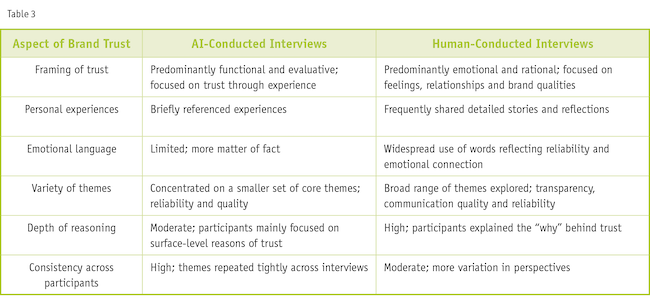
Discussion
“Qualitative interviewing is about more than just the ability to ask a lot of relevant questions – it’s about body language, tone, silences, hesitations, enthusiasm, passion, boredom. These are subtle elements that require powers of reasoning, cultural understanding, and human empathy that AI simply doesn’t possess” (Wilson 2023). This creates a high bar for an AI moderator, which currently lacks the interpretive abilities gained from human life experience, such as the ability to read culturally specific responses through nonverbal communication (e.g., gestures, facial expressions, silence, body language, etc.).
The core promise of AI moderation rests on delivering speed, scale and efficiency without sacrificing quality. AI interviews were easier to code due to their structured format, but this came at the cost of thematic richness, personal narratives and nuanced reasoning. Therefore, fast, “frictionless” data collection should not be equated with qualitative understanding. 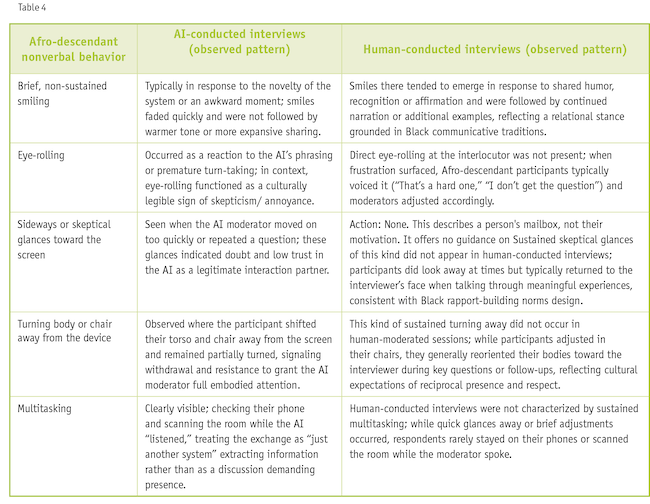
This research demonstrated that AI moderators currently still lack the ability of human-moderators to maintain engagement, foster depth and storytelling, capture subtlety and probe fluidly when conducting qualitative market research interviews with Afro-descendant and Latine respondents in the U.S. AI systems may be able to approximate surface markers of empathy but at present lack the ability to adaptively recognize emotion, clarify meaning and adjust questioning in culturally rooted fashions.
This gap greatly matters in AI‑moderated interviews. Some people may potentially talk more because they feel less judged, but what gets lost is the culturally grounded back‑and‑forth work of recognizing emotion, clarifying meaning and adjusting questions in real time to the contours of a particular life. In this sense, AI-moderation can yield helpful content, but still miss emic meaning. Subtle shifts in affect such as hesitation, irony and sudden silence may be ignored or treated as noise.
Recommendations
Currently, the use of AI-moderators would be advantageous with Afro-descendant and Latine study participants when scale and speed of responses are required more than nuanced insight, social understanding, emotional understanding or cultural understanding. In addition, AI-moderated interviews may serve as a valuable replacement for conventional open-end responses in survey work. AI moderation also may be applied to quickly and inexpensively explore new topics of interest that emerge from the analysis of quantitative data.
Importantly, caution should still be taken and a critical lens applied when considering use of AI-moderators in market research with Afro-descendant and Latine respondents – because every human interaction is influenced by culture. Skilled human-moderation is currently still needed to establish rapport, maintain engagement, read cues, build trust, encourage sharing and probe topics in culturally grounded ways that would otherwise be misinterpreted.
As the capabilities of artificial intelligence tools evolve, it will be important to conduct ongoing research regarding the amelioration of concerns expressed here, such as the interpretation of human emotion, understanding of cultural dynamics, inability to appropriately express empathy and general potential for errors. It remains unclear whether the interpretation of culturally specific nonverbal cues will soon be feasible by an AI moderator. 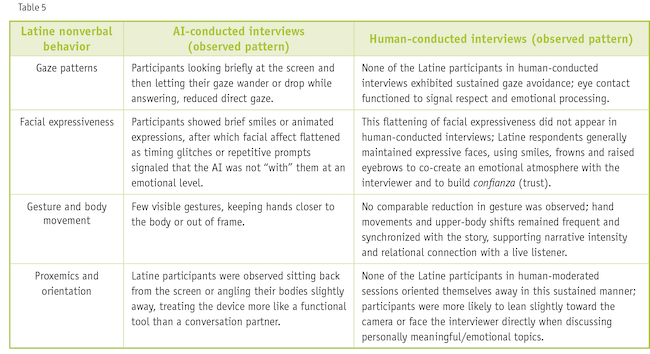
Attitudes towards AI vary within and between countries and communities, which may lead to biased samples if individuals who distrust AI prove less likely to participate – or participate with less engagement – in studies conducted by and about AI-moderators. Importantly, the findings of our comparative research have implications beyond Afro-descendant and Latine populations in the U.S. We encourage practitioners to conduct research on research of AI moderation platforms and seek more than cursory reassurances regarding the capabilities and training data underlying them. Ongoing improvement in AI moderation can be achieved by partnering with and obtaining feedback from both qualitative research experts and study participants.
AI is reshaping qualitative research. Will the market research industry deploy it in ways that preserve cultural intelligence, protect nuance and maintain the integrity of the communities we all study?
Editor's note: Autumn D. McDonald is the owner of ADM Insights and Strategy and has led research for Fortune 500 companies spanning six continents, across more than 80 brands and over two decades. McDonald earned her M.S. in applied anthropology from the University of North Texas. She holds a full-time faculty position at Howard University. Tharius Sumter is a principal at ADM Insights and Strategy. Tharius has led research and research teams at Fortune 500 companies for over 15 years. He earned a master’s of political science from Emory University. He has served as associate professor at Washington and Lee University. Max Matus is a principal at ADM Insights and Strategy and the director of the doctoral program on cultural studies at the College of the Northern Borderland in México. He specializes in the use of ethnography and semiotic methods. Matus earned his Ph.D. in sociology in Wageningen University in Holland. Melissa Vogel is a principal at ADM Insights and Strategy and a business anthropologist with over two decades of experience in research domestically and abroad. She holds a Ph.D. in anthropology from UPENN with a regional specialty in Latin America. She is a professor emerita at Clemson University. Christopher Ashford is a principal at ADM Insights and Strategy and a human development scientist with over two decades of experience whose work bridges the social sciences, education, technology and global development. He holds a Ph.D. in human development and education from the University of Pennsylvania. Josie Murphy is an analyst at ADM Insights and Strategy. She studied sociology and earned her BBA in business management from Howard University, where she developed a strong foundation in analytical thinking, research and critical inquiry. Murphy is also a Fulbright Scholar whose work centers around evidence-based analysis.