
Are you listening?
Editor's note: Jim Stone is executive vice president, innovation and marketing science at Maritz Research, St. Louis. Eric Levy is vice president, global marketing at Maritz Research.
Who hasn’t heard stories like these?
A passenger on a jet sees his expensive guitar thrown to the tarmac and complains to the airline, but gets no satisfaction. He creates a YouTube video that goes viral, generating more than 12 million views.
A telephone hardware manufacturer launches a much-anticipated handset, only to learn through social media that the phone has significant hardware and software issues.
A woman purchases a baby shower gift through an online retailer and finds herself at war with the retailer over the price, shipping and availability of the items she purchased. With no other recourse, she tweets her complaint to friends and family. The story gets picked up by the media, consumer protection organizations and legislators in Washington, D.C.
An automobile manufacturer releases a high-tech option for its vehicles. As customer problems begin pouring into the manufacturer’s customer support area, an astute employee adds additional representatives to monitor social media and address customer complaints there as well as direct complaints made to the company.
The impact of social and consumer-generated media (CGM) is clearly enormous, akin to the proliferation of the Web twenty-some years ago. These are the narratives that keep corporate communications executives up late into the night with worry. Some of these stories have become mythic in the many retellings but they point to one clear trend: companies have lost control of their brands. Consumers all across the world have been empowered to make or break corporate reputations with the stroke of a pen – or in 140 characters or fewer.
Like many other industries, marketing research practitioners are grappling with the implications of this medium. How will it impact our data collection? Are we getting a true picture of the marketplace if we ignore consumer-generated media? As research professionals, what are our obligations to consumers who throw their opinions freely into the social media landscape?
Pundits, politicians and professors argue vociferously about these points but one thing is clear: like the companies they support, marketing research companies have lost control of the voice of the consumer. Perhaps we’ve misjudged ourselves, thinking that our sophisticated approaches, high-end technology and advanced analytical methods have actually empowered us somehow. The reality is the voice of the customer has always belonged to the customer. We’re just the conduit.
With decreasing survey response rates and coverage issues becoming critical problems to both practitioners and client organizations alike, there’s little doubt that marketing researchers will need to develop new approaches to try to address the burgeoning social marketplace. The marketing research industry has only begun to face these and other related issues – some with greater success and impact than others.
Stand on the precipice
Just as the research industry was slow to recognize and leverage the influence of online, we now stand on the precipice wondering whether our significant investments in data collection technology, people and analysis will evaporate in favor of some strange flavor of social media aggregation. It occurred to us, as marketing researchers specializing in customer experience measurement, that our own industry may be willfully blind when it comes to consumer preferences in this new world. It became apparent that while many assert points of view on these topics, no one has really done a thorough job of assessing the customer’s perspective of this new world.
We set out to rectify this. Late last year, we conducted a poll among Twitter users to better understand consumer expectations, behavior and attitudes when they complain about companies through Twitter. This study highlighted a key aha moment that shouldn’t have surprised anyone: Tweets are not personal communication; if a consumer tweets a complaint about a company and the company responds to try to solve the problem, the vast majority are absolutely delighted that the company responded.
In an age of robust call centers, online chat representatives and embedded e-mail tools, why would anyone be shocked that consumers actually think that companies see their tweets and act accordingly? After all, haven’t we trained this new generation of consumers that the squeaky wheel gets the grease? Lifetime value scores have been replaced by Klout scores – she who has more followers gets more attention.
This realization, combined with the news that Congress was again considering sweeping privacy legislation, as well as a significant shortage of data-informed dialogue on the issue, led us to conduct a follow-up study to better understand consumer awareness, usage and attitudes toward ways they could speak to companies they do business with.
Again, the findings weren’t shocking to anyone who has already realized that consumers are in charge. However, even we were surprised at some of the key learnings that emerged from this study.
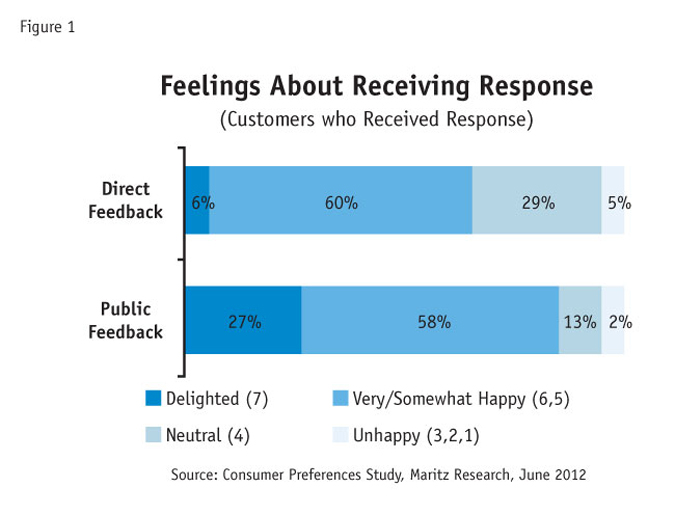
We were not surprised that the majority of consumers who complain about a company expect that company to respond. We were intrigued to see that this was true irrespective of the method consumers used to voice these complaints. In fact, among consumers who received a response back from the company, those who used “public” feedback mechanisms (social media like Twitter, Facebook, etc.) were much more likely to be delighted or at least somewhat happy about this response than were those who used the more traditional “direct” route, such as a phone call or an e-mail (Figure 1). Almost all of the consumers complaining with public methods (85 percent) were at least somewhat happy about receiving a response vs. 66 percent of those who used direct methods.
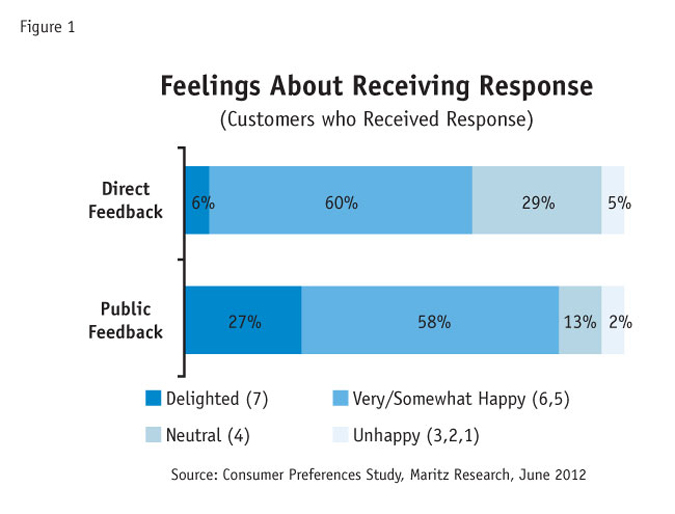
When you look at “delight,” more than one-in-four of the consumers using public methods of complaint were delighted with receiving a response, compared to less than one-in-10 consumers who complained directly to the company with traditional means. That’s pretty great to know. Social media is still new enough that consumers apparently don’t think that companies are on the ball about monitoring for complaints and therefore, those companies that do respond get on their customers’ good sides with greater ease.
And consumers apparently aren’t wrong with these lessened expectations. Only about half of the consumers who complained using social media said they received a response to their complaint. Compare that to the 90 percent of consumers using direct methods to complain receiving a response back from the company (Figure 2).
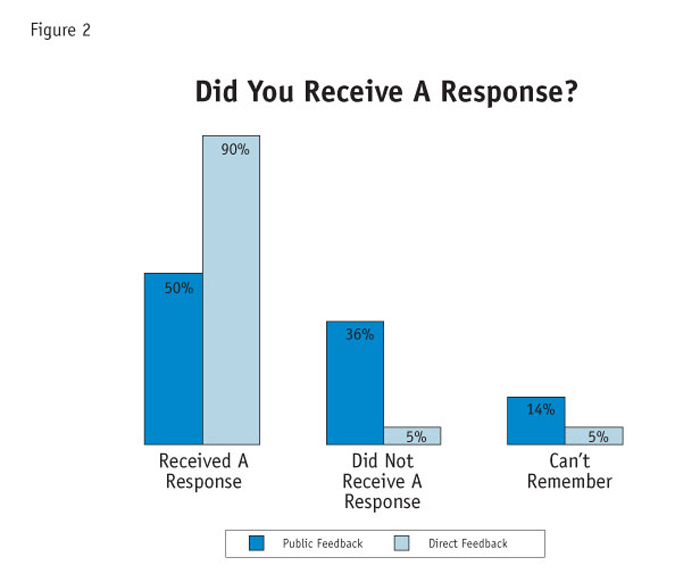
Which bucket of companies includes your company? Which pool of “delighted” consumers would YOU rather have?
Let’s put this in context. Not surprisingly, most consumers (59 percent) use only direct means when they need to complain about a customer experience. That is, most consumers are still using telephones, letters or e-mail to contact these companies. Contrast that with the finding that nearly one-in-10 (9 percent) of consumers only use public mechanisms to complain – Twitter, Facebook, Google+, LinkedIn, etc. However, another one in three consumers (32 percent) is using BOTH types of communications methods.
Surprisingly close
Add up the proportions of those using at least one of the methods and we find that the disparity between those who at least sometimes use public complaint mechanisms to be heard is now surprisingly close to those ONLY using direct methods – 41 percent vs. 59 percent.
Who are these public complainers? Not surprisingly, the majority are under age 45, about 73 percent. Compared to those using exclusively direct methods, only half as many (39 percent) are under age 45. Among those using both methods at least sometimes, 61 percent are younger than age 45.
This becomes even more startling when we dig into which method is most preferred: only one in seven consumers (14 percent) prefers public methods of complaint. The majority still prefer direct methods (86 percent), but given that the whole social movement arguably started in 1997 (with SixDegrees.com, according to Boyd and Ellison’s “Social Network Sites: Definition, History, and Scholarship”) – in 15 years, social media has gone from being a novelty to the main mechanism of company conversations for a significant proportion of the U.S. population.
Age clearly plays a huge role in the method preferred (Figure 3). Although direct methods are preferred most regardless of age, this is most apparent among older consumers. Conversely, a third (34 percent) of the 18-24-year-old consumers prefer public methods. While this falls off dramatically as age increases, it doesn’t seem like a very large disparity given how new public methods are relative to other methods. And the clear trends in the data give us an indication of what the future probably has to offer.
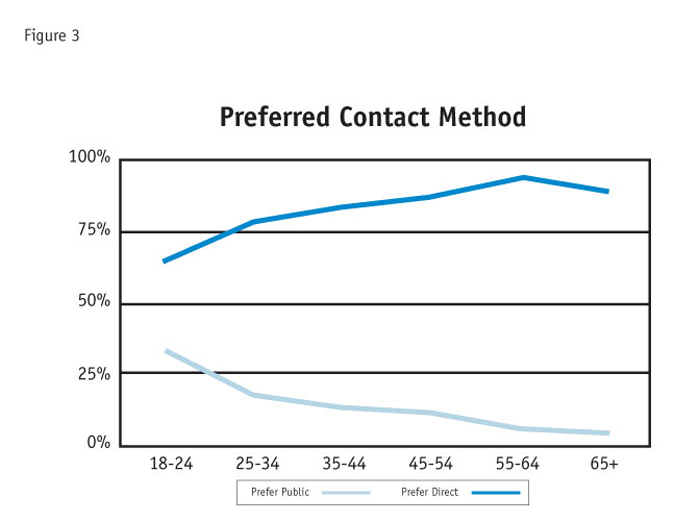
Assuming a new method of contact isn’t around the corner, what will today’s teenagers prefer when they become adult consumers? How long before public methods overtake direct methods in popularity? Our data suggest the next generation, who will be the first to have grown up in a social media-dominated environment, may well be the first to prefer the public methods. After that, it would only be a matter of time until today’s dominant methods become secondary.
Crumbling of the divide
Another area that was interesting to us was the crumbling of the so-called digital divide. Although the majority of both public method and direct method preferrers were white, those preferring public means were much less likely than their counterparts to be white. In addition, those preferring public methods were twice as likely to be Hispanic or Latino (25 percent vs. 11 percent).
Other common wisdom discarded by this study included the finding that there was no significant difference in the incidence of males or females in the groups preferring public methods vs. those preferring direct methods. Also, the notion that education drives online sophistication and comfort was turned on its ear: those preferring public vs. direct methods were equally likely to be high school graduates or college graduates. Interestingly, those preferring direct methods were more likely to have a post-graduate education. Apparently, those with more school prefer “old school” methods of contact.
Created new expectations
In summary, there’s no doubt that social media and CGM have created new expectations about how companies and consumers interact. Regardless of complaint method, consumers expect the companies they deal with to respond. And, if they complain using the new “public” methods (social media), a company who responds is more likely to garner delight from these consumers.
While age, education and income are still useful predictors of online vs. direct preferences, they aren’t as predictive as they once were. There’s strong evidence that the trends we see in this study will become the norm as younger consumers make up a larger proportion of the non-retired marketplace.
As an industry, we need to look hard at our concepts of privacy for their appropriateness in the age of social media. Where once we laid out strict guidelines to self-regulate our industry and protect our livelihoods, we need to examine whether online conversation fits into this bucket of “respondent protection.” Certainly someone standing on a street corner and shouting his opinion isn’t looking for privacy. Social media and CGM are the new soapboxes of our generation. Our thinking and approaches have to extend beyond protecting our data collection investments to stay relevant in this new era.