
Editor's note: Steve Henke is president of Harpeth Marketing, a Franklin, Tenn., firm providing outsourced marketing and consulting services to the market research industry. He can be reached at 615-415-3980 or at steve@harpethmarketing.com.
There’s not a person reading this whose firm isn’t doing some sort of e-mail marketing. And you should be. Even with all of the technological changes taking place in the world of marketing and sales, good ol’ e-mail continues to be one of the most effective and cost-effective ways to generate leads and then nurture them over time.
But like anything else it requires planning and discipline to do it right. To help make the most of your e-mail marketing efforts, make sure you’re following these seven critical guidelines:
1. Provide value, don’t sell. There are a few e-mails that I receive every day. Yes – every single day! And you know what? I look forward to receiving them. Why? Because they provide content that’s interesting or useful to me. You need to be doing the same. Stop selling. Inform and educate instead. Help solve your readers’ problems. Use e-mail to position your firm as a thought-leader and showcase your expertise. That is what will lead to new business opportunities.
2. Get them to your Web site. I receive e-mails from a couple of research firms that seem to go on forever. I have to keep scrolling and scrolling and scrolling. For one, that’s just not a reader-friendly e-mail. More importantly, if you embed a full article in an e-mail – and even if it’s a good article – you’re not pushing them to your Web site. You ALWAYS want to push to your Web site. Use the e-mail to tease them about the article and then have a button that says, “To read the complete article, click here.” They can then finish the article on your site, learn about what you do, access other resources, etc.
3. Measure what you do. Make sure you’re using a commercial e-mail platform that does two things:
- tracks all of the basic metrics – e-mails sent and received, opens, bounces, opt-outs and click-throughs; and
- provides a list of WHO did what, for tracking and follow-up.
Monitoring metrics teaches you how well your e-mail marketing is performing, what content topics interest readers and helps you to fine-tune the process with A/B testing (which kinds of subject lines work best, which day of the week gets the best results, which layout is most effective, etc.). The goal? Continuous improvement.
4. Don’t be spammy! If you haven’t done business with the people in your database, swapped business cards with them at some point or if they didn’t download one of your white papers, then they shouldn’t be there. Also, just because they connected with you on LinkedIn doesn’t mean they want to be on your e-mail list. And please don’t scrape online directories and drop e-mails in your database. Finally, if someone wants to opt-out, make it easy for them. Check out the CAN-SPAM Act if you’re not sure what to do.
5. Be consistent. Like I mentioned earlier, some e-mails I receive daily, some weekly and some monthly. It doesn’t matter what frequency you commit to, you just have to stick to it. This means editorial calendars and a production schedule. By the way, your inability to stick to something easy – like a regular e-mail schedule – might leave an impression with your clients that your project management skills aren’t very good. This is not what you want them thinking.
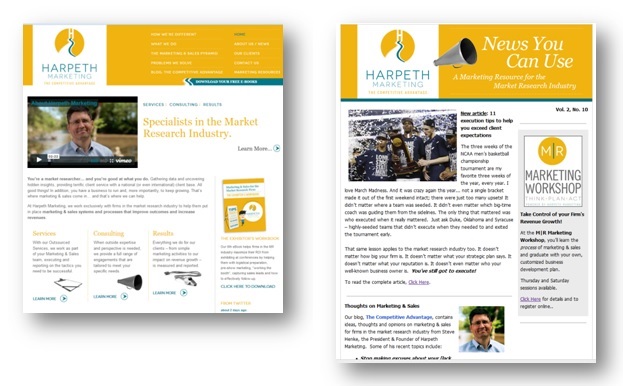
6. Integrate the look and feel. When a recipient receives one of your e-mails, there should be no doubt that it comes from your firm. The look and feel of the e-mail should be very consistent with your Web site, blog and other marketing communications. This is not the time to try something new. In fact, it’s a great opportunity to reinforce your brand in the marketplace. As an example, below is the home page of the Harpeth Marketing Web site (left) and a recent e-mail sample (right).
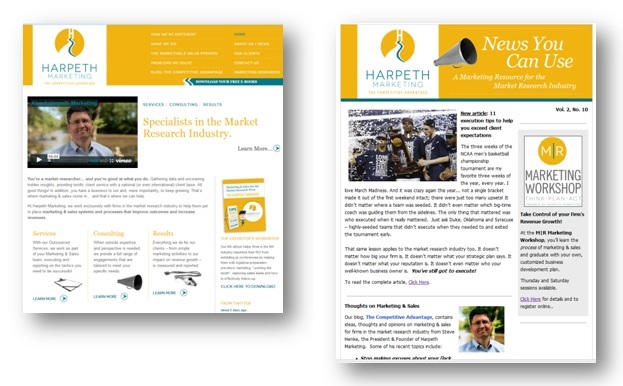
They don’t have to be exact duplicates but there should be very strong consistency in the design and the tone of the writing.
7. Take care of your database. For e-mail marketing success, taking care of your database means two things:
- Get rid of bad e-mail addresses. The bounce-back list you receive after each e-mail blast is a good resource for this. For each “hard bounce” (a permanent error), remove that e-mail address. Also, pay attention to your LinkedIn e-mail notices about people changing jobs. Use that information to keep your e-mail database up-to-date.
- Segment your list. I am amazed at the databases I see where everyone is just lumped in together – clients, prospects, vendors and even competitors. Take the time to segment them into the appropriate groups. You might even want to consider dividing the clients and prospects further based on the industries they’re in. You do all of this for two reasons – to make sure that only the people you want to receive your e-mail receive it (i.e., no competitors) and to be able to target mailings (e.g., only to clients or only to those in the automotive industry) if you choose to.
Bottom line: E-mail marketing is going to be with us for the foreseeable future so make it part of your arsenal and do it right by following the e-mail marketing guidelines above. Your results will be worth the effort.
Free download: To download a free spreadsheet for tracking and reporting your e-mail activities, click here(no e-mail address required).