
The 2016 edition of the annual Quirk’s corporate researcher salary survey received responses from a total of 1,290 client-side insights professionals. The ongoing study was debuted at the height of the Great Recession, allowing us to see the evolution of client-side researchers’ environment. In the past three years we have begun to see a consistent trend in responses regarding job satisfaction, salary and compensation. And although many of the results are not shocking, the 2016 findings regarding gender may point to a trend to watch in future surveys, as a larger percentage of employed client-side respondents were women as compared to men, with the exception of those over age 66. For those under the age of 35, women exceeded men by more than 30 percent.
The study continues to receive responses from a wide range of industries. This year, the highest percent of respondents were employed in organizations that operate in health care/ pharmaceuticals (12 percent), followed by consumer goods (10 percent), banking/financial (9 percent) and insurance (7 percent).
A range of benefits
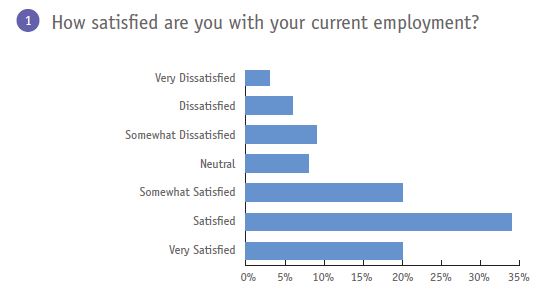
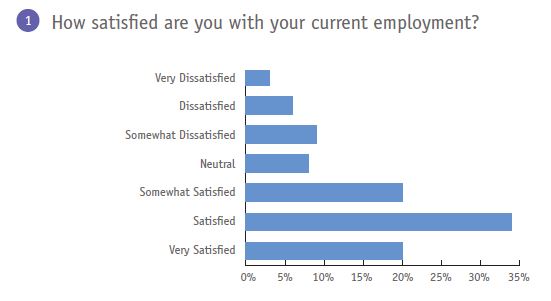
Job satisfaction continues to be on par with our recent surveys (2013, 2014 and 2015, specifically), as the 2016 data shows that 20 percent reported that they are very satisfied with their current employment, 34 percent satisfied and 20 percent somewhat satisfied. 1
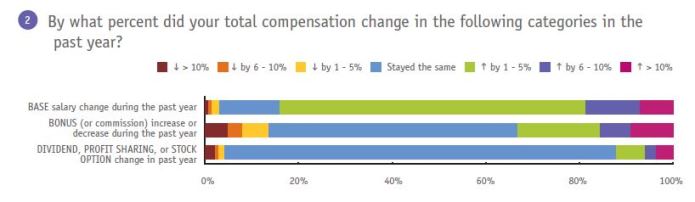
The steady trend in total compensation may be one reason corporate researchers are finding job satisfaction. Less than 3 percent of respondents reported a decrease in base salary during the past year and approximately 84 percent saw an increase. Of the 84 percent, approximately 65 percent received an increase of 1-5 percent, which is generally enough to stay ahead of inflation. 2
As in previous years, we received a number of comments that highlighted the importance of non-monetary or non-traditional benefits, which often increase happiness in the workplace. We dug into this year’s comments in the compensation section of the survey and were inspired by respondents who related benefits that promote a positive work/life balance:
"International travel air tickets for family and discounts on major hotels, retail, entertainment, automobile brands, restaurant brands, international health/dental coverage for family and educational allowance for children.”
“(Compensation is) lower than other companies with directors at the same level of experience. Conscious choice to have a better work/life balance.”
And when it came to bonus or commission increases, although 53 percent of respondents reported no change in the last year, we received a number of comments from respondents who are finally obtaining the rewards of years of hard work:
“This is the first year anyone’s had a bonus in years.”
“We had strong company results last year which led to large increase in bonus.”
And while only 16 percent reported a decrease, several respondent comments expressed the disappointment of stagnant or decreased bonuses:
“Raises are horrible.”
“I believe I am underpaid, making less than I did in a similar position in the 1990s.”
“Since the financial crisis, many employees in the financial services industry have experienced frozen salaries and reduced bonuses.”
“It’s crap, but that’s my fault for not changing jobs.”
Job-hopping for upward mobility
As companies continue to stabilize, and the often rocky economy remains on the path to recovery, market researchers are in a better position to pursue new employment.
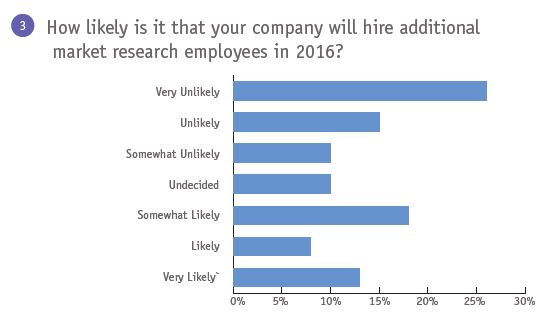
This year, approximately 39 percent of respondents said it was somewhat likely, likely or very likely that their company would hire additional MR employees. When looking at the result of crossing the question, “How likely is it that your company will hire additional market research employees in 2016” with, “How satisfied are you with your current employment,” we saw a positive correlation. In fact, 82 percent of those who reported that their company was somewhat likely, likely or very likely to hire in 2016 were somewhat satisfied, satisfied and very satisfied with their employment. This compares to a 68 percent reported satisfaction if their company was somewhat unlikely, unlikely or very unlikely to hire additional marketing researchers. 3
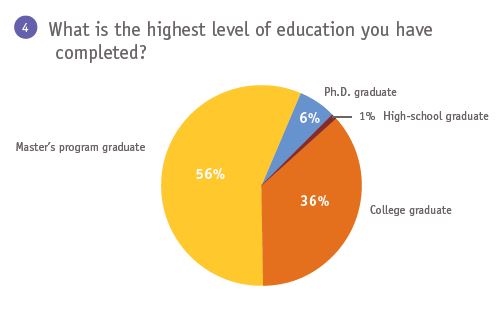
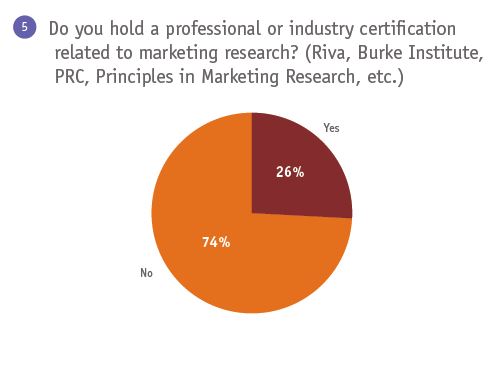
Researchers can bring a wealth of experience with them when changing companies. Approximately 30 percent of respondents reported 16 to 25 years of experience in marketing research. Master’s degrees are also common, as 56 percent of respondents shared that they are graduates of a master’s program (6 percent reported having a Ph.D.). When asked if they held a marketing research certification (RIVA, Burke Institute, Principles in Marketing Research, etc.), 26 percent of respondents said yes. 4 5
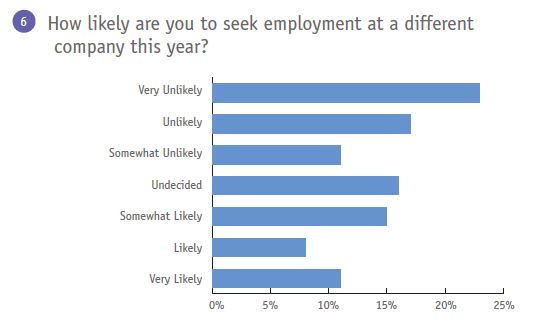
While members of their industry have gone through rashes of wanting to change jobs (2011, specifically), client-side researchers reminded us again this year of the role job-hopping has in upward mobility, specifically when it comes to pay raises and bonuses. Job-hopping is still proving to be an option for those looking for increased compensation and job satisfaction. Thirty-four percent of respondents reported being somewhat likely, likely or very likely to seek employment at a different company. Many of the respondent comments noted their pay raise or bonus was the result of an internal promotion or a change in employer:
"I changed jobs to get this increase.”
“I switched jobs in 2015; my previous employer did not offer a bonus.”
When looking at the result of crossing the question, “How satisfied are you with your current employment” and, “How likely are you to seek employment at a different company this year” we were a bit surprised to find that 73 percent of respondents that reported being somewhat satisfied, satisfied or very satisfied said they were somewhat likely, likely or very likely to seek employment elsewhere. Maybe it is a case of the grass always being greener on the other side. 6
While we haven’t seen drastic changes in the past two years, it’s exciting to see companies are still looking to expand marketing research departments. We hope the state of the national and global economy continues to give corporate researchers more options for seeking job satisfaction, fair compensation and a positive work/life balance.
METHODOLOGY
The marketing research salary and compensation survey was conducted online from April 26 to May 26, 2016, among Quirk’s subscribers. In total we received 3,236 responses. We received 1,290 usable surveys from client-side researchers (corporate market research) and 1,627 usable surveys from provider-side researchers (market research company employees). An interval (margin of error) of 1.7 at the 95 percent confidence level was achieved. (Not all respondents answered all questions.) For complete survey results, including provider-side data, with crosstabs, visit www.quirks.com.