
Editor’s note: Arun Mamtani is founder and CEO of market research firm ResearchFidelity, Inc., Dallas.
At the heart of the Internet is the premise that all traffic be treated equally. This principle, known as net neutrality, was built into the fabric of Internet since its creation. It guarantees a level playing field for users and content providers by ensuring that no one has to pay more for better access to online content. A free and open Internet is key to promoting innovation and driving entrepreneurship, to sharing ideas and to freedom of speech.
As Internet usage has grown, so has the need to ensure rapid delivery of content to the end user. Large Internet service providers (ISPs) are starting to charge Web companies like Netflix and Google in order to offer speedy delivery of their content. Proponents of net neutrality worry that ISPs have too much power and can break the way the Internet works. They are asking the FCC to stop it.
In May 2014, the FCC voted to move forward with a net neutrality proposal that would allow broadband providers to charge Web sites for faster delivery of their content – in essence allowing the creation of “fast lanes” on the Internet. The proposal also defined rules for ISPs to remain transparent about their performance and prevented them from blocking/slowing any content (such as from competitors). But the fast lane options would essentially allow the creation of two tiers of Internet service.
This proposal received near unanimous opposition from the public, as 3.7 million comments were filed on the FCC Web site. Internet advocates fear that the proposed rules would undermine equal treatment of all Internet traffic, and some have pushed for reclassification of the Internet as a public utility under Title II of the Telecommunications Act, which would give the FCC more power to regulate broadband providers.
President Obama joined the debate, expressing his opposition to the proposed rules and asking the FCC to keep the Internet open and free by preventing blocking, throttling or paid prioritization of content. He has requested that the FCC classify broadband service under Title II while forbearing from rate regulation and other provisions that are less relevant.
In response to this feedback, FCC chairman Tom Wheeler has postponed the net neutrality decision to 2015, when he is expected to offer a new proposal.
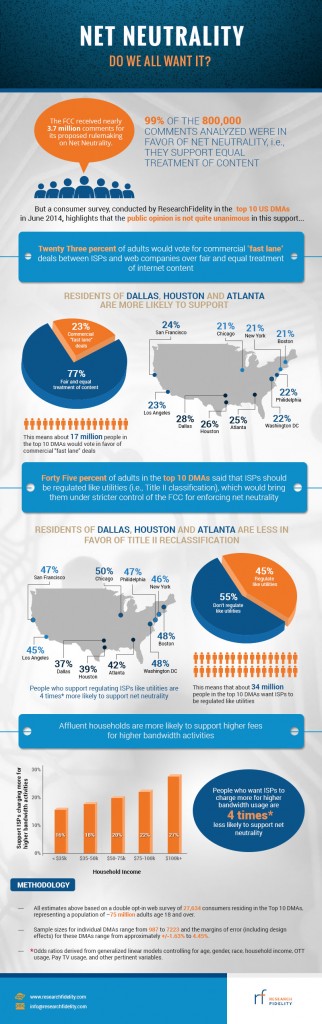
In June 2014, we ran a consumer survey in the top ten U.S. DMAs to measure public understanding and opinion on various topics related to net neutrality. We surveyed nearly twenty-eight thousand respondents in these top ten markets and analyzed results by demographic segments and geography. Our findings were somewhat in contrast to what was being reported based on the public comments filed with FCC.
We found that public opinion is not as unanimously in favor of net neutrality as would appear from the comments to FCC. Nearly one in four adults in the top ten DMAs are in favor of paid content prioritization, and just under half of the respondents agree that broadband providers should be regulated like utilities. We found that consumers in southern DMAs such as Dallas, Houston and Atlanta are more in favor of implementing fast lanes and less in favor of Title II than those in other parts of the country. Our analysis revealed that affluent households are more likely to support higher Internet fees for higher bandwidth activities.
Why were the findings different from the unanimous opposition being reported from the FCC comments? We believe it’s because a majority of the comments to the FCC (at least 60 percent of the 800,000 comments that were analyzed by independent analysts) were form letters written by organized campaigns. Our survey, in contrast, is fielded to random adults in the top ten DMAs representing the overall population. The results are weighted to demographic benchmarks in those DMAs to account for sample bias due to non-coverage and non-response. Furthermore, we ran conditional logit and generalized linear models controlling for a full range of demographic attributes in order to identify key predictors impacting public support for net neutrality. Building on model output, we also highlight contrasts and insights by population segments.
The net neutrality decision is far from over. As the debate continues, market researchers must continue to monitor and track public opinion and deliver new insights on public understanding and opinion of a complex and evolving topic.
