
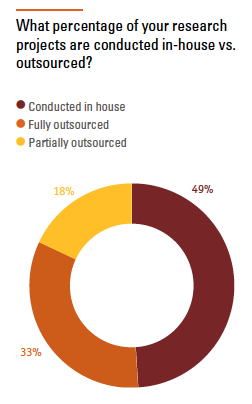
As skilled as most researchers are at the multitude of tasks they need to tackle each day, they can’t do everything. That’s where outsourcing comes in. Q Report survey respondents indicated that about half (49 percent) of their projects are completed fully in-house, leaving the rest either fully (33 percent) or partially (18 percent) outsourced.
Data collection (28 percent) and recruitment (26 percent) were the most-outsourced parts of the research process, followed by data analysis (22 percent) and project management (12 percent).
The Q Report survey included an open-end to get more details on what parts they outsource:
“We handle more basic surveys in-house (ad testing, basic AA&U-type surveys). We outsource projects that require more advanced analytics or complex sampling/data collection (segmentation, multi-market trackers, etc.).”
“When we outsource, we almost always go full-service. However, we are more hands-on than most clients, taking an active role in survey development, QA, data analysis and report development. In addition, several of our reports combine outsourced research with other data we collect ourselves.”
“We outsource a special segmentation project. The firm that does this project for us has been doing it well before I came onboard and they do a pretty good job. Also, this is a massive project and I am the sole member of the market research/insights department, so it frees me up to do multiple projects at a given time.”
“Our internal team designs the research, oversees the development and execution by vendors, guides the analysis and report-writing and then rewrites and shortens the presentations to tell the story and focus on the critical elements.”

Another open-end sought more insights on why they choose to outsource.
“We only do global projects – do not have language capabilities across all countries.”
“It would be much more expensive to do all research we need in-house. Outsourcing means we do not need infrastructure, staff.”
“It’s a balancing act between how quickly vendors can provide results and the staffing capabilities they provide. Additionally, some of our larger strategic work (CSAT studies) is outsourced to avoid our own biases.”
“The lack of staff isn’t necessarily an issue now but we have done several projects that have tracked annually or semi-annually for a decade or more and that work has stayed with the same vendors so it’s more a matter of difficulty transitioning internally when our outsourced partners already have the capabilities.”
“We tend to outsource large, nationally representative consumer studies that are too complex and time-consuming for us to manage in-house, to recruit respondents for and to manage data collection ourselves, given the limited resources we have and lack of personnel.”
“To get useful inputs from agencies who deal with many and varied clients – learn from their experience.”
“To gain unbiased insights from a third party. In pharma, it is also critical to outsource market research in order to maintain compliance and adhere to industry regulations.”
“Outsourcing is more expensive but we have a small team (one manager, one analyst, one intern) and will leverage vendors when we are at in-house project capacity. We also will outsource when we are interested in trying a new methodology.”
“Only when our department is too swamped or when a certain level of distance is needed from an ethical standpoint.”
“We like to see what suppliers can bring to the table in terms of design, analytics and reporting that we don’t have in-house.”
“The biggest reason is the regulated nature of our industry and need to manage the privacy and confidentiality of our respondents – particularly as it relates to HIPAA.”
Clearly, outsourcing offers a number of advantages for researchers. But the biggest one may be that it lets them do what they do best: synthesize, analyze and present information to help their organizations answer their most pressing business questions.
“To not fatigue our client sample, which is small. For focus groups and other research that requires facilities.”
“I am a one-man-show and need help to make projects possible.”
“We are consumer insights professionals and our time is better spent on the ‘so whats’ than on performing the actual research tasks. It’s a rabbit hole we don’t want to go down as our vendors are experts on this part.”
“We don’t consider data collection as our core-business; instead, we prefer to focus on adding value via design and analysis.”
“We don’t get financially rewarded for being good at cutting data. We get rewarded for surfacing insights and implications and socializing them.”