Changing the conversation
Editor's note: Michelle Kirszner, senior vice president of qualitative research at Lieberman, New York, has 17 years of international research experience leading strategic healthcare research programs across the U.S., U.K. and Australia. Kirszner holds an M.S. from the London School of Economics and Political Science and a BA with First Class Honours from the University of Melbourne. Jennifer Francis, senior vice president at Lieberman, Great Neck, N.Y., has 25+ years of research experience in a broad range of industries, including pharmaceuticals and consumer packaged goods. Her expertise is in strategic and tracking research, concept/message testing, market assessment/forecasting, stakeholder satisfaction/equity and segmentation. She holds an M.A. in industrial/organizational psychology from Hofstra University.
Today’s patients aren’t walking into oncology appointments empty-handed. They’re arriving with ideas. Opinions. Possible treatment paths. And increasingly, those perspectives are shaped before the visit even begins – by generative AI.
In a recent mixed-method study among cancer patients and oncologists conducted by Lieberman Inc., we found that generative AI is already shaping how patients prepare for visits, what they ask, what they request and how they process information throughout the care journey.
The implications extend well beyond healthcare.
In high-stakes categories where decisions are emotional and clinically complex, generative AI is acting as an invisible intermediary between patients and doctors. Individuals are increasingly forming perspectives before engaging directly with experts, brands or systems themselves.
For insights and research teams, this introduces an important new question: How do we understand decision-making when part of the journey is happening in conversations we cannot see?
Already part of the care journey
Generative AI is now embedded in how patients seek, interpret and revisit complex information. In our research, we found that many cancer patients use generative AI to better understand their diagnosis, interpret test results, explore treatment options and prepare for clinical conversations.
What is particularly striking is how quickly usage becomes habitual. Once patients begin using generative AI, many incorporate it into their ongoing care journey, returning regularly as new questions, symptoms and uncertainties arise.
Clinicians are noticing this shift as well. Two-thirds of oncologists report seeing an increased number of patients bringing AI-generated information into appointments and an even greater number expect this trend to continue growing.
Together, these findings suggest that AI is increasingly shaping how patients think, prepare and engage before conversations with providers even begin.
Adoption intensifies during moments of uncertainty
AI adoption appears to accelerate during periods of heightened stress and uncertainty in the cancer journey. Among patients using generative AI, 72% experienced a negative cancer-related event in the previous six months, compared with 51% of the broader patient population. Common triggers included treatment side effects, worsening disease and insurance or financial concerns. In these moments, people are actively searching for information, clarity and reassurance and generative AI offers an immediate way to explore those questions privately. For some patients, AI has evolved beyond a search tool into a companion available 24/7 to help process complex information and emotionally navigate uncertainty in real time. 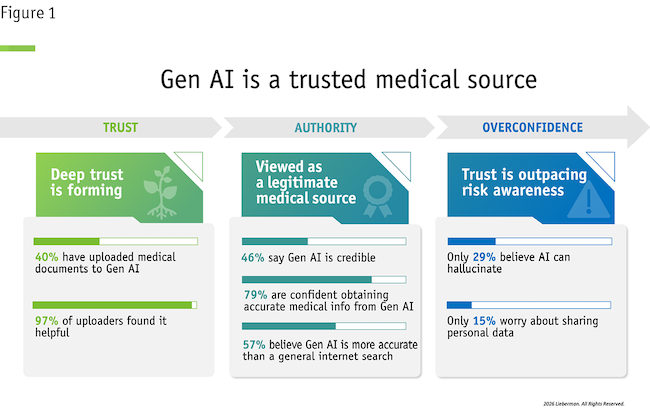
Trust is rising faster than understanding
As people engage with generative AI, many quickly begin to view it as a credible and most say they trust the accuracy of the medical information they receive (Figure 1).
At the same time, awareness of the technology’s limitations remains relatively low. Fewer than one-third recognize that AI can generate inaccurate or hallucinated responses.
Patients are also engaging with these tools in highly personal ways. A substantial number report uploading sensitive medical documents such as test results into AI platforms and nearly all say the experience helped them interpret the information. Concerns around data privacy, however, remain surprisingly limited.
Together, these findings point to a critical shift: trust in AI is accelerating quickly, often ahead of a full understanding of the risks, limitations or clinical context behind the information being generated.
For researchers, marketers and healthcare stakeholders, this creates a blind spot. Patient perspectives and decisions are increasingly being shaped by inputs that exist outside traditional healthcare visibility.
AI is influencing what gets discussed and what gets requested
Generative AI is doing more than helping patients gather information. It is actively shaping the nature of the clinical conversation with their doctors.
Half of patients report discovering cancer-related information through AI that had not previously been discussed by their doctor and most bring that information to appointments.
What makes this especially important is the nature of the topics patients are raising (Figure 2). Patients are bringing forward potential treatment options, diagnostic testing ideas and even suggestions for clinical trials that may be relevant to them.
This signals an important evolution in the patient journey. AI is increasingly influencing how patients think about next steps, shifting not only what gets discussed, but potentially what enters the decision-making process itself.
Even more striking, many of these AI-driven conversations translate into action. Over half lead to treatment requests and roughly two-thirds lead to requests for diagnostic testing. Physicians approve many of these requests, including 77% of treatment-related requests and 75% of testing requests.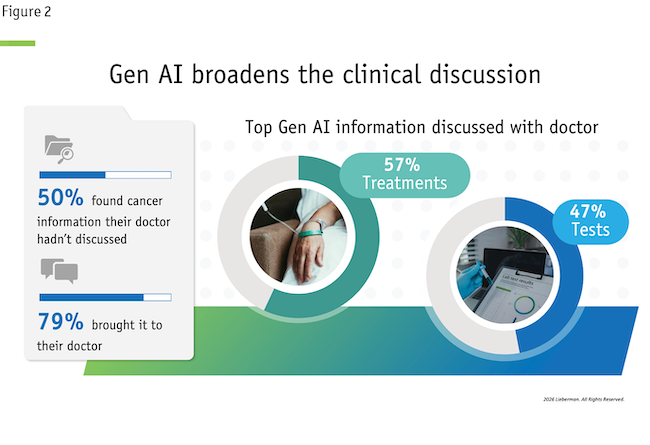
Strengthening doctor-patient interactions
One of the more surprising findings is that AI may be strengthening, rather than weakening, the patient-provider relationship. Most say AI helps them prepare for appointments, ask better questions and feel more empowered in conversations with their doctors.
Importantly, many also say their relationship with their doctors has improved since using AI and oncologists largely agree that AI-informed patients can contribute positively to engagement when the information is interpreted appropriately.
As one patient explained:
“I now know the better ways to ask questions and express that I am concerned, but without engaging in a power struggle.”
These findings suggest that generative AI is changing not only the information patients bring to appointments but also how they navigate discussions.
Shadow layer of decision-making
At the same time, generative AI is creating a new layer of healthcare activity that exists largely outside traditional observable systems.
Many patients report turning to AI instead of contacting their doctor’s office, while nearly half say they use it to ask questions they do not feel comfortable raising directly with their physician. Yet only a minority of doctors say their patients are asking fewer questions in between appointments. In reality, these questions are being directed to AI.
AI is also playing an emotional role in the cancer journey. More than half of patients say these tools help reduce anxiety and many describe using AI to process fear, uncertainty and difficult information in real time.
Perhaps most importantly, patients are no longer relying on a single source of truth. Instead, they are triangulating information across AI and human experts. Large majorities report validating AI-generated information with their doctors while also using AI to interpret, pressure-test or contextualize what experts tell them.
Together, these behaviors point to the emergence of a “shadow layer” of decision-making where interpretations, concerns and preferences are increasingly formed before the formal healthcare interaction occurs. For healthcare organizations and researchers, this creates a growing visibility challenge. Many of the influences shaping patient thinking now exist outside traditional touchpoints and research frameworks.
Experts are adapting but remain cautious
Most oncologists do not view generative AI as inherently threatening. In fact, many are actively encouraging appropriate patient use and recognize the potential value these tools can provide.
At the same time, clinicians express substantial concerns around misinformation, interpretation and clinical relevance. Many describe growing challenges around helping patients determine what is credible, medically appropriate or personally applicable to each unique situation.
Clinicians are navigating a shift in which patients are increasingly informed, albeit through different channels and perspectives. The physician’s role is increasingly extending beyond education into interpretation, contextualization and helping patients navigate an expanding universe of information.
As one oncologist noted:
“Patients come in with more information on the plate. But we have to differentiate between what is good information versus what is bad information.”
This shift may ultimately reshape how expertise is delivered in the healthcare experience.
The human relationship remains central
Despite the growing role of AI, patients and clinicians continue to place enormous value on human expertise, judgement and reassurance.
Most patients view AI as a support tool within the healthcare journey while still seeing their physician as the ultimate authority when it comes to determining what is right for them personally. Clinicians largely share this perspective. Many expect AI to reshape aspects of their role, but few see it replacing the human dimension of care.
Across our research, one theme remained remarkably consistent: expertise matters, but human reassurance matters more.
As one patient explained:
“AI gives me information, but it doesn’t give me reassurance. My doctors know me, they’ve seen what I’ve been through. That matters more than what an algorithm can tell me.”
Implications for research teams
For insights professionals, this shift introduces a significant new blind spot.
People are increasingly forming opinions, questions and preferences after interacting with AI-generated interpretations, often before engaging directly with brands, healthcare systems or experts. Traditional research approaches frequently assume visibility into the major drivers of decision-making, but those assumptions are becoming less reliable.
This raises important new questions for the industry:
- How do we understand what individuals are seeing before they enter the system?
- How do we measure the influence of AI-generated interpretations on attitudes and behavior?
- How do we capture decision drivers that may never surface in traditional customer journeys or research conversations?
- What happens when AI becomes an invisible intermediary between consumers and institutions?
These questions extend far beyond healthcare.
Entrenched in the journey
Our research reveals a broader shift in how healthcare decisions are taking shape. Generative AI is increasingly influencing how people interpret information, form opinions and prepare for interactions before engaging directly with healthcare systems or experts. A new, non-human entity is entrenched in the patient journey.
For healthcare organizations, pharmaceutical companies and insights teams, understanding these invisible influences will become increasingly important to understanding patient behavior itself.