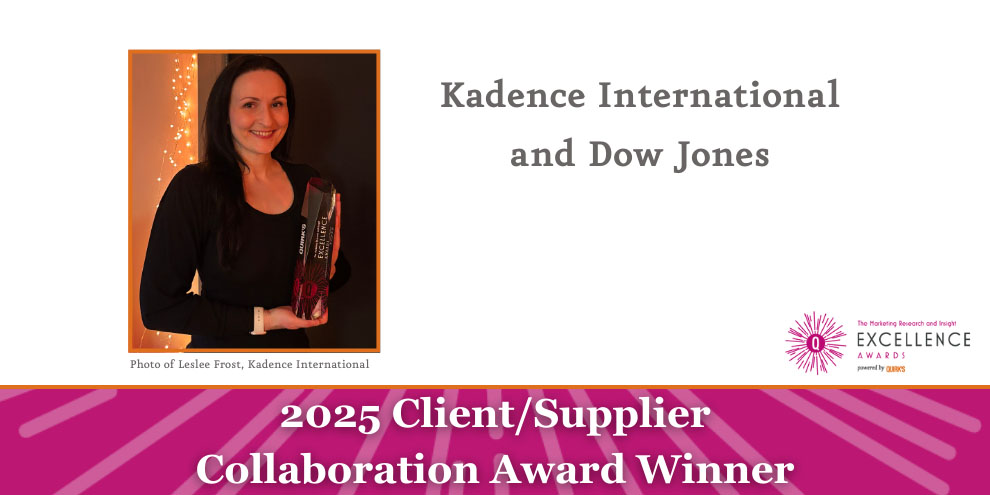
Q&A with the 2025 Client/Supplier Collaboration award winners: Kadence International and Dow Jones
Editor’s note: Kadence International and Dow Jones are the winners of the Client/Supplier Collaboration award, a category in the Marketing Research and Insight Excellence Awards. The award winners were announced during a virtual celebration on November 19, 2025. To learn more about the awards, visit https://www.quirksawards.com/.
The Client/Supplier Collaboration award, a category in the Marketing Research and Insight Excellence awards, acknowledges a team of clients and vendors that worked together on at least one project and maintain an ongoing relationship centered around using research to solve strategic problems.
During a virtual celebration, the winner of the 2025 Client/Supplier Collaboration award was announced as Kadence International and Dow Jones. The two companies have partnered for seven years to support the evolution of Factiva, a global business intelligence platform.
Leslee Frost, insight manager; Bianca Abulafia, head of strategy and client services; and Katrin Scheibert, head of design U.K., all of Kadence, commented on the long-standing partnership and what it means to truly collaborate.
Frost explained that ultimately collaboration is about people and not process.
“Curiosity, generosity, and the space to ask questions often matter just as much as frameworks or methods,” Frost said. “The strongest work emerges when teams feel comfortable thinking out loud, challenging each other constructively and exploring ideas before they are fully formed.”
What is the key to a great client/supplier collaboration?
Leslee Frost
A shared sense of purpose and trust is fundamental. The strongest collaborations are built when both sides are align on the business questions that genuinely matter, rather than treating research as a series of isolated tasks.
Open communication and clarity around objectives allow research to function as a joint endeavor, where both client and supplier are invested in reaching the right outcomes. This alignment makes it easier to prioritize effectively, navigate trade-offs and stay focused on delivering insight that supports real decisions.
Long-term collaboration strengthens this further. Continuity enables deeper understanding, more constructive challenge and a shared sense of accountability for the quality and impact of the work. With a common history and shared context, teams can work more efficiently, challenge assumptions openly and build on learning rather than revisiting the same ground.
Over time, this creates an environment where insights can be tested, refined and applied with confidence, ensuring they remain both rigorous and genuinely relevant to business decision-making across different teams and stages of development.
The strongest work emerges when teams feel comfortable thinking out loud, challenging each other constructively and exploring ideas before they are fully formed. This ultimately reflects how we work with clients – approaching projects as partnerships and embedding collaboration as a deliberate way of working.
Bianca Abulafia
Trust is key and is something that takes time to build.
Investing time and effort in listening and connecting the dots from project to project helps that trust properly cement itself. Trips to the pub after a debrief for a beer are also pretty crucial for getting to know one another on a human level and understanding how we all tick!
Describe the methods you used for storytelling to ensure data was not siloed.
Katrin Scheibert
To ensure data was not siloed and that findings were widely accessible and embedded across different teams, our storytelling approach focused on creating adaptable visual outputs in a variety of formats. We moved beyond static reports to create visual outputs tailored for different purposes, including infographics and visual summaries, videos, worksheets and even interactive guides.
The result was a system where data wasn't just shared, but was continuously circulated, consumed and actively used by relevant stakeholders.
Leslee Frost
Indeed, it was important to ensure storytelling focused on creating continuity over time rather than producing one-off outputs.
Consistent core teams at both Dow Jones and Kadence enabled shared context to develop across projects, while insights were documented rigorously and structured to be revisited. This allowed us to cross-reference previous work, track how user needs and behaviors evolved and build on existing learning rather than starting from scratch.
This cumulative approach turned individual studies into an ongoing narrative. Personas, frameworks and recurring themes acted as shared reference points across teams and initiatives, helping stakeholders quickly orient themselves within the broader body of learning. By maintaining clear links between past and current insight, research remained coherent and accessible, even as projects, priorities and audiences shifted.
As a result, insights were more likely to be retained, discussed and applied, rather than becoming isolated outputs tied to a single moment in time.
What was the biggest roadblock for your team and how did you overcome it?
Leslee Frost
The most significant roadblock in this long-term collaboration was maintaining continuity and strategic impact of insight across a rapidly evolving product, organization and market landscape.
Over seven years, Factiva underwent substantial change: new user groups emerged, internal teams shifted, priorities evolved and the pace of technology development accelerated, particularly with the rise of generative AI. In this context, there was a real risk that research could become fragmented, overly tactical or disconnected from long-term product strategy. Ensuring research remained both forward-looking and grounded in existing user needs required a disciplined and collaborative approach.
The teams overcame this by treating insight as a cumulative, living asset rather than a series of stand-alone projects.
Kadence and Dow Jones continuously refreshed personas, frameworks and learning, allowing new research to build directly on prior insight rather than starting from scratch. Iterative research cycles, early-stage concept testing and regular stakeholder engagement ensured findings stayed relevant and actionable as decisions were made.
Crucially, insights were designed to travel. Through visual storytelling, workshops and stakeholder-ready outputs, research became a shared reference point across teams.
This enabled Factiva to evolve with confidence, aligning innovation with genuine user needs, and ensuring long-term research investment translated into sustained business impact.