
Editor’s note: Lynne Van Dyke is principal at market research and consulting firm KS&R, Syracuse, N.Y. This is an edited version of a post that originally appeared here under the title, “Ideation and the hero’s journey.”
I love action movies. They don’t require a lot of higher-order thinking, and I am spared the angst of a romantic comedy. The action hero is a good guy – adept at one-liners, skilled in overcoming problems and ultimately victorious. While my husband complains that it’s obvious what is going to happen to Sylvester, Arnold and Liam, I embrace the predictability of the hero’s journey.
The hero’s journey is an archetypal narrative structure to describe the hero on an adventure. It was introduced by Joseph Campbell in The Hero with a Thousand Faces in 1949. This pattern is found in books, TV shows and movies. You know it … think Star Wars and Harry Potter. The hero begins in his or her ordinary world, receives a call to adventure, meets a mentor, crosses the threshold into the unknown, finds allies, confronts enemies, faces tests, encounters a major ordeal, has a setback and is ultimately victorious.
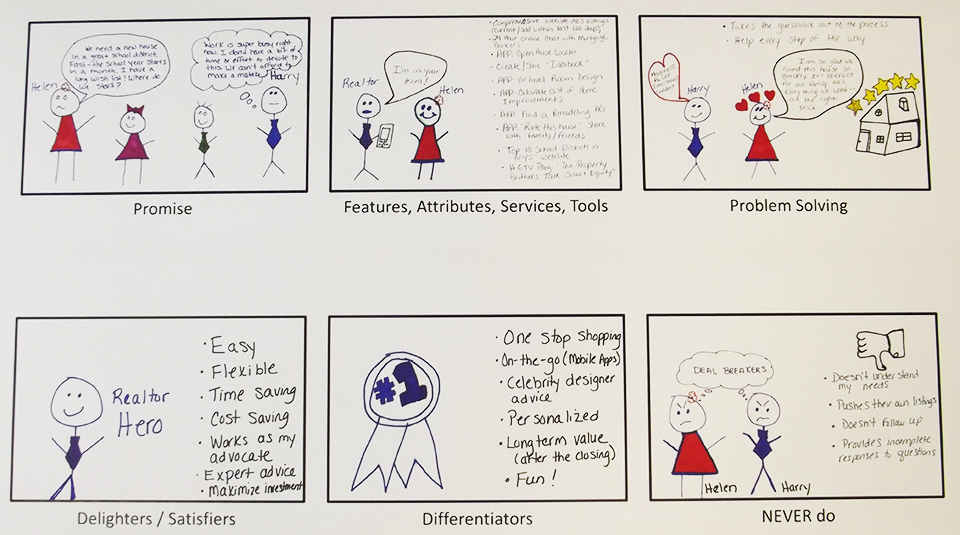
The hero’s journey is a great innovation tool that can be coupled with storyboarding in qualitative research to help participants define and describe the path toward a goal – and the ideal experience along the way. (The example below shows a storyboard created by married Millennials tasked with creating the ideal house hunting experience.)

How it works
Participants work in small groups. Each group receives a:
- storyboard with a start frame and an end frame;
- persona sketch of the target market customer – consisting of two-to-three sentences profiling the hero to give context but not narrow participants’ thinking or create false impressions; and
- a big idea starting point that is the driver of the journey.
Participants work together to create a narrative that describes and explains:
- the hero’s train of thought (to reveal his/her goals, wants/needs and expectations);
- what the hero says;
- what others around the hero say (internal and external to the company);
- scenarios/circumstances that the hero finds himself in;
- pain points, frustrations and barriers; and
- key moments and advisors, services, products and tools that help the hero to succeed.
To ensure that the vision and journey portrayed on the storyboard are meaningful and powerful, here are a few tips for the facilitator working to help participants:
- Adhere to the ground rules: facilitators should be fun, permissive, non-threatening and withholding of any judgment/criticism. Embrace the unexpected – no idea is too out there or insignificant!
- Think about and record the touch points, moments and events of the experience: triggers, decisions, actions and changes in functional/emotional states (who, what, when, where and why).
- Identify and describe what needs to be true or what would solve problems and overcome barriers (sentence completion for “I wish…” and “It would be great if…”).
- Draw talk, thought and heart bubbles to indicate what is going on inside the hero’s head and his or her reactions and emotional state. Simple iconography like smiley faces and angry faces make the story come alive.
- Make sure that the journey has a happy ending! What does success look like? What does it really mean? What are the functional and emotional benefits?