
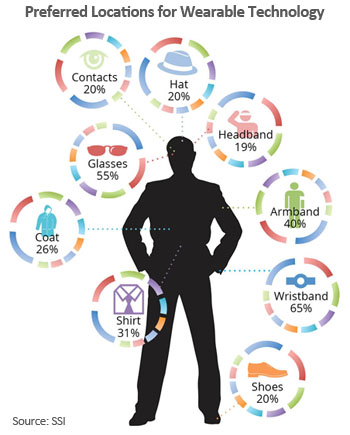

More than 3,600 people from seven countries – Australia, France, Germany, Japan, the Netherlands, the U.K. and the U.S. – weighed in on their vision for the future and their interest in wearable computer devices. (This survey includes respondents who were surveyed using SSI’s new QuickThoughts mobile app.)
The items chosen most often among the list of wearable devices were wristbands (65 percent), glasses (55 percent), and armbands (40 percent). Wristbands were consistently the top choice across countries. In France and Japan, glasses were tied as the top choice and came in at or tied for the second choice in all other countries. Interest was highest in the U.S., with 43 percent of participants either “very” or “somewhat” likely to make the purchase.
Additional findings revealed that wearable technology has increased the public’s awareness of privacy. More than 70 percent of respondents agreed with the statement, “Due to smartphones and social media, nothing in public is private anymore.” And more than 75 percent believe that governments need to create better laws to protect people’s privacy when they are out in public. There were wide variations by country: 46 percent of respondents in Australia selected a concern about invasion of privacy with the devices, while only 22 percent of respondents in Germany did so. Of all the countries surveyed, Japan stands out as the country with the lowest level of concern about privacy in today’s wired world.
In spite of the concern over erosion of their privacy, the survey showed the attitude toward wearable technology was mostly positive with respondents describing it as “interesting” (35 percent), “convenient” (31 percent) and “fun” (30 percent).
Thirty-seven percent of participants had heard of the new wearable computing device from Google, Google Glass. Awareness was highest in the U.S. (51 percent) and the Netherlands (46 percent), but at least a quarter of participants in each country have heard of the new product, which has yet to be released to the public. SSI also explored why or why not people were interested in purchasing Google Glass. Looking through some of the open-ended responses, there is an excitement over this technology, revealing interest from those who want to be trendsetters:
“A lot of times I missed a ‘KODAK MOMENT.’ This would catch these moments hands free !!!!!!” – 55-year-old male
“I like the idea of able to search the net with a blink of your eyes.” – 36-year-old male
“It’s the next step after tablets and smartphones.” – 20-year-old female
“To not own a piece like this is like being left behind.” – 27-year-old male
“A new way to integrate technology into my life.” – 23-year-old male
There is also a perception this new technology appeals more to a younger generation, causing older participants to shy away:
“I am afraid I am far too old for all this new technology.” – 62-year-old American female
“I’m too old for this type of technology. It’s meant for younger people.” – 60-year-old U.K. female
“I am too old for this kind of nonsense.” – 80-year-old American female