Q&A with Merrill Dubrow
Editor’s note: Nancy Cox is the founder of Research Story Consulting and former CPG corporate researcher. Her work and play include words, sketchpads, cooking (not baking) and the occasional sock puppet.
Passions, hobbies, healthy distractions and even guilty pleasures – discover how the research community plays and how that plays out in their work life. In the Venn diagram of work and play, what happens when they overlap? Research colleagues share their work and play stories in this interview series by Nancy Cox.
Hello Merrill Dubrow, CEO, M/A/R/C Research
What is the “play” in your life?
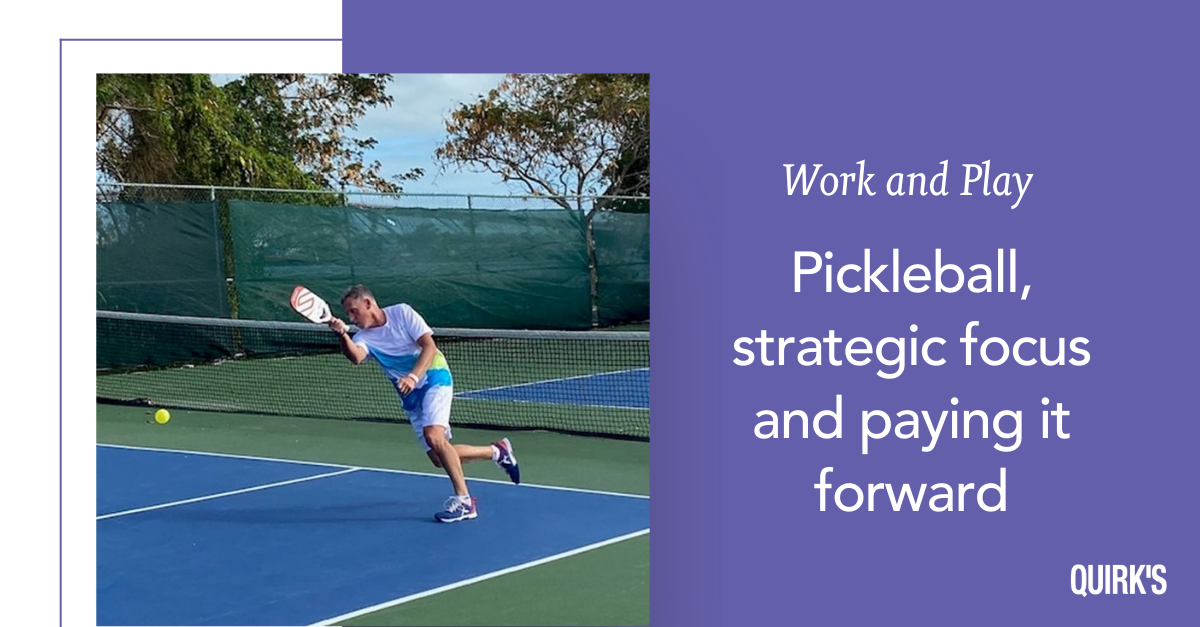
My play is pickleball. I love the game socialization within the game, and the strategy. While it can be physically hard, I’ve played in 105-degree Texas heat and in Florida with both heat and humidity in the 80s, it never feels like work to me.
It’s play because I’m around friends. I forget about work and its stress. I’ve been in the industry for 35 plus years, mostly in a senior position for decades with countless decisions daily. Pickleball allows me to relax a little bit, be athletic, be competitive at a satisfying level. Even at that competitive level, the decisions aren’t impacting the lives of dozens of people. I make a bad pickleball decision, the worst that can happen? I lose a point.
I had played tennis since my mom taught me when I was 8 years old. I played through high school then continued to play through the years with friends. About seven years ago, one of my friends said, “We’re playing pickleball, why don’t you come along?” I said, “What is that?” I had never heard of it. I was lucky to start playing with guys who had grown up in the pickleball industry, as the game was expanding.
Basically, pickleball is a miniature version of a paddle sport played on a court about 25% of the size of a tennis court. The ball has holes kind of like a wiffleball. The paddle is roughly the size of a racquetball paddle but instead of strings, there’s a composite face. There are zones and rules about where you can hit the ball. It’s a fast-paced game that can be played singles or doubles. I play six days a week, singles and doubles. Sometimes twice a day.
I truly cannot say enough about the benefits. Pickleball gives me a lot of benefits. For example, I really pay attention to my Fitbit. In a doubles game, I get about 1,100 steps a game. In a singles game, I get about 1,550 steps a game. A lot of steps in a short amount of time as a game usually takes 10-12 minutes — a long game takes 30 minutes.
The socialization is fantastic because the small court size means you’re much closer to other players than in tennis. You can hear each other. In pickleball doubles, when you’re serving, you’re only about 5 feet away from your partner. On the opposing side, the person furthest back is only 40 feet away.
How has your play influenced your research work?
There are many parallels between pickleball and business. Business is all about communication. Business is all about strategy. Business is all about making adjustments. COVID, financial crisis of 2007, 9/11, the dot-com boom and then bust. You’re making tremendous adjustments and communicating throughout those adjustments.
Same with pickleball. Most people play doubles, which demands the same good communication that successful business requires. Without that communication, you’re both going to go for the ball. You might be out of position.
Pickleball requires strategy. For example, I’m thinking about my next shot against different players. There’s a very finesse player, who plays the ball right 99.9% of the time. Another one always moves to his left, as he favors hitting the ball with a forehand. Another one spins the ball very well but also hits the ball hard. He’s at his best when he’s using the whole court, using the angles.
This is 100% like working with different clients. Some clients are looking for a very specific deliverable. Others may be looking for a price while another is looking for timing. Some want to see specific experience in their vertical or prior experience with specific people in their department. You need to understand their tendencies. Great executives anticipate the clients’ prospects, anticipate what competitors are going to do.
This understanding can come by listening and observing as well as doing. When I first started pickleball, I didn’t immediately see the strategies. That came by listening and observing very talented players. Where is their footwork? How are they serving? Are they hitting hard or soft? How are they communicating on the court? Those observations moved my skills forward.
Pickleball has also taught me how to be a little bit more focused. M/A/R/C has had a great run from when I purchased it seven years ago, but we had a bad year in 2022. We took a dip and the reason was me. I wasn’t as focused, I was scattered – we had too many good ideas.
Pickleball has taught me that if you can’t have too much going on in your head. You need to stay focused on the strategy such as if you’re playing with lefty focus on how they favor the right side of the court.
Pickleball reminds me that even though I’ve been in the insights community for over 35 years, I can always learn, always get better. Pickleball has allowed me to do both of those things.
What would you tell readers who want to know more about your area of play?
First, ask your friends, who plays pickleball? If you ask 10 people, you’ll probably get three or four who will raise their hand. Search online, “Where can I play pickleball open play in [your town]?” You’ll get a list of courts, times, skill levels. The pickleball community has done a good job with apps for court reservations and other helpful info. Check your existing sports/gym memberships – Lifetime Fitness also has a really good pickleball program across the country. And YMCA typically has courts.
It’s not an expensive sport. You can wear shorts and athletic gear you may already own. You will need court shoes. A three pack of balls is $12 to $15 or even cheaper online. For paddles, I would not advise buying something labeled as a starter paddle — it won’t have the bounce that you want. If you spend $60 to $80 on a paddle, you’ll get a better feel if you really enjoy the game.
You don’t have to come to pickleball from tennis. You can start with pickleball. It might be a little bit easier if you have played racquet sports – table tennis, racquetball, badminton. You have already developed a similar hand-eye coordination. If you’re athletic, have good reach and hand-eye coordination, pickleball is easy to pick up.
Again, it’s a very social game. When my group is done playing, if I see three people on the court, who are at any level, I’ll ask if they want a fourth for a game or two. Or if I see people playing outdoors using indoor balls, I’ll give them several outdoor balls. Truth – I usually have 50 to 100 balls in my bag. Because people helped me along the away. Many, many others were patient with me.
At M/A/R/C, we all believe tremendously in giving back to the industry. Whether it’s being on the Insights Association board, the A.C. Nielsen Center at the University of Wisconsin, presenting at conferences, writing articles or teaching at various universities. Why not pay it forward? Same with pickleball. It’s a fun game still growing in popularity and access. Who knows, maybe pickleball will be an Olympic sport someday? You read it here first on Quirk’s Media!