
Editor's note: With 30+ years in market research and business intelligence, Rich Ratcliff has spent his career turning complex technology challenges into operational results. As chief trust officer at OpinionRoute, he leads the charge on data integrity and trust – bringing a deep, hands-on understanding of the insights ecosystem and what it takes to deliver research that's accurate, reliable and scalable. Find Ratcliff on LinkedIn.
In 2022, I spent months tracking down two active survey fraudsters and interviewing them on Zoom. One ran a virtual device farm of 25 machines, producing 100 fraudulent survey completes a day. The other was a physics student in Bangladesh who had turned survey fraud into a side business – and was teaching it to hundreds of others through a YouTube channel with over 300 tutorials. I brought those findings to the stage at ESOMAR Congress. That became the beginning of discipline for us.
Over the past few years, I've continued conducting white-hat conversations – structured interviews with reformed or cooperative fraudsters willing to walk through exactly how they exploit the survey ecosystem. These are backed by video footage, data logs and ethical hacking-style evaluations of recruitment environments, survey flows and incentive systems.
What comes through in every conversation is the same thing: Fraudsters aren't winning because they're unusually sophisticated; they're winning because the industry keeps leaving the same doors open.
Below are the most actionable findings – some directed at sample companies, some at research operations teams, all grounded in what fraudsters actually told me.
For sample companies: Close the payout window
Fast incentive payouts are the single most exploited vulnerability at the supplier level. Fraudsters target platforms that pay out quickly – especially those that allow cash-outs within 30 days of sign-up or before reconciliation is complete.
The playbook is consistent: complete as many surveys as possible in the first 25 days, cash out along the way, then wipe the device and start over under a new profile before detection systems catch up. It works because fraudsters move fast and quality control moves slowly. When incentives are paid immediately and flagged accounts are reconciled weeks later, the fraudster has already won – often without a trace.
A useful diagnostic: look at how many accounts in your system were active for fewer than 30 days. If that number is high, fast payouts are likely feeding it.
The fix isn't eliminating incentives – it's restructuring the timing. Review payout timelines for new users specifically. Ensure reconciliation windows precede cashout eligibility.
And if you work with third-party fulfillment partners, audit their payout systems and build contractual accountability for fraud losses into the relationship. These aren't easy conversations, but they're necessary ones.
For research operations teams: Four things to change now
The following recommendations come directly from white-hat conversations about how fraud operates inside surveys themselves. None require major platform overhauls. All of them close real, documented exploits.
1. Rotate your tracker links – every wave, without exception
Static survey links that stay live across waves become what one white hat called "fraud annuities." When a fraudster successfully infiltrates a survey, they save the link, document how to qualify and share it on community boards. If the same link goes live again in the next wave, they're back in immediately – armed with pre-tested answers, the right device configuration and a thread full of coconspirators.
One white hat described a tracker link that had been active, on and off, for over three years. Every time quotas reopened, the thread lit up: "Quotas open. Go now." The damage compounds quietly – a few bad completes per wave don't always trigger alarms, but over time your tracker data degrades and client trust erodes.
The fix is simple: generate a new link at the start of every wave. The survey content, logic and quotas don't need to change – just the access point. Also avoid naming conventions like "tracker" or "monitor" in link titles; those terms are flagged by crawling tools fraudsters use to find longitudinal studies. Done right, this takes under 15 minutes.
2. Check IP addresses twice – at entry and at completion
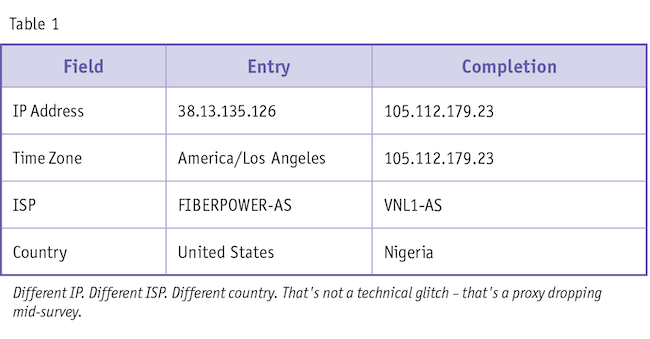
Cheap rotating proxies – the kind fraudsters use to mask their location – drop or flip mid-survey without warning. That means a respondent who entered from an apparent U.S. IP address may finish from a completely different country on a completely different ISP. Most quality systems only check IP at entry. They never look again.
Adding a check at completion and comparing the two is straightforward. A mismatch in IP alone isn't necessarily fraud – there are legitimate reasons an IP can shift. But when the IP, ISP and country all change between entry and completion, there is no legitimate explanation. This is a triple-flag that should result in automatic termination.
Table 1 shows a real example from our own data logs.
3. Rotate screeners and split your LOI calculation
Fixed screener sequences are a gift to fraud rings. Once a fraudster successfully navigates a screener, that path gets documented and shared. Answer keys circulate on community boards. Automations and AI agents get built to follow the same button pattern every time. Non-English fraudsters – who often aren't reading your questions at all – just follow a positional cheat sheet.
Where methodology allows, rotate screener question order and answer options within questions. You're not trying to confuse genuine respondents – you're eliminating the value of a static cheat sheet. Automation breaks down quickly when the path isn't predictable. Just don't rotate where order clearly matters: concept monads, exposure sequences or brand lists tied to shelf position.
On length of interview (LOI): Most researchers calculate LOI from start to finish. Fraudsters know this and they exploit it by racing through the screener and core survey, then parking on the demographic section at the end – running another survey in the background while they wait for enough time to pass. Measure LOI excluding demographics, from the end of the screener to the last non-demo question. You're not penalizing fast, thoughtful readers. You're targeting respondents who treat your core survey like a race and your demographic section like a waiting room.
4. Ask respondents what the survey was about
This is the simplest recommendation in the list and one of the most revealing. At the end of the survey, add a short open-end: "In your own words, what was this survey about today?"
Many fraudsters can't comfortably read English and rely on answer patterns and copy-paste open-ends to get through. By the end of a survey – especially a technical or niche B2B study – they often have no real sense of the subject matter. Authentic respondents give short, specific answers: "pricing for cloud software," "a new snack brand." Fraudsters produce generic noise: "It was about my opinion," "the survey is good," or something obviously pasted.
As a bonus, genuine respondents use this question to give you useful UX feedback – where the survey was confusing, too long or repetitive. It's a fraud check and a research quality signal in one.
5. Monitor what respondents do, not just what they answer
I asked a member of our white-hat team a simple question: Do you know when you are being watched inside a survey? Without hesitation: Yes. Then they told me how they know. Most surveys, they said, are obvious. Some require a quick look at the page code. But they rarely have to worry about it.
Their exact words: “I open the survey, switch back and forth between tabs, let Google or AI help me understand the subject, pull the answer and move on. The survey has no idea. It just sees answers.”
That is not a sophisticated attack. That is a Tuesday. And it is happening across studies right now, undetected and indistinguishable from a legitimate respondent by every metric the survey was designed to capture. The survey records what they answered. Nobody is watching how.
There are approximately 150 measurable behavioral signals available inside a browser session: keystroke cadence, response time, characters per second, mouse movement patterns, scroll behavior, tab visibility, window focus events and more. E-commerce platforms use these signals to catch bots. Banks use them to flag account takeovers. Market research, by and large, does not use them at all.
The recommendation here is different from the others in this series. The previous four are relatively simple operational pivots. This one requires outside expertise. Attempting to self-instrument behavioral signals without proper calibration will produce misread data and misfired logic – which is arguably worse than not measuring at all. The right path is to partner with technology built specifically for this purpose, embed it into the survey environment and receive a clean risk flag in return. The survey programmer's task is then simple: If risk flag equals true, terminate. One logic branch.
If a client asked you today to demonstrate how you monitor respondent behavior inside the survey, what would you show them? If the answer is nothing, that gap is worth closing.
The bigger picture
None of these recommendations replace device-level fraud detection, behavioral monitoring or post-survey QC. They're not meant to. What they do is close the easy doors – the ones fraudsters rely on precisely because the industry has left them open for so long.
The most consistent thing I've heard across all of these white-hat conversations is that fraudsters aren't impressed by our defenses – they're impressed by our complacency. They share notes on which platforms audit payout accounts, which studies rotate their links, which surveys check IP twice. The ones that do those things get avoided. The ones that don't keep showing up on the community boards.
These changes are low-cost and implementable now. The harder question is whether our industry will treat fraud prevention as an operational standard rather than an afterthought. The fraudsters are already treating it as a full-time job.