
AI exposes insights teams that matter
By Niels Schillewaert, Head of Research and Methodologies, Conveo
It has become a cliché to say that AI is transforming the insights industry. What is easier to underestimate is the amplitude of that change. The impact of AI is operational, organizational and deeply personal for insight leaders and their teams right now.

Two shifts will define the next phase of insights: fundamental reskilling and augmentation; and going beyond what people say to capture real-world consumer experience.
These shifts determine which insights executives and teams will become more influential inside organizations.
Fundamental reskilling and augmentation
AI anxiety is understandable. History shows that every major technological wave automates tasks before it creates new value. What is different this time is the speed and breadth of change.
Recent announcements from major consultancies have made this tangible. Deloitte, McKinsey and Accenture1 have all acknowledged that AI is reshaping professional services work, particularly non-client-facing and production-heavy roles. These widely reported AI-driven restructuring plans make one thing clear: reskilling is no longer optional. If this is happening at the world’s largest advisory firms, insight organizations (client-side as well as agency-side) should not assume immunity.
The new skills premium. The core value of insights professionals no longer lies in executional mastery – writing discussion guides, managing fieldwork, building charts or summarizing transcripts. AI does much of that faster, cheaper and increasingly well.
The premium will decisively shift to:
AI literacy – knowing how to work with AI tools, not around them.
Critical thinking – asking better questions, spotting weak logic, understanding mechanics of how things work.
Creativity – reframing problems, designing smarter research, imagining new angles.
Narrative consulting – turning evidence into stories that drive boardroom decisions.
As Sam Altman2 so succinctly put it, the most future-proof skill is the ability to learn, adapt and understand what people truly want and need. That has always been the stated mission of insights professionals, so let’s use AI to practice human understanding at a higher level.
From doing the work to shaping the work. At Conveo we are therefore building an AI platform that helps democratize execution, end-to-end – from design to recruitment and field to instant analysis and co-creation.
The teams at our clients are already doing more studies, faster, across more markets and cultures with the same headcount. Many of our insight leaders report that this increased throughput is not reducing trust – on the contrary, it is increasing it. When insights teams deliver at the speed of business, more often and with sharper clarity, their visibility and influence rise.
But this only happens when AI is treated as a companion or a team member that is integrated into your workflow, not as window dressing or a threat. AI should allow insights executives to reinvest the saved time into what is strategically important: synthesis, sense-making, stakeholder engagement and business impact.
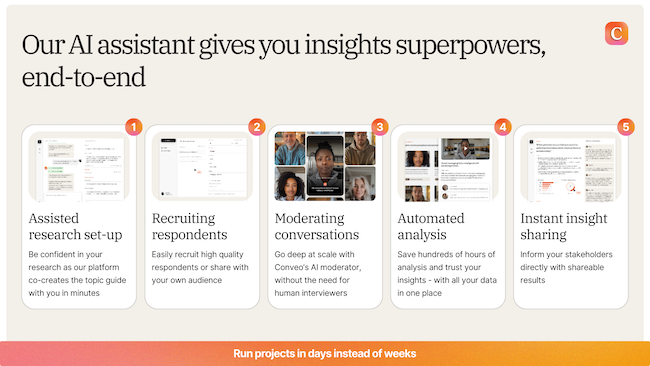
Figure 1: Conveo’s AI integrated into your insights workflow.
Go beyond what people say – combine conversation and observation
To apply these premium skills and generate premium insights, one needs rich and holistic input and AI can deliver exactly that. This shift that AI brings is therefore not about how we work but what we can now learn.
Conveo’s AI-moderated video interviews are pushing qualitative research beyond traditional limits by combining conversation and observation. Our AI conducts human-like conversations while observing actual behavior in local language and culture as well as real-life context. The AI moderator has memory to probe and reference to earlier statements and deploy projective techniques during the interview – all while capturing non-verbal signals.
Multimodal video insights in practice. This means the AI analysis of what people say (interview transcripts) is complemented with how they say and show things (multimodal video analysis).
Through combined verbal, vocal and visual analysis, AI captures what people:
- express non-verbally (tone, pace, hesitation, vocabulary);
- feel (emotional signals and intensity);
- do and share (actions, sequences, routines, on-screen behaviors); and
- are surrounded by (products / SKUs, brands, context and environments).
This bridges one of the longest-standing gaps in insights: the distance between stated attitudes and actual behavior. It also enables teams to capture consumer reality with a richness and scale that was previously impractical.
What this enables:
- Mission-based research and ethnographies at scale. AI-moderated mobile studies allow participants to complete missions in real-life contexts: shopping journeys, in-home routines, product usage or digital and UX experiences. Video analysis can recognize actions, products and sequences, revealing patterns that would otherwise require costly, small-sample ethnography.
- Stimulus and experience response. Consumers respond to concepts, packaging, advertising and touchpoint experiences emotionally in non-verbal ways – often before they articulate an opinion. AI-driven video analysis captures these non-verbal reactions and their intensity, revealing what words miss.
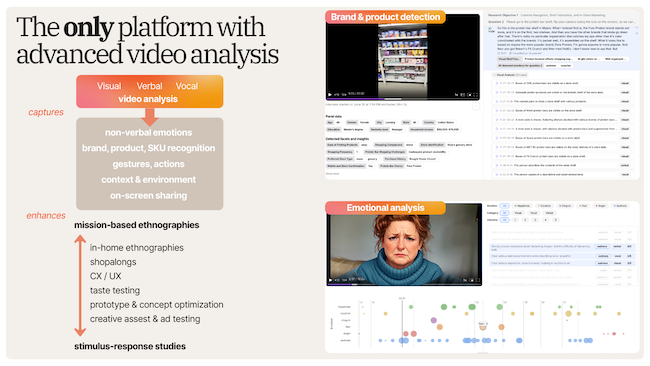
Figure 2: Video analysis enhances insights use cases.
Case study: Capturing unspoken frictions in online dog food shopping
Edgard & Cooper conducted an AI-moderated, mission-based study in Germany, France and the U.K. to understand how consumers shop for dog food online in real time. Participants completed an actual e-commerce shopping task while sharing their screen and thinking aloud. While one participant gave a detailed verbal account without mentioning brands or emotions, AI video analysis revealed repeated consideration of the brand Pooch & Mutt and a strong non-verbal expression of dismissal and disgust toward a low-cost alternative. These emotional reactions were not articulated verbally but were clearly visible in facial and vocal cues.
Why it matters: Combining conversation with observation allowed the team to identify true brand consideration and emotional frictions in the decision journey – insights that would have remained invisible in traditional interview-based research.
Will not replace
AI will not replace the insights professional. It will expose the difference between those who execute research and those who shape understanding.
With AI, insights teams will be able to scale their impact without scaling headcount – conducting research in contexts that were previously impractical, with richer data and more time for interpretation and advisory.
The question is no longer whether AI belongs in insights. The question is whether insights teams are willing and able to move upstream in decision-making, closer to strategy.
References
1 https://www.linkedin.com/news/story/accenture-plans-ai-restructuring-7100217/https://qz.com/mckinsey-layoffs-white-collar-jobs-ai
2 https://www.finalroundai.com/blog/sam-altman-reveals-one-skill-ai-cant-replace