Choosing labels: As women redefine what it means to be a woman, research must evolve
Editor’s note: Chloe Williams is a partner at 8TH DAY, where she applies imagination and cultural insight to help brands unlock growth and stay relevant in a changing world. Sixty-three percent of women in North America feel the labels society uses to describe them don’t fit.
Mother. Career woman. Homemaker. Feminist. These labels show up everywhere: in screeners, segmentation frameworks, positioning. They feel like neutral descriptors. They aren't. They are choices, and increasingly, they are the wrong ones.
Our recent Hidden Women study of 2,700 women across North America reveals a widening gap between the labels brands use and the identities women actually find meaningful.
The gap between roles and identity
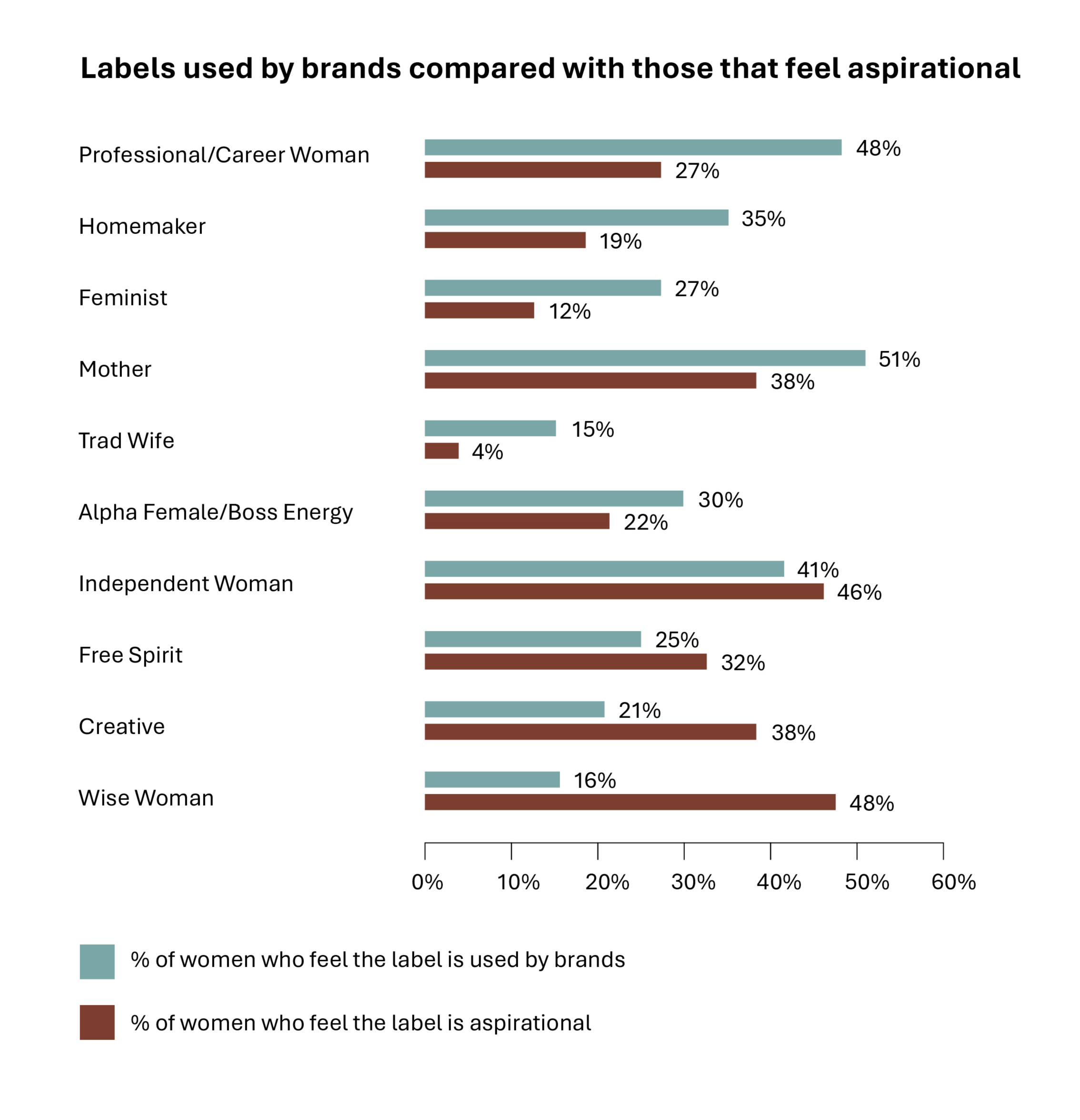
Labels used by brands compared with those that feel aspirational
When we asked women which labels brands most commonly apply to them, and separately which labels feel aspirational, the divide was clear.
“Professional/Career Woman” is used by brands to describe 48% of women. Just 27% find it aspirational. “Homemaker” is applied to 35% of women but only 19% embrace it.
“Mother,” perhaps the most relied-upon label, is used by brands for 51% of women. Meaningful to many, yes. But it also excludes non-mothers entirely and reduces every woman to a single role.
Now look at the other side of the gap. “Wise Woman” feels aspirational to 48% of women but very few brands talk to women this way. “Independent Woman” resonates with 46% and brands apply it to 41%, closer, but still trailing.
Brands, and the insights that inform them are over-indexing on roles. Women are increasingly aspiring to states of being.
This distinction matters. A role is something assigned. A state of being is chosen.
Research that anchors women in roles is asking them to respond from a position that may no longer reflect how they see themselves or may never have.
Labels that help anchor also flatten a complex identity into a single dimension.
Women’s lives have changed. Our data hasn’t
Eighty-two percent of women believe they are actively redefining what it means to be a woman today, across all ages, income levels and ethnicities.
Traditional milestones that once structured women’s lives – marriage, children, home ownership – no longer operate as a universal or linear path. Their timing has shifted. Their relevance has shifted. For many women, they are optional.
By 2030, 45% of women are projected to be single. And yet much of our segmentation logic still organizes women by household structure and life stage, as if those markers remain stable anchors.
What often passes for insight is actually a reflection of past constraints – what women were expected to do not what they now choose or aspire to. Legacy data doesn’t just describe the past – it also preserves it. When historical patterns are treated as truth, outdated norms get reinforced by default. Insights look rigorous, but in reality they are describing a version of women that is quietly disappearing.
The problem accelerates in AI systems trained on historical data. They learn what has been, not who women are moving toward. When a woman asks an AI system what salary to request in a job negotiation, it often recommends a lower figure than it would for a man with identical qualifications. Why? Because women have historically earned less, and the system mistakes that gap for guidance.
That same logic is inside our insight systems. If we keep looking backwards our understanding won't reflect the emerging reality women are building.
When women are unseen, they disengage
Despite decades of research investment, only 1 in 10 women feel fully considered in the products and services brands put out into the world.
Women rarely complain when a brand stops fitting their life. Instead, they adapt and find workarounds. Eventually, they find alternatives that fit.
“Brands don’t really understand women’s lives. They assume we use things the same way men do,” woman ages 25-34.
When a brand's product or underlying assumptions stop fitting a woman's actual life, revenue doesn't immediately collapse. What shifts first is something quieter: preference.
Women in our research described this with striking consistency. They stop feeling seen before they stop purchasing. By the time it shows up in a sales report, their decision to move on has already been solidified.
What this means for research
If women are actively redefining what it means to be a woman, then our segmentation, our tracking and our research must evolve with them.
For recruitment, are you capturing the diversity of women’s lives or defaulting to outdated milestones?
Before a discussion guide goes into field, consider if the framing invites women to share the full complexity of their lives or does it close it down before the conversation even starts.
International Women’s Day invites us to celebrate women. For insight professionals, it’s a moment to ask whether the systems we rely on are built for the women emerging or the women our data remembers.