
Productizing insights
Editor's note: Jess Waldschmidt is assistant director of market research and strategy in the Division of Ecampus at Oregon State University, where she leads market research, forecasting and strategic analysis for degree and certificate programs. With over 12 years of experience in higher education research and strategy, she holds a survey research certification from the Burke Institute and volunteers as a research fellow studying workforce transformation and the future of work.
Most organizations are rich in research and poor in reuse. You can feel the gap: Someone remembers “that slide from two years ago” but no one can find (or trust) the latest version. New teams rerun foundational work because prior learning isn’t searchable, comparable or clearly current. (And when a key researcher leaves, the unwritten context goes too.)
The failure mode is rarely the research; it’s the packaging. Insights get captured as one-off deliverables, filed away in places that are hard to search and hard to keep current. Good work turns into duplicate work.
The result is predictable:
- Questions get re-asked because prior answers aren’t findable or trusted.
- New teams lack visibility into past insights and start from scratch.
- Insights teams become translators instead of multipliers.
This isn’t an effort problem. It’s structural and it’s cultural. The fix isn’t “do more studies” or “build a bigger repository.” It’s to treat insights like a product: design a reusable asset, assign ownership, maintain it over time and build habits that make reuse the default.
The more polished and tailored the deliverable, the less reusable it is. Decks optimize for persuasion, not later discovery or comparison. Rigor stays locked inside projects instead of living in a system.
That creates a scaling ceiling: demand grows and one-off work grows with it.
In this article, I’ll share a “build once, use everywhere” maturity model for scaling insights, plus the operational moves that shift teams from one-off deliverables to reusable knowledge. The payoff is faster answers to repeat questions, higher trust in what already exists and less duplication.
Scaling requires a shift from “deliver the deck” to “maintain the asset” – reusable formats, governance and update cycles that keep insights trustworthy after the project ends.
What it means to treat insights like a product
Productization is designing research assets to be reused, not just delivered. It means structuring insights so they can be applied, compared and updated over time with infrastructure that makes them findable and interpretable beyond a single project.
For example, a canonical insight record might capture:
- Claim: What we believe to be true (in plain language).
- Evidence: Links to the underlying study/data and key supporting facts.
- Context: Audience, segment, product area, journey moment, geography.
- Confidence: Strength of evidence, caveats and known limitations.
- Provenance: Date, methods, owner/steward and version.
It’s not a slide library. A shared folder of decks isn’t reusable if it still requires the author to explain it.
It’s not stakeholder self-service. Productization isn’t expecting non-researchers to navigate raw data or interpret findings alone.
And it’s not less rigor. Standardization doesn’t replace good research practice, it helps preserve it at scale.
At its core, productization is a design choice: answer today’s question in a way that can be used again, by someone else, in a different context.
Rigor moves into the system
Concerns about productization are predictable; people worry it will oversimplify work or dilute rigor. Done well, it does the opposite: rigor moves into the system instead of being reinvented in every project.
- Scoping is standardized. Core questions, decision criteria and boundaries are defined at the framework level.
- Method selection is governed. Approved methods, when to use them and how to combine them are captured as shared standards.
- Metadata carries context. Audience, sample, timing, confidence and dependencies are structured so insights stay interpretable over time.
- Governance keeps the bar high. Ownership, review and update cycles keep reusable assets aligned with current standards.
When rigor lives in scoping standards, method playbooks, metadata and governance, projects can move faster without cutting corners.
Beyond knowledge management: the product lens
This isn’t a new diagnosis. Quirk’s has long covered “insight farming” over “insight hunting,” getting insights out of decks and into searchable libraries and treating research as an ongoing program not one-off projects.
This article adds a different lens: product development and maintenance culture. Productizing insights treats core learning like a versioned product with owners, roadmaps, QA, change logs and deprecation. Making it stick is less about tools than norms: how work is requested, published and rewarded.
Knowledge-management language is useful, but it can hide the hard parts: lifecycle ownership, maintenance work and behavior change. A product frame makes those requirements explicit.
How do you run insights like a product team?
- Name a steward per domain. One accountable owner for what’s “current” and why.
- Keep an insights roadmap. A backlog of assets to create, improve or retire (not just studies to run).
- Version and deprecate. Mark what’s current, what changed and what’s legacy.
- Set maintenance cadences. Decide review cycles and update triggers up front.
- Measure reuse. Time-to-answer, percent resolved from existing assets and repeat use of the same frameworks.
The 'maintenance tax' of productized insights
Productized insights aren’t “set it and forget it.” They come with ongoing cost and responsibility. Once research becomes an asset, someone has to own its lifecycle: creation, validation, updates and retirement. Without maintenance, even great assets drift out of date.
The risk isn’t just stale content, it’s lost trust. If stakeholders find outdated numbers or legacy frameworks, they route around the system and go back to bespoke requests.
Designing for productized insights means designing for upkeep:
- Clear ownership. A named steward with authority to keep assets current.
- Defined lifecycle. Create, review, update, archive/retire – explicitly.
- Planned review cadence. Set cycles by domain pace (quarterly, annually, etc.).
- Versioning and signaling. Version numbers, change logs, current vs. legacy.
With explicit ownership, lifecycles, cadences and versioning, productized insights stay trustworthy enough to use in real decisions.
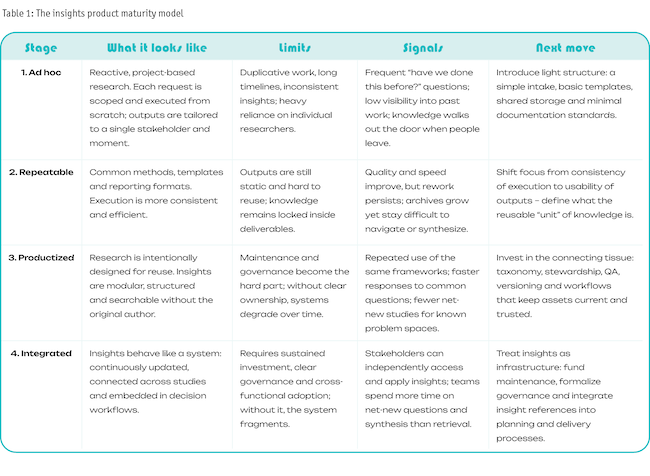
With that product frame in mind, organizations tend to move through a set of recognizable stages as they shift from one-off research to scalable, reusable knowledge (Table 1). Across these stages, the shift is from producing answers to building a system that retains, connects and reuses them.
Addressing the ‘bespoke bias’
Resistance to standardized insights is usually less about quality and more about what stakeholders feel they’re giving up. Tailored decks feel “just for me,” so shared assets can initially feel generic.
The shift is cultural as much as operational: position standardization as reliability (faster answers, clearer comparisons, shared language) and involve stakeholders early so assets reflect the decisions they need to make.
Flexibility matters; keep core structures consistent, with configurable elements that can be tailored without starting from scratch.
A few practical ways to chip away at bespoke bias:
- Make the time savings visible. Track and show how often a standardized asset lets you answer a request in hours instead of weeks.
- Showcase reuse stories. Highlight concrete examples where a shared framework or asset helped multiple teams move faster or align on a decision they’d previously debated in circles.
- Involve stakeholders early. Run working sessions where stakeholders react to prototype assets, name what’s missing and help prioritize which views matter most. Co-creation builds ownership.
- Build feedback loops. Treat standardized assets as living products: collect feedback after they’re used, iterate on what’s confusing or missing and close the loop by showing what changed as a result.
Over time, the goal is for “custom” to feel like the exception you choose intentionally, not the default you fall back on because nothing reusable feels good enough.
Your minimum viable insight system
Stage 3+ organizations are defined by a small set of repeatable, designed assets: canonical insight formats, structured intake forms, a lightweight taxonomy, standard research plan templates and clear QA checkpoints. Together, these create a consistent path from request to reusable insight – so each project adds to a shared system instead of disappearing into a single deck.
A traditional deliverable is a static deck built for one moment and audience. A productized insight is a modular record: a discrete claim linked to evidence, tagged by context (segment, product, journey), versioned over time and designed to be pulled, combined and updated as new studies land.
Build the system, not the deck
Scalable insights don’t come from doing more research. They come from designing what you already know so it can be found, trusted and reused.
The future of the insights function isn’t louder storytelling or more heroic decks. It’s quieter infrastructure: intake, formats, taxonomies and governance that keep delivering value even when no one from the team is in the room. When organizations stop paying for the same answers twice, they unlock capacity for better questions instead.
That shift is less about acceleration and more about discipline. The highest‑leverage teams do less rework and more maintenance. They treat insights as productized, reusable knowledge – assets with owners, lifecycles and version histories – not as disposable outputs. When the culture values that kind of reuse, infrastructure compounds quietly in the background and the impact of every new study extends far beyond the slide where it first appeared.