
••• political research
'I approve’ tagline sends different message
In the article, “How encouraging niceness can incentivize nastiness: An unintended consequence of advertising reform” in the Journal of Marketing Research, Clayton Critcher of the University of California-Berkeley and co-author Minah Jung of New York University describe a series of studies examining the effects of the familiar “I’m Candidate X and I approve this message” tagline that accompanies political ads on radio and TV as mandated by a 2002 law.
The research suggests the law created an unintended effect: The authoritative-sounding phrase makes policy-oriented negative ads seem more credible, reports Pacific Standard’s Tom Jacobs.
Many participants in a study saw the notification as an indication that “the ad had been touched by regulation,” said Critcher. “That gave a legitimizing halo to the message as a whole.”
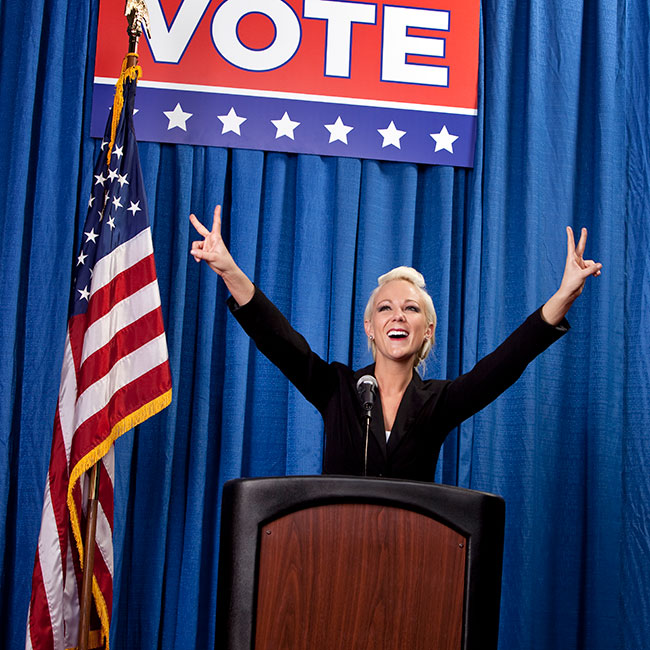
As a result, “Not only did the tagline enhance the perceived believability of policy attack ads,” the researchers write, “it also produced more positive evaluations for the ads’ sponsoring candidates.”
The researchers found that the approval language, when delivered by the candidate, constituted a promise, which had the effect of encouraging higher ad evaluations. But this effect did not occur when the words were spoken by a narrator, using third-person language (“This ad is sponsored by Steve Kagan; he approved this message”) or if the candidate was heard but he or she did not make an explicit endorsement of the ad’s content.
That finding suggests a simple fix. “Requiring a candidate to deliver a tagline, but one that has no approval language,” the researchers conclude, “may satisfy the goal of keeping voters informed about who is running ads, without ironically lending credibility to (negative) messages.”
••• social media research
Family posts need to be picture-perfect
As part of a marketing campaign, beverage maker Minute Maid partnered with Edison Research to commission the “This is Good Parenting” survey to better understand how parents are using social media to share their families with the world. The survey uncovered an open secret: candid family pics are usually not very candid.
Ninety-four percent of parents surveyed who post pictures or videos of their family on social media admit to posing or staging at least one of them and more than one-third (36 percent) of parents who post pictures or videos of their family admit to staging or posing most or nearly all of them.
In addition, more than four-in-five (81 percent) parents who post pictures or videos of their family admit they avoided posting because something embarrassing was in the background, while 80 percent of parents have avoided posting because their house looked messy. Forty-three percent of parents who use social media agree they only post flattering photos or videos of their family.