

••• education research
What comes after the cap and gown?
High school students consider future paths

A nationwide survey from American Student Assistance (ASA) of 3,000+ students in 7th-12th grade gives insights into teens’ plans after high school. Teens’ interest in college is down while nondegree paths are on the rise. Nearly half of all students say they aren’t interested in going to college, with just 45% saying two- or four-year college was their most likely next step. Meanwhile, 38% of teens say they were considering trade or technical schools, apprenticeships and technical bootcamp programs, although only 14% say that such a path is their most likely next step.
Parents are one of teens’ biggest influencers – and they’re skeptical of nondegree options. A vast majority (82%) of teens say their parents agree with their plans to go to four-year college, while only 66% said parents supported plans to pursue a non-degree route. In fact, teens reported that parents were more supportive (70%) of foregoing education altogether right after high school vs. pursuing a non-degree program. Nearly one-quarter (23%) have no immediate plans to continue formal education or training upon graduation. Teens not planning to continue education after high school indicated they were thinking of beginning full-time work, entering a family business, starting their own business or joining the military.
Teens, and especially middle schoolers, are feeling better prepared to plan their futures. In recent years policymakers, educators, employers and other stakeholders have pushed to make career-connected learning a more prominent feature of our education to workforce system. Survey results say it’s paying off. Agreement with the statement "My school provides me with the right resources to plan for my next steps after high school" grew from just 59% in 2018 to 63% in 2021 and to 82% in 2024. Notably, the largest increase occurred at the middle school level, where confidence in in-school planning resources jumped from 60% in 2018 to 90% in 2024.
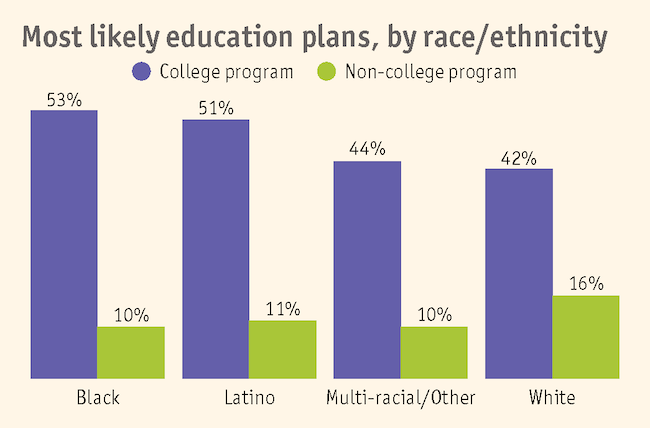
Boys and girls are equally interested in college when they’re in middle school but by high school, more than half (53%) of girls say they’re likely to attend college compared to just 39% of boys. The gender gap is smaller when it comes to non-degree pathways: 15% of high school boys say they will likely attend vocational/trade school, participate in an apprenticeship or take a certificate program, compared to 10% of high school girls. Urban teens were least likely (39%) to say they plan to go to college. Suburban teens are much more likely to plan to attend a college program (64%), while 46% of rural students planned on attending college. More than half (54%) of Black teens and 51% of Hispanic youth are planning to go to college, compared to 42% of white teens.
This report summarizes the results of a quantitative online survey of U.S. youth ages 13-18 in 7th-12th grade. The study was fielded in December 2024 with 3,057 total respondents.
••• financial research
Kids’ buy-now clicks cost parents
Families struggle to teach financial responsibility

Families across America are learning the hard way that the “click to buy” culture isn’t just draining adult wallets. A new survey by personal finance company Achieve reveals that 31% of parents have caught their kids making unapproved online purchases. This surprise spending costs parents $170 on average, while 19% of parents report costs of over $300 – proof that small clicks can snowball into big expenses.
The study of 2,000 parents of children 18 and under was conducted by Talker Research. It paints a broader picture of how children interact with money and how families struggle to teach lasting lessons about financial responsibility. Parents reported that these surprise charges aren’t limited to video games and fashion items. Some kids went bigger, buying computers, smartphones, smart watches, cameras and even dabbling in stocks and cryptocurrency. The findings underscore the financial blind spots created by a generation of kids growing up with instant digital transactions.
When kids overspend, parents most often start with a conversation (56%) but some resort to taking away a device (23%) or demanding repayment (20%). Sixty-five percent of parents always require their kids to ask before making online purchases, while 11% of parents report they rarely or never require permission. When asked to compare their children’s level of financial responsibility to their own at the same age, 39% of parents say their children are more responsible, 18% say their children are less responsible and 43% believe it’s about equal.
Despite the risks, many parents admit they aren’t monitoring their kids’ financial habits closely. Almost one-quarter (23%) rarely or never check their child’s debit or credit card activity, while 11% say they rarely or never require permission before digital purchases. At the same time, most parents recognize the educational gap, with 44% admitting it’s harder to teach financial lessons with digital money than with physical cash.
Families are trying, but often failing, to use allowances as teaching tools. More than half of parents (57%) give their children a regular allowance, usually paid in cash (73%). The typical monthly payout is $119, but 14% of kids receive more than $250. Despite those budgets, overspending is widespread. Only 12% of parents say their kids never exceed their allowance.
While over half (56%) of parents respond to unapproved spending with a conversation, parents also turn to firmer steps, including returning the purchase (27%), confiscating a device (23%), grounding (21%), demanding repayment (20%) or freezing account access (11%). Yet two-thirds of parents (66%) admit they’d relax if they believed their kids understood the value of money and 61% even wish a financial expert could step in to teach healthy spending habits.
Talker Research surveyed a nationally representative sample of 2,000 American parents with a child aged 18 and under living at home. The survey was commissioned by Achieve and administered and conducted online by Talker Research between April 14-23, 2025.
••• restaurant research
It’s about more than just the food
Diners want a dash of experience with their meal

While diners still crave warmth and connection from their dining experiences, they also expect seamless personalization, smarter booking experiences, offerings that extend beyond the dining room and tailored marketing that speaks to them, not at them. From AI-assisted reservations to Google-driven discovery and luxe, experiential add-ons, operators are embracing automation not to replace, but to enhance the human experience, finds marketing and operations platform SevenRooms.
Ninety-four percent of diners use online resources, like Google, social media and media sites, to discover new restaurants. While 69% of Gen Z rely on social media for discovery, only one in 10 consumers use influencers for recommendations, signaling a shift away from influencer-driven discovery. Google is a top discovery channel for consumers, with 58% of operators investing in Google Ads and 50% investing in organic Google strategies, like SEO, in 2025. Seventy-four percent of consumers are comfortable using AI in the restaurant booking experience, yet most operators haven’t adopted AI for the booking experience, creating a sizable innovation gap.
Eighty-three percent of diners are willing to sign up for restaurant marketing programs but want more than a discount – they expect VIP treatment. Forty-seven percent say the top perk they want from restaurants is birthday and anniversary promos, followed by exclusive offers or early access to events. Text is becoming a dominant channel for real-time engagement, with 48% of consumers preferring connecting with restaurants via text.
E-mail is still a top choice for promotions, menu updates and special events, with 62% of consumers preferring to connect with a restaurant via e-mail. Operators are embracing personalization, but 77% still face barriers, with their biggest challenges being tracking performance (35%), ensuring a consistent experience across locations (31%) and knowing who and how to personalize for (28%).
Despite economic challenges, consumers are willing to pay a premium for special events and experiences, with 74% saying they plan to or have already returned to a restaurant after a unique experience. They are willing to pay more for personalized experiences, including curated appetizer platters (62%), customized tasting menus (59%) and commemorative menus or special-occasion keepsakes (57%).
Experience-led programming is driving repeat visits and revenue, with consumers saying they’d pay more than a typical meal for holiday menus/celebrations (63%), tasting menus (55%), live music/dance (53%) and cooking classes (51%). Restaurants are opening new revenue opportunities with upgrades during the booking process, including scenic views, premium drink options, tasting menus, flower bouquets, chocolate truffles and other items. However, basic hospitality is back in, with 25% of diners saying their most valued staff interaction is a simple “welcome back.”
Eighty-seven percent of consumers would buy a non-meal item from a restaurant. Popular items consumers would buy include pantry items like spices or dried pastas (36%), food subscriptions for cheeses or frozen items (23%), at-home meal or cocktail kits (22%) and cookbooks (21%).
Forty-nine percent of operators use online reviews to determine their ideal guests and 59% use reviews to evaluate guest perception. Thirty-five percent of consumers say design and ambiance directly impact their connection to a restaurant, enhancing the in-service experience and increasing repeat visits. Restaurants are rethinking loyalty through branded experiences and storytelling, moving towards greater personalization to build deeper connections.
Seventy-nine percent of operators are already using AI, with 99% using AI seeing benefits, including faster response times to guest inquiries (48%), quicker decision-making (47%), reduced operational costs (39%), increases in guest satisfaction rating (38%) and greater team efficiency (37%). AI is helping reduce time spent on reading and responding to guests by 27%, freeing up teams to focus on in-person experiences.
SevenRooms partnered with Censuswide Research to survey 1,000 U.S. consumers from December 12, 2024-January 6, 2025. It also surveyed 257 U.S. operators from December 24, 2024-January 15, 2025.
••• shopper research
Two differing views of the same economy
Shoppers are stressed, retailers are sanguine

Consumers are becoming hyperaware of pricing. More than half (55%) of consumers plan to prioritize products with the lowest prices when shopping in the coming months, while only 5% of retailers think shoppers will choose to trade down to lower-quality products and less expensive brands than the ones they’re accustomed to, finds shopping platform Rakuten.
Retailers understand that shoppers will prioritize price but they believe that brand loyalty will remain intact. Thirty-three percent believe that shoppers will look for ways to save and stack incentives to continue purchasing their preferred brands. An additional 32% believe that shoppers will shift to discount retailers that feature their favorite brands.
Consumers are struggling with their everyday purchases, impacting the opportunity for retailers to engage shoppers and drive revenue. Nineteen percent of consumers say they cannot afford to pay their household bills and 17% cannot afford necessities like food and gas. Only 36% of consumers say they can afford all their daily expenses in addition to non-essential items. Over a quarter (28%) cannot afford personal purchases like new clothing, makeup, electronics and more and roughly two-fifths (41%) plan to shop less than in previous years
Retailers understand that consumers are financially stressed, with 74% saying shoppers are more concerned with the affordability of everyday purchases than last year. Regardless, 73% of retailers were optimistic that they would meet their company’s sales objectives for the first half of 2025. This optimism was backed by an increase in spend with 67% saying their marketing budgets increased over last year.
Inflation remains top of mind with most (39%) consumers citing it as having the most impact on their shopping plans. Shoppers remain pessimistic about inflation as 77% believe prices will continue to increase.
Grocery prices have a large effect on how shoppers spend, even beyond the grocery store, with 57% saying that rising grocery prices have caused them to cut back on non-essential shopping. Shoppers are split on how to address rising grocery prices. Forty-one percent are spending more at the grocery store to purchase from the same brands they’re accustomed to while 39% are shifting to cheaper alternatives. Thirteen percent say they are completely abstaining from buying products affected by price hikes.
While retailers are sensitive to shopper sentiment and the impact of inflation on household budgets, they believe that shopper loyalty will remain. This is reflected in how retailers are choosing to spend their increased marketing budgets. A majority (83%) say they are prioritizing social media spend, followed by search (65%) and display (50%). Only 36% of retailers are prioritizing performance marketing channels like affiliate to drive sales.
While performance marketing isn’t their top priority, this tactic is receiving more attention from retailers this year, with 30% of marketers planning to reallocate some of their upper-funnel budget towards lower-funnel performance drivers. Nearly half (48%) say they will be increasing their spend in offering incentives like loyalty-based rewards and cash back.
These surveys were conducted online by The Harris Poll on behalf of Rakuten. The retailer survey was conducted from March 10-17, 2025, among 101 retailer marketers in the U.S. The consumer survey was conducted from March 6-10, 2025, among 2,058 U.S. adults.
••• small business research
A welcome new team member
How small businesses are using AI

There has been a dramatic shift in how small businesses are embracing AI, with current usage jumping from 39% in 2024 to 55% in 2025. Research from sales and marketing platform Thryv underscores how AI is rapidly becoming a cornerstone of small business strategy, helping owners save time, reduce costs and compete more effectively in an unpredictable economy.
AI adoption is especially strong among companies with 10-100 employees, where usage jumped year-over-year from 47% to 68%. Younger business owners and those in professional services and retail sectors are leading the charge, integrating AI into marketing, customer service and operations.
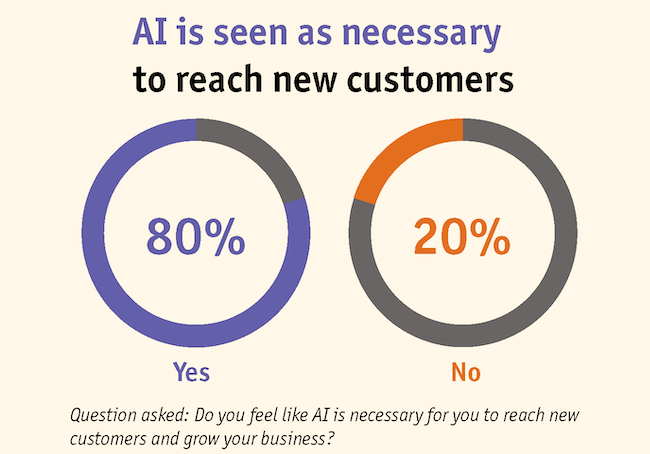
Eighty percent believe AI is essential to reach new customers and 78% say it’s necessary to meet rising consumer expectations for speed and personalization. These perceived benefits far outweigh concerns about data security, which decreased 40% year-over-year.
Among current AI users, 63% use it daily and 33% use it weekly. Top applications include data analysis (62%), content generation (55%), marketing automations (47%) and customer engagement tools like chatbots (46%). Fifty-eight percent report saving over 20 hours per month. The time saved by AI has been used to improve current processes (58%), get new customers (56%), develop ideas to expand business (49%) and develop marketing and other content (42%). Others say they use the time saved to spend it with customers (40%) and employees (29%). Sixty-six percent say AI saves their business between $500 and $2,000 monthly.
Seventy-five percent of small business owners agree that AI can help improve content marketing, 66% believe it can help by automatically responding to customer reviews and 61% say it can improve customer relations. Forty-nine percent of businesses have incorporated AI in business automation, 29% in social media, 48% in data analysis and forecasting and 48% in content creation.
Two-thirds (67%) agree that AI takes pressure off themselves and their staff. Almost half (46%) say it makes them less reliant on employees. While only 14% of respondents believe AI could replace an employee, nearly half (42%) are open to the idea under the right conditions. As AI adoption levels continue to rise among small businesses, this openness could impact AI’s influence on staffing levels.
Forty-one percent of small businesses believe AI will help them navigate economic uncertainty, with another 40% saying it might. Optimism is highest among white-collar and service-based businesses, where over 70% see AI as a strategic advantage. Of those not currently using AI, 52% say they plan to before the end of 2025 and 48% say they will implement it by 2026 or later.
Data was collected from 540 small business respondents between May 4-14, 2025. Respondents are decision makers for their business and are 21+. Respondents have been in business for one year or more, have 1-100 employees and report revenue ranging from $100,000 to $9.9 million.