
The Creative AI Loop
By Thomas Zoëga Ramsøy, Founder and CEO, Neurons
Modern research teams face a persistent paradox. We have more sophisticated tools, more data and more methodological rigor than ever before, yet insights still take too long to turn into action. Weeks, sometimes months, separate insight generation from execution. High-value research projects regularly exceed $40,000, only to arrive on a decision maker’s desk after a campaign is already live or too late for anything more than minor adjustments. The result is familiar and frustrating: insights trapped in decks and postmortems, instead of embedded directly into the work they were meant to improve.
This is not a question of belief in insights. Brands and advertisers all agree that understanding people matters. The market research industry was worth $140 billion in revenue in 2024 according to ESOMAR, showing the scale and importance of insights work. Friction appears when speed, scale and creative reality collide. Research teams are asked to answer fundamental questions: What will people notice? What will they feel? What will they remember?
Part of the challenge is methodological. These questions have traditionally required neuromarketing methods such as eye-tracking, brain monitoring and implicit measures, which are scientifically robust but slow, costly and complex to translate into action. Traditional methods like surveys, focus groups and interviews struggle with these questions altogether, as much of human attention, emotion and memory formation happens outside conscious awareness.
Another reason is conceptual. Insights are still treated as lagging indicators, explanations of what worked or failed after launch. But what teams actually need are leading indicators that guide decisions before money is spent. This is where AI enters the conversation – but not in the way the industry initially imagined.
A new foundation: neuroscience-trained AI
In 2024 around 47% of researchers worldwide had already used AI regularly in their work and about 83% planned to invest more in AI for research, according to a Qualtrics Report. The real question is not whether to invest in AI but where to invest. The biggest gains come from AI systems that learn from the right foundations.
When AI is trained on large-scale neuroscience and behavioral data, it stops acting like a generic pattern-recognition tool and begins to function as a validated proxy for human response. Instead of guessing, it can forecast attention, emotion, cognition and memory with consistency.
This enables a new class of systems: agentic AI that is predictive, suggestive and generative. Together, these capabilities form what we call the Creative AI Loop.
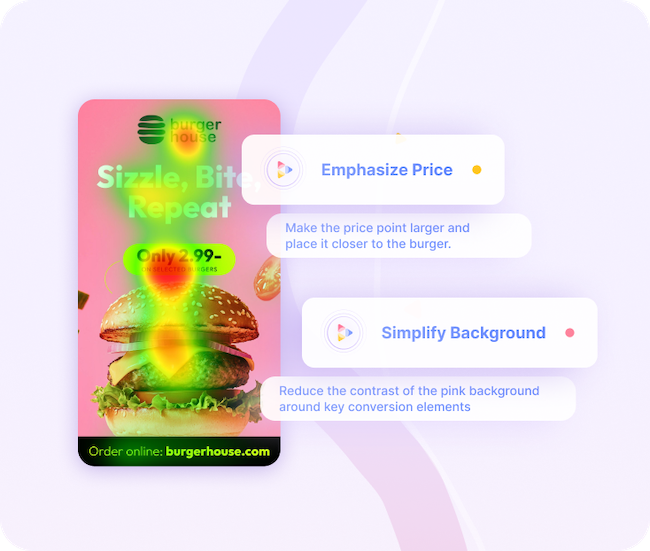
Figure 1: Ad with AI heatmap. Predictive AI shows attention patterns, while suggestive AI explains how to improve impact.
Predictive AI: simulated consumer responses
Not every human response can be predicted. Some metrics are poorly validated or insufficiently reliable. The first task, therefore, is identifying which responses can be predicted with high validity and reliability and which can meaningfully predict audience responses. Only through this quality assurance can we collect high-quality data for AI models to learn from and predict.
Predictive AI gives insight teams an early read on how people are likely to respond to an asset, concept or experience. It delivers simulated responses in seconds, such as heatmaps and behavioral metrics, data that would traditionally require weeks of fieldwork.
This allows teams to identify issues early: attention drop-off, emotional flatness, cognitive overload, weak branding cues or poor memorability. Instead of validating ideas after the fact, researchers can filter and prioritize before expensive testing or production begins. This reduces downstream waste and late-stage surprises.
But prediction alone doesn’t paint the full picture.
Suggestive AI: From data to insights
The hardest part of insights work has never been data collection. It is interpretation. Suggestive AI bridges this gap by translating predictive outputs into clear, actionable insight.
This is not a generic large language model summarizing data. A true suggestive AI must be curated and domain-trained. It needs to understand how predictive scores relate to benchmarks; how attention, emotion and memory work across formats and industries; and what actions are most appropriate in context. Recommendations must be grounded in marketing and neuromarketing knowledge, explaining not just what to do but why.
This is where AI begins to behave like a strategic partner, offering evidence-based decision pathways. Still, even strong insights can stall if teams cannot align on next steps. This is where the third type of AI model completes the Creative AI Loop.
Generative AI: What would better look like?
In 2025, 95% of generative AI pilots failed, an MIT report found. Our view is that this is largely because generative AI delivers value only when guided by predictive and suggestive intelligence. Without that foundation, it tends to produce random variations rather than meaningful progress.
When properly guided, generative AI can produce hypotheses grounded in behavioral science, such as versions that strengthen emotional relevance, reduce cognitive load or improve memorability. For the first time, researchers can show what better looks like. Alignment happens faster because insight and execution converge visually.
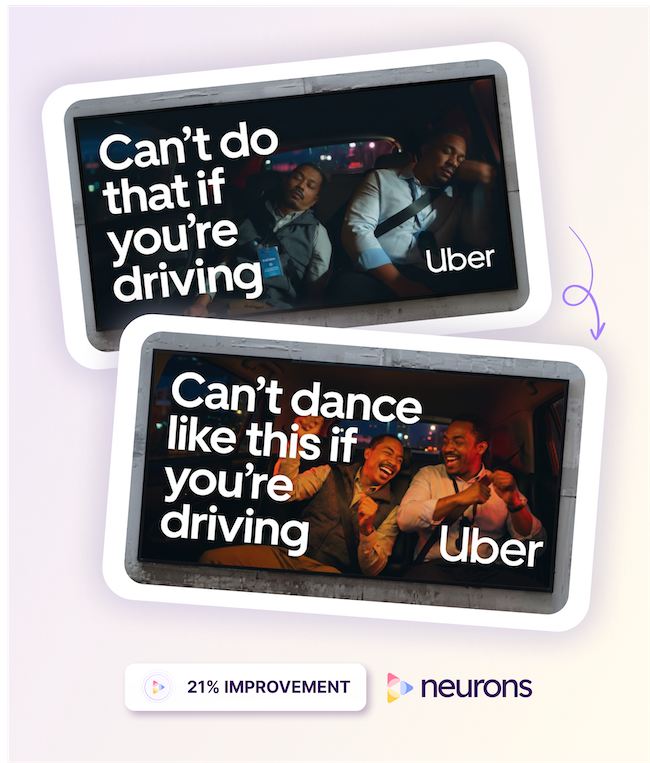
Figure 2: Original vs. AI-improved ad. Generative AI visualizes improved ad creative based on predictive and suggestive AI insights.
The Creative AI Loop in practice
Together, these three stages form the Creative AI Loop:
- Predictive AI shows how people will respond.
- Suggestive AI reveals why they respond that way and what decisions matter.
- Generative AI illustrates how impactful improvements could look.
This closed loop is the new operating system for insight teams. Neurons AI puts this into practice through predictive, suggestive and generative AI. Together, they help teams keep scientific rigor while moving faster, reducing creative risk, improving alignment across teams and influencing decisions earlier.
Most importantly, Neurons AI is built to support insight professionals, not replace them. It helps researchers have more impact by making validated insights faster to access, easier to understand and easier to share visually.
The future of insights
As the industry enters a period defined by speed and uncertainty, research teams need tools that augment their capabilities without sacrificing quality. Neuroscience-trained AI like Neurons offers that combination.
The future of insights will not be defined by how much AI can produce but by how well AI understands humans and helps researchers turn that understanding into better decisions. With the Creative AI Loop, that future is no longer theoretical. It is operational.