
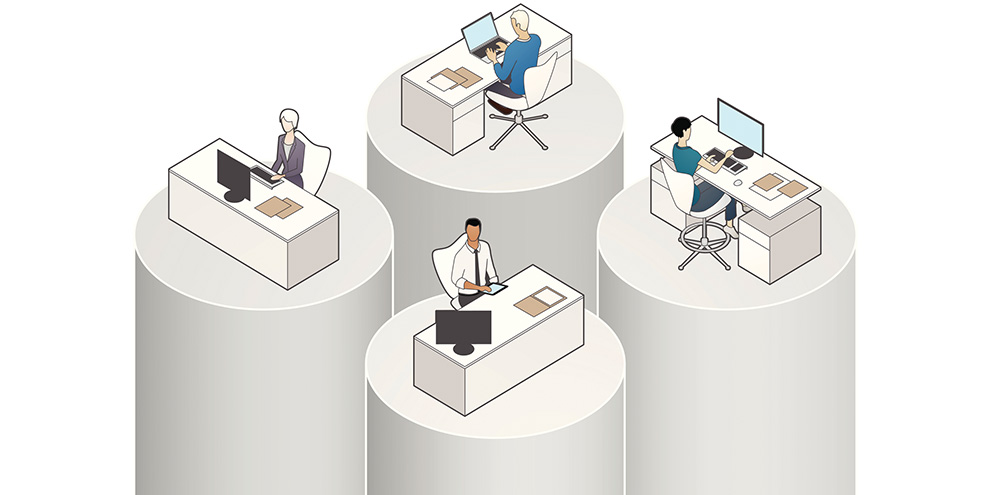
Silo smashing
Editor's note: This article is an automated speech-to-text transcription, edited lightly for clarity.
Research silos can be costly and time consuming for research teams. NPR was having this issue but has worked to smash their silos.
Gwynne Villota, director at NPR, says the team is still learning, but there are key aspects of their workflow that have helped to solve the silo problem.
Villota shared these aspects of the NPR team’s workflow during a 2025 Quirk’s Event – Virtual Global session.
Session transcript
Joe Rydholm
Hi everybody and welcome to our session, “Silo Smashing.”
I'm Quirk’s Editor, Joe Rydholm. Thanks for joining us today.
Just a quick housekeeping note that we won't have a formal Q&A after the session, but our speaker will be in the chat during the session. So, feel free to submit your questions and comments using the chat tab during the presentation.
Our session today is presented by NPR. Enjoy.
Gwynne Villota
Hi everyone, my name is Gwen Villota and I'm part of the Audience Insights Team at NPR headquarters.
I'm here today to talk about silo smashing. So, how the NPR Audience Insights Team works within and across the organization to help NPR stay audience focused.
So, what does that mean?
Over the next few minutes, I will talk about how we are structured, how we communicate, the tools that we use, what this looks like in practice and where we need to still improve because we are definitely not perfect at this.
Let's start with how our team is organized. We are a small but mighty team. There are 15 of us spanning 12 locations. Suffice it to say we are remote and so we have to work that much harder to make sure that everybody knows what they need to know and is up to speed.
We are structured probably like many of you by consumption platform and also by client.
I am part of the Content Research Team. We do research on new and existing shows, sometimes on products and I spend a lot of time on broadcast data.
We also have a revenue-related research team that focuses on our corporate underwriting, development and marketing teams.
Then finally, a digital analytics team that is basically half of the overall insights team that works with any and all first party data.
And I expect also like many of you, our data are really isolated and siloed by consumption platform. We also rely on a lot of different third parties to supplement what we can't get in the analytics.
Across all of those different tools, often what is measured is defined differently. What counts as an occasion, a play or a user varies by the amount of time they spend on the platform.
Aside from the measurement differences, the tools to access all of them are unique and bespoke. And no, very few datasets speak to any other datasets. So, especially on the digital side, the technical skills might be similar, but application on web data versus app data versus donor data for instance might be very, very different.
We serve clients across the organization. So, of course, as a media company, our biggest division is content. I work very closely with them. But as I said, while we sit within the marketing division, they're a client. But then there's also a long list of other divisions, like member partnerships, who maintains all of our station relationships. We really work with clients across the whole organization.
Additionally, there are satellite analysts with dotted lines into content and our development team.
It's also the case that our clients don't always have one single point of contact within audience research. So, in other words, if I'm working on the Up First podcast, I would talk to some people on the audience insights team about analytics and I would talk to me or someone on my team about audience attitudes or other lifestyle behaviors.
So, this leaves us all feeling a little like this a lot of the time. We are constantly thinking about what we're doing and with whom and for what reason.
Let's move now into communication.
I would say the biggest thing that we do to ease communication is having recurring meetings. We have so many different recurring meetings at so many different levels, like a team meeting, one-on-ones with direct managers, staff that are working on the same project or with the same client have dedicated recurring meetings, there are dedicated cross trading recurring meetings between teams. We have recurring meetings with stakeholders. You get the idea.
We put time on the calendar at some sort of cadence. It might be daily or weekly or quarterly. We don't of course keep them all, but it's much, much, much easier to cancel those meetings than to try to navigate the complexity of everyone's schedule when you need to talk to someone tomorrow. We try to plan ahead.
I think we all try really hard to not let the end of the meeting be the end of the information sharing. I know that I take my meeting notes and I copy some into my agenda with my boss. I put others in agenda notes for my one-on-ones and just constantly thinking about how the information needs to go back and forth, up and down and side to side.
We also recognize that people take in information in a lot of different formats, in different cadences and on different occasions. And so, we try to make our information available, even the same information, in lots of different ways.
So, we have a weekly email where we highlight some snippet or tidbit of information that we've recently learned or shared with a client team. We have a Slack channel that anybody can join to hear similar kinds of information, sometimes we post to industry studies or other things, but there's less limitation on that compared to a weekly email.
We have a monthly meeting that has been at 2 o'clock on the third Tuesday for the last 12 plus years. We got about a hundred people at this meeting. Topic rotates obviously, but it's just a different format for people to take in the kinds of findings we're surfacing about our audience.
We have an intranet page where more recurring deliverables can live. We also have what we call an ‘Analytics Speed Dial’ that's a one-stop shop for all of our dashboards.
A lot of information goes back and forth, is cross posted in these different places or gets a deep dive in a monthly meeting and a really short Slack message summary. But just trying to hit all of our stakeholders wherever they might be and considering the amount of time they have available for our meetings.
There are a few things that we try to do to have healthy meeting habits.
Our meeting invites, especially the standing ones, have a linked agenda in the invite where we can add our notes. We can prep for the meeting. There are standing agenda items that we just copy down each time and then start filling things in. We get nudges in Slack to remind people to check the agenda or other things like that.
We have also made sure that our expectations for things, like remote work and availability, are pinned in those agenda documents so that everybody can find them, and no one is surprised, especially new hires.
We also implemented something called ‘Documentation Day,’ which is a day, three or four times a year, where we cancel all our meetings and we spend the day heads down cleaning things up, making sure that codes are updated or methodology for pulling a particular run of data is all documented and up to date.
All of this is a chore, but like other chores, it feels good when it's done and everything is tidy and organized and everybody can find what they're looking for and not have to ask somebody where the notes for the meeting were or what we talked about.
Next, what are some of the tools that we use?
We are a pretty lo-fi organization in terms of the tools we use. We rely heavily on digital tools because of all the time zones and the different work schedules. We try hard to make that information location agnostic.
We have a bias for simplicity. We do a ton in group Google Docs, including editorial planning. Even in the content division, some of our meeting agendas have gotten so long over time that they crash, and we have to restart our computers and start building new documents.
We have experimented with more bespoke or dedicated tools, like agendas in Lattice or dedicated notes apps, but ultimately, we found it's just easier to be in the tools that everybody is already using. And for us, in a lot of cases, that is Google.
We have also implemented a request form.
This is available to any internal NPR employee. And you can probably see some of the basic questions here. It's not that we never have conversations with stakeholders, but if somebody is just trying to fill out a grant application or an awards nomination, this is an easy place to go to document all of those requests.
They are fed into a dedicated Slack, a dedicated private Slack channel, and then whoever is best positioned to answer that question, claims it by emoji. Then also links to the documentation when the request is done so that if we get similar requests, we can just go back and see exactly how we handled it the previous time.
Maybe this sounds good. Maybe some of this sounds helpful. What's it like in practice?
It's not always so clean. It means we're definitely always on and keeping our eyes and ears open to all of the various places where people can find us or interact with us.
Projects start a lot of different ways.
Sometimes it starts with a show executive producer who checks a dashboard and says, "huh, my show grew a lot last week. Can you help me understand why?"
And other times we take a look back at what we've worked on and say, “It looks like we haven't checked in with your audience in a while, and we should do that.”
And along the way, we need to be mindful of all of the various stakeholders and their respective priorities.
What I mean by that is that sometimes something that one team wants is not the best thing for a different team. We spend a lot of time navigating that intermediate space between stakeholders.
So, how do we approach the actual question that the stakeholders are asking?
We try to walk through this process, especially with our analysts. Starting of course, what is the real question that the stakeholder is asking? Is there a question behind the question? That could be in the form or the other intake process, but it almost always involves a conversation or at least a message or two to make sure that our understanding and their understanding are the same thing.
Very early on, we want to understand what decision this data will inform. If it is just curiosity, then it takes a much lower position on our priority list. We want to make sure that it aligns with our business strategy.
We want to understand who the key stakeholders are and not just who they are, but whatever we know about them.
How do they take in information?
What's their communication style? What are their goals?
What's our existing relationship with this person? Is this an opportunity to strengthen that relationship or do we need to do what do we know from our past work with them that could help?
Are there other stakeholders in the mix?
What existing internal or external research is relevant? We have lots of third-party data providers. How close can we get to answering this question without doing any new or original research? Sometimes not very far, but sometimes we get a good start.
Then lastly, how much effort should we invest in this? If the question is just about curiosity and it is a low priority show or stakeholder for some reason, then we're not going to spend nearly as much time on it as if it's the CEO or something about a show like Morning Edition or All Things Considered.
I would say also that several team values are critical to making this work. A lot of what I talked about is tools and process.
But at the end of the day, we are people. I think we are really lucky that as a nonprofit we tend to work with a lot of colleagues who are really mission-oriented and committed to NPR as a nonprofit. And there's just a lot of dedication there.
There's also a lot of mutual respect. We have a lot of confidence in one another and the analytic prowess of our colleagues. That comes through in how we interact and work with each other.
And there's also a spirit of generosity that people are going to do their best work, and we take trust and confidence in all of that.
We also have some practices that facilitate working across teams.
I've talked a little bit about how we take the time to make time.
We put a lot into our relationships. We tend to air towards transparency. We show our work and make everything available.
We favor simplicity over prettier, complex solutions.
We take the time to build relationships because we know in the long run that will pay off, but we also know it's not perfect and we still have a lot of work to do.
We always struggle with getting our research schedules in sync, especially within the primary and analytic side. Even though we might be working with the same client team, the pace of the research is different. The depth of the research is different, and it just continues to be a challenge.
We also spend, as I said, a lot of time aligning stakeholders. That is also a very time-consuming process.
There are a lot of disconnects between our primary and analytic data. We spend a lot of time thinking through those and how to make sense of it all.
Finally, we need to increase our roadmap transparency.
We have a pretty good sense of our research priorities for the year, but there's not, right now, a great way for our stakeholders to see all of that. We want to make that available so that they understand all the work that we're doing.
So, now I would invite you in the chat to talk about what other practices your team has that help you guys work efficiently and get your insights to the teams and stakeholders that need them.
I will be watching the chat, so I'll chime in too, but I'd love to hear from you.
Thank you very much.