
Fielded in the summer of 2016, this edition of our corporate researcher work life survey tackled a range of topics identified in consultation with some helpful Quirk’s readers: budgets; outsourcing; pain points in managing and conducting MR; challenges faced by insights workers and their departments; use levels of a variety of established and newer MR methods; the effectiveness of the newer methods; factors that contribute to choosing MR techniques; and how their department rates on a number of aspects.
While other factors ebb and flow, the 2016 results confirm that the life of a corporate researcher has a familiar look and shape to it from year to year. The historical hassles are on full display: shortages of time and budget; inability to prove ROI and make an impact with insights; trouble corralling the use of DIY MR tools by untrained internal clients; vendors who woo you with expertise and then saddle you with junior-level “analysts.”
But in general, respondents seemed to be able to rise above. Based on their answers to our questions, it feels like management buy-in to the research process is generally good. It’s not hard to find and retain staff. And there’s no shortage of methods and tools available to help them satisfy their organizations’ insights-gathering needs.
Let’s take a closer look.
Budgets held steady
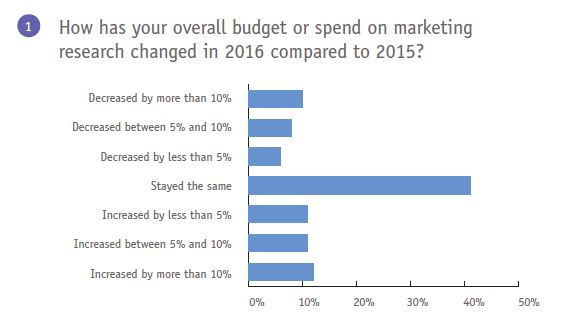
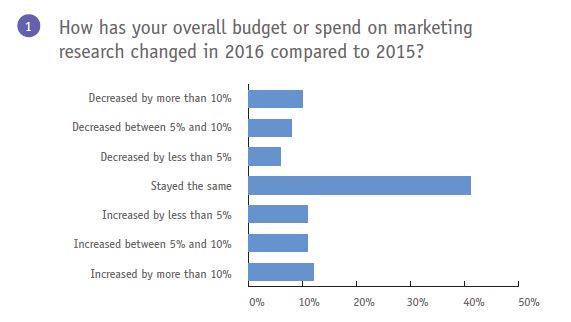
Budgets appear to have held steady again for 2016, with 41 percent saying their spends stayed the same as in 2015 and about equal numbers reporting some sort of decrease (24 percent) or some sort of increase (34 percent). 1
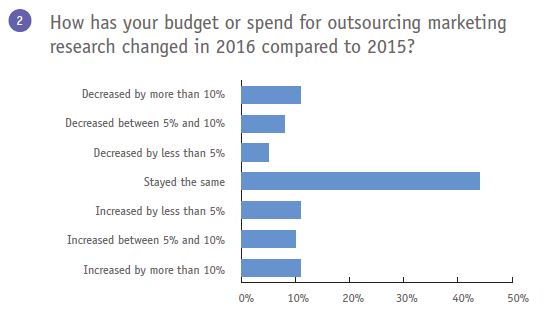
It was status quo for readers’ MR outsourcing budgets as well: 44 percent reported no change; a collective 24 percent reported decreases between less than 5 percent and more than 10 percent and 32 percent cited an increase of less than 5 percent and more than 10 percent. 2
Familiar notes were also sounded in response to a question about pain points in managing and conducting marketing research.
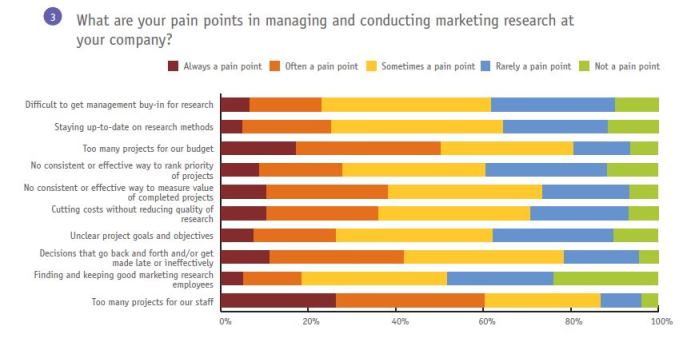
The descriptors “overworked and under-budgeted” have long beenapplied to marketing researchers and our respondents are no different. Nearly 29 percent cited “too many projects for our staff” as always being a pain point and 33 percent claimed to often have “too many projects for our budget.” 3
“We are under constant pressure to synthesize not only our custom, proprietary research but also many, many sources of syndicated [data], including things our executives may just come across.”
“It’s not our company culture to conduct strategic, forward-thinking research, so we end up spending $ on reactive, one-off projects with limited long-term value, rather than investing in studies that will guide company direction and major initiatives.”
"Because of reduced budget, sometimes I feel we have to go with lesserquality agencies, which is definitely a pain point. Also because of reduced budgets, we have been taking on more and more of the ‘grunt’ work – project management, data input. This saves us cost but ultimately is not as motivating for employees who are very skilled managers and should be more focused on strategy, insights and action as opposed to project management. We have the time and capability to take this work on, it’s just not as rewarding or the best use of our time.”
“Management doesn’t realize the amount of effort and time that is required for research projects. Therefore, no additional headcount is ever allocated. They also do not realize the difference between good research and poor research or when to do focus groups versus a survey. I’m pretty burned-out.”
Even in billion-dollar companies, the marketing research function can fall on the shoulders of one person and our readers who are solely responsible for gathering insights shared some of the difficulties they face.
“Being the only research person on staff, who also has various other work assignments, it can be difficult to focus on projects and having time to learn. There’s no one in the company to turn to as a mentor or to be able to learn from, so more and more is getting outsourced to others that are more qualified to do various tasks. I find I don’t really have the time or brainpower to commit to learning complex points in the research process.”
“I’m ‘it’ for market research. Lots of things we could do to improve analytics, transform from descriptive/ inferential to predictive analytics, but not enough time to ‘play with the data’ while doing what is expected.”
As you might expect, aspects of working with vendors were also cited in response to our pain-points question.
“Turning vendor reports into something truly insightful. Vendors are still too much into the mentality of delivering the data and less about what it means and the implications for the business.”
“I find it difficult to find research companies that understand my business and research objectives and provide good client service. Too many large research companies make it too difficult to work with them – I want one senior research expert as my main contact throughout the project. I don’t want to talk to multiple employees and have to explain the research objectives over and over again. I want research that is customized to my specific product category and business needs – I don’t want suppliers to force a cookie-cutter approach. I want a final report that contains a clearlywritten story with implications and recommendations. I spend too much time providing feedback on reports that often feel like a data dump with no cohesive story.”
“Too much turnover within market research companies. You finally get a great research partner team and then they start moving people around.”
“I feel like a lot of our research partners have been dropping the ball with the table stakes (QA issues, missed deadlines, etc.) as of late. I’m not sure if this is due to less resources/ bandwidth, but it is a pretty common issue we have been dealing with recently.”
On a more hopeful front, nearly 29 percent said getting management buy-in for research is rarely a pain point (the highest-cited option) and “finding and keeping good marketing research employees” was most-cited as not being a pain point.
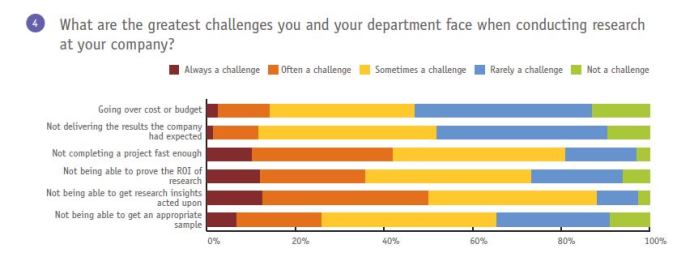
When asked about challenges faced by their departments, not being able to prove the ROI of research, not being able to get insights acted upon and not completing projects fast enough were the top three situations labeled as “always” being a challenge. 4
“A pain point for us is determining which projects are the highest priority for the company, not just the client team we are helping. Need more upper management support to help define key initiatives, allocate the appropriate resources ($, time, people) to those efforts and use insights to apply customer insights in strategic decision-making.”
“Pain points? Internal stakeholders that ignore research results and proceed with their own agenda as planned. Only conducting the first phase of a multi-phase study and then declaring the project complete. Monday-morning quarterbacking of research results (Why didn’t we learn X? Because you didn’t ask X!).”
To their credit, the researchers seem to be able to stay within their budgets – insufficient though they may be – with 40 percent saying cost overruns are rarely a challenge. Nor do they seem to have trouble delivering the results the company expected, as nearly 39 percent said that too was rarely a challenge.
Embrace, adopt and tinker
There are frequent calls for the industry to change and evolve more rapidly and while our research for our Corporate Researcher Report has repeatedly shown that insights pros would love to embrace, adopt and tinker with the newest, buzz-fueled tools, the reality is that their own internal audiences make doing so difficult.
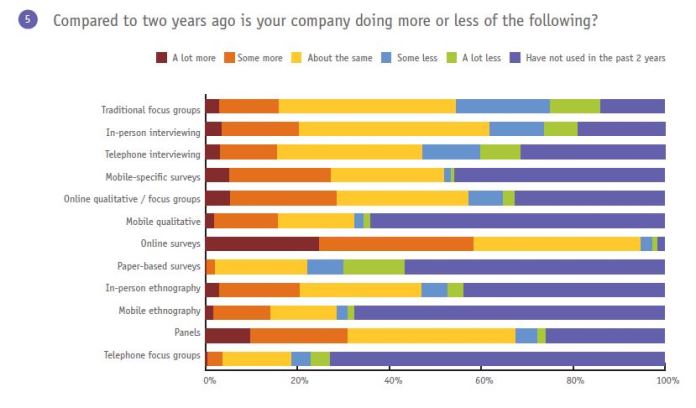
In each iteration of the CRR we’ve asked some variation of a question or questions designed to understand the usage and perceived efficacy of new and existing methods. This time around – and with an eye toward the fact that change doesn’t happen quickly – we asked respondents to tell us how much they were using selected traditional MR methods compared to two years ago. Not too many surprises here, as tech- or Web-based methods such as online surveys, panels, online qualitative/ focus groups and mobile-specific surveys garnered the most “a lot more” usage mentions. In the “a lot less” camp were paper-based surveys, traditional focus groups, telephone interviewing and in-person interviewing, respectively.
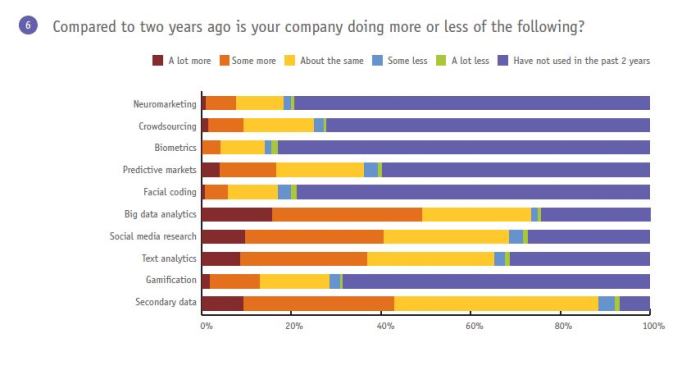
For a similar question on newer, buzzier methods, the top choices in the “doing more of” arena were big data analytics, social media research, secondary research (not exactly a new method!) and text analytics. The methods with the highest percentages of respondents saying they have not used them in the past two years were biometrics, neuromarketing, facial coding and crowdsourcing, perhaps indicating that their appeal may remain at niche levels for the foreseeable future.
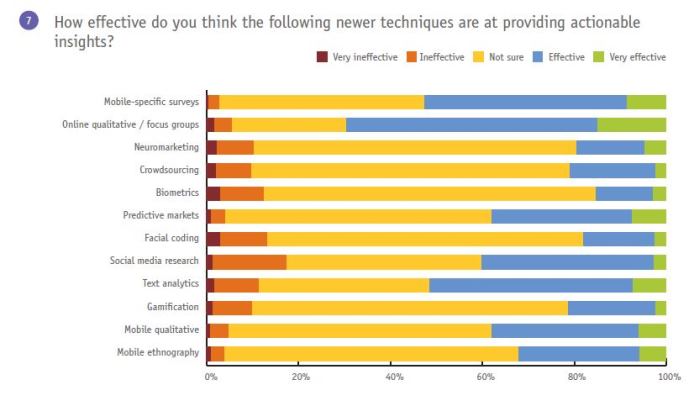
As to a method’s effectiveness, online qualitative/focus groups, mobile-specific surveys and text analytics earned the three highest combined “effective/very effective” totals, with predictive markets and mobile qualitative tying for the next position. Social media research, facial coding and biometrics earned the three highest combined “very ineffective/ ineffective” totals. Tellingly, for about half of the methods, the percentages of those who were not sure of their effectiveness were above 60 percent, perhaps another factor contributing to the difficulty of proving the ROI of MR. 5 6 7
Two different narratives
There seem to be two different narratives around qualitative research these days. It’s either undergoing a renaissance, as certain companies (re)discover the value of speaking to and hearing directly from their customers, or it’s being pushed aside, especially the traditional focus group, as old-fashioned or unnecessary in the social media age. We asked an open-end about that topic, seeking to understand if readers had replaced traditional qual with other methods and, if so, what were their reasons for doing so. Many of the answers were simply one word: no – meaning they have not replaced qualitative methods. Others were happy to elaborate on their current situations.
“We have not replaced traditional qualitative with alternative methodologies but we have certainly enhanced them with alternative methodologies. One thing I find very effective is using video diaries with ethnography. Video is particularly effective in telling the story to internal clients in such a way that they act on it.”
“We haven’t replaced traditional methods but, depending on the scope and objectives, use new techniques as a way to complement the traditional methods. We have used online qual (bulletin boards, communities) to complement in-person ethnography and IDIs.”
“We have replaced a lot of focus groups with online communities.” “
Primary method for qualitative for us is phone focus groups with Web support – allows for more inclusive sample, fewer groups and no travel compared to traditional groups.”
“Focus groups are still our ‘go to.’ (Sigh...)”
“We have not replaced traditional qualitative but have added an online patient panel community, which provides more opportunities for innovative online qualitative and quantitative work.”
"Online community – insights delivered faster, cheaper and engages our most loyal customers. They feel they are adding value to our business. In fact, they are ensuring we remain focused on delivering to their needs.”
“If anything, the cost of traditional qualitative vs. larger quant studies has meant we’ve done more traditional qual recently and have been trying to find quant alternatives.”
“Phone plus Web-based qualitative. Allows you to see respondents’ facial expressions and show them content instead of purely reading content to respondents. Also saves on travel costs. But still not inexpensive.”
Sticking to their guns
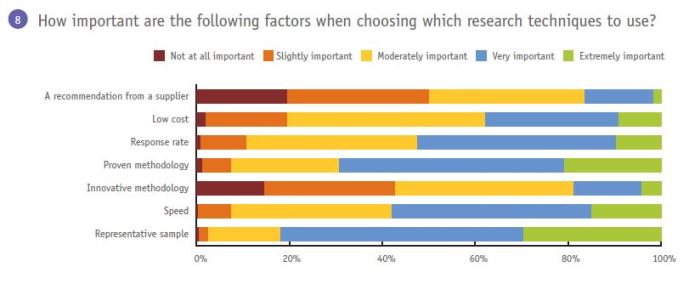
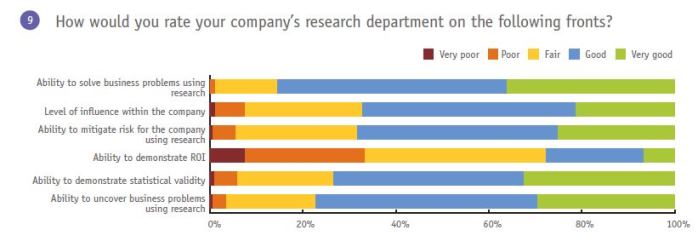
The 2016 data on the importance of various factors in influencing the use of MR techniques echo those of two years ago, when researchers claimed to be sticking to their guns when it comes to the importance of a representative sample, a proven methodology and a suitable response rate. Those three factors rose to the top this year as the most-cited combined “very important” and “extremely important” factors when choosing which techniques to use. The ROI problem cropped up again in response to the question “How would you rate your company’s research department on the following fronts?” “Ability to demonstrate ROI” earned the highest number of “very poor,” “poor” and “fair” votes among the list of choices such as “ability to demonstrate statistical validity,” “ability to uncover business problems using research” and “ability to solve research problems using research.” The good news? High percentages of readers rated themselves as “good” or “very good” at the latter two abilities. 8 9
How do researchers keep current? Attending or viewing Webinars was the top choice, followed closely by “read print or digital magazines and e-newsletters” and, a bit further down, “attend in-person conferences or events.” “Read blogs and Web sites” came next, just ahead of “request information from potential suppliers.”
Specific highs and lows
After inquiring about the generalities of their lives as researchers, we also wanted to get some specific highs and lows so we posed questions about recent wins and disappointments for their departments. Some of these wins should inspire hope for the ROI-demonstrating crowd!
“We launched a product based on consumer insight. However, research revealed that execution of the product (e.g., packaging, messaging, merchandising) was not optimal. The research was pulled together in a very short time within a very limited budget. Research learnings were used to re-launch the product, which resulted in 37 percent increase at POS at one of our major accounts.”
“Validated a market risk and its impact on the company now and in near future. Ran a quick study focused on a single market that we were able to compare to two prior studies. A fresh look at the data from new perspective confirmed the issue and estimated its impact. Senior leadership – while disappointed with the news – was very happy to have that confirmation.”
“Convinced senior management to adopt higher and more targeted measurement standards for our brand-tracking and c-sat studies, on which our company bonuses are partially based. The conversion represented a shift in attitude and a renewed emphasis on research data in decision-making.”
“We did a very exploratory study at a local level in China. We included all our internal teams outside of [the insights function] to attend. One of our key product managers was inspired from a focus group learning and, based on this information, tweaked a current product she was developing. This specific change helped win us a business worth millions of dollars in the long-term so was a very valuable insight and win.”
“We used gamification to study pain points within the purchase decision and test things we could introduce during the decision that could help to overcome pain and convert more business. Our work was presented to the board and was very well-received. We’ve launched a few initiatives directly from the study and project millions in new revenue that we have already begun to see.”
“B2B project with major advertisers and ad agencies that place business for major U.S. advertisers. Using creative, hybrid sample of clients, prospects and sales channel networks, retained two qualitative research consultants to conduct strategic telephone interviews. The net-net is validated company direction from folks who write checks for or influence spending decisions for products our company sells. Research team was applauded for innovative sampling strategy that yielded both insights on paths to continue and those to steer clear of or amend before moving forward. In the process also uncovered a handful of hard, tangible, tactical feedback that other collaborating internal teams can incorporate in their daily work processes to further aid their quality delivery.”
As for disappointments, readers have had a few.
“Research recommended doing shopper research to understand a new category and how consumers shop. However, management turned down the request. Rationale provided was that they can walk the stores themselves to understand the category and that experience from other categories will be used to drive the new category. Cost was also an issue. While research dept. still feels strongly about the recommendation, we could have done a better job getting everyone on board much earlier.”
“Completed consumer research partway through the product development cycle. The consumer said they are not interested in the proposed product but the project is proceeding as planned because it is the division president’s idea.”
“I think the biggest disappointments happen when someone with a big job title feels they need something that is useless and won’t listen. Doesn’t happen very often but when it does, it sucks and wastes time.”
And finally…
"I don’t think anything went wrong with the research. But nothing is being done with what we learned.”
That’s one historical hassle that will likely be with us forever.
METHODOLOGY
The Corporate Researcher Report work life survey was conducted online from June 7 to June 28, 2016, among pre-qualified corporate marketing research (clientside) subscribers of Quirk’s. In total we received 796 responses from which we had 695 usable qualified responses. An interval (margin of error) of 3.7 at the 95 percent confidence level was achieved. (Not all respondents answered all questions.)