

Editor’s note: Grayson Kemper is a senior content developer for B2B research and review firm Clutch, Washington, D.C.

Clutch recently surveyed 300+ small business owners and managers about how they invest in SEO.
According to our research, despite the benefits they provide, many businesses neglect to invest in SEO services and resources that can produce the best engagement with target search audiences.
The survey’s data illustrates that small businesses tend to invest more in complementary or off-site SEO services such as social media marketing rather than services that optimize their sites’ Web pages for SEO.
This article looks at how businesses currently invest in SEO and outlines tips for how businesses should use SEO services to attract, engage and retain online consumers according to their marketing objectives.
Keyword research
Keywords are at the heart of SEO. SEO involves improving a site’s search ranking for keywords relevant to its services and offerings. Though the most basic level of SEO, keyword research is not among the Top 6 most common SEO services that businesses invest in, according to Clutch’s survey.
In the age of e-commerce, keywords represent phrases of intent or phrases that indicate consumer action. There are various levels of intent that demonstrate the level of interest and likelihood a consumer is to convert on a purchase.
Since phrases represent the likelihood that a searcher converts on a given product or service, it’s crucial for businesses to choose the best phrases to target for the level of engagement they desire.
For example, users that search “What is SEO?” are likely in the awareness or interest stages of the conversion funnel – they are collecting information about a service or product that interests them. These are low-intent phrases, in that they do not necessarily indicate that a user plans to act on a given service.
On the other hand, users that search a high-intent phrase like “top SEO companies in New York” likely live in the bottom two stages of the funnel: decision and action. They are considering converting on a product or service and need to take action on the details of that conversion – the provider, logistics and cost.
A business should make marketing goals and objectives to determine the level of intent their target keywords fall under. If a goal is simply to have searchers associate their brand with a given topic, such as SEO, that company should target low-intent, general keywords such as “SEO” or “SEO meaning.”
For companies that want to engage customers at the decision and action phases of the conversion funnel, keyword targets should be high-intent phrases like “top SEO companies in New York”.
Site content
While keywords are the heart of SEO, a site’s content is what actually determines its search rankings. To rank for a target keyword, your site needs to have content that corresponds to the subject of that term.
The most effective way to optimize a site’s content for key terms is to strategically place those terms in your actual content: i.e., in blog posts, in the titles of product pages and in company descriptions.
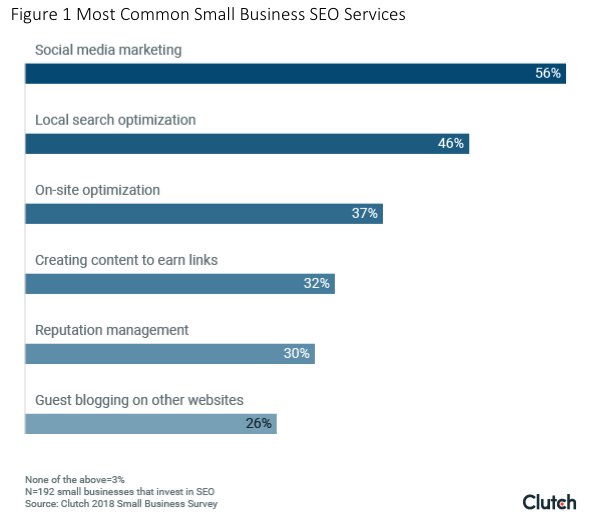
Clutch’s survey shows that 37 percent of businesses invest in on-site optimization (Figure 1).
- Bad: Grayson’s company is an SEO services provider that provides SEO services to small businesses and SEO services to large businesses.
- Good: Grayson’s company is an SEO services provider that has experience with businesses of all sizes. Examples of the some of the SEO services his company provides are …
Successfully integrating key terms in a site’s content signals to Google that the site is relevant to a given search.
Local SEO to target local customers
While they may fail to regularly research their keywords targets, small businesses often target local customers through local SEO services.
Small businesses in particular benefit from local search optimization, since it allows them to engage with their target, local customers. Forty-six percent invest in local SEO services.
Optimizing for local search allows businesses to compete against larger or more established competitors.
One way to optimize for local search is to update listings for local online directories, particularly as it pertains to names, addresses and phone numbers (in addition to hours of operation).
The primary listing to target for local SEO is your Google My Business listing. These listings appear in relevant Google results in the format of the local “three pack” (see image below).
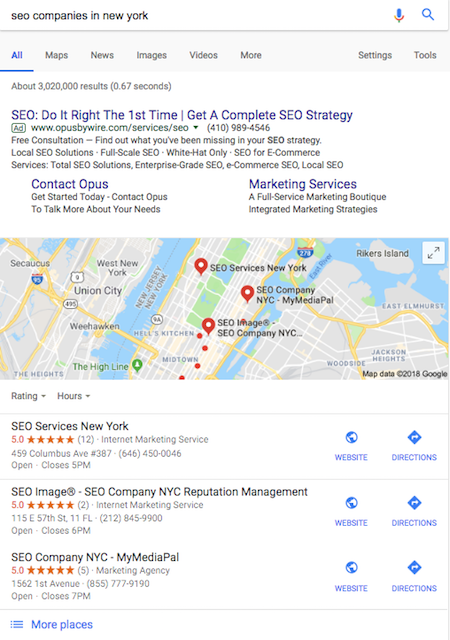
Local three packs are a boon for local searcher engagement. If a company has an optimized Google My Business listing, it is possible to appear for a relevant search within its immediate area.
Off-site, complementary SEO services
An effective SEO strategy is comprehensive: it includes a variety of services that complement each other. Typically, these services are performed externally from a site’s Web pages.
Content marketing and social media marketing are two prime examples of complementary, or off-site, SEO services.
According to Clutch’s data, small businesses invest heavily in complementary SEO services. Over half (56 percent) invest in social media marketing, while approximately one-third create content to earn links back to their site and 26 percent use guest blogging to help their SEO.
Content marketing efforts such as guest blogging allow businesses to drive traffic and earn inbound links. Inbound links act as endorsements of a site’s content, which signals to Google that the site being linked to is an authority on a given topic.
Combined with keyword optimized site content, complementary SEO services like content marketing signal that a site is both relevant and authoritative on a given topic.
Businesses reflect their preference for off-site services in the metrics they track to determine the success of their SEO.
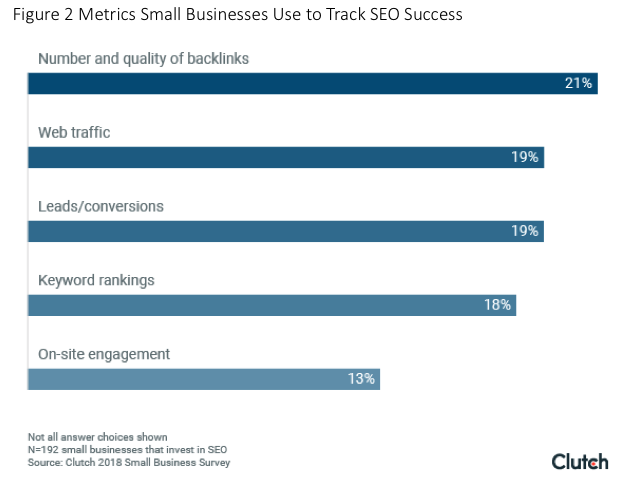
Small businesses measure the number and quality of backlinks to their site as the primary metric to determine the success of their SEO efforts, according to Clutch’s survey (Figure 2).
The reason businesses invest and value off-site services likely relates to their price. Services like social media marketing tend to be cheaper than bringing on an expert SEO company for on-site services.
Paid search
One of the most appealing things about SEO is its organic nature.
Well-designed and maintained SEO allows for long-term organic search rankings that can eventually become self-perpetuating. The higher a site is in search rankings, the more traffic it receives, which in turn further helps it retain its place among top results.
However, starting SEO from scratch is incredibly difficult, particularly for competitive key terms. One way to establish immediate visibility to target search audiences is to conduct pay-per-click (PPC) campaigns.
PPC ads guarantee top results for target search queries. These ads provide visibility for sites regardless of their organic search standings, which make them incredibly useful for smaller or newer Web sites. Currently, less than half (45 percent) of businesses invest in PPC advertising.
PPC campaigns complement a business’ organic SEO. For example, a business can use the results of paid campaigns to determine how format, ad copy and descriptions perform among searchers. A company can then use this insight to inform its organic SEO efforts to achieve similar engagement from this group.
Engage customers
Businesses that target and optimize for relevant keywords and invest in complementary SEO services are well-suited to engage with their target customers through their SEO efforts.
It’s important that a business formats its SEO as an extension of its overall business and marketing objectives.
Whether investing in local SEO for small businesses or national SEO for enterprises, businesses that understand how SEO can be used to engage consumers will remain effective in their efforts. However, small businesses have yet to fully embrace SEO as a beneficial business investment.