
There’s a wonderful buzz throughout the marketing research industry around efforts to improve gender diversity and equality. Achieving a 50/50 ratio of male and female speakers at MR conferences. Saying goodbye to male-only panels. Seeking female representation on advisory boards. And – particularly close to my heart – including more female voices in MR publications.
Quirk’s has been a strong advocate for women since it began serving the industry more than 30 years ago. So when we were asked by several people to take a look at the state of the research industry in terms of gender equality, it seemed natural to include it in our annual Q Report.
Marketing research working environments tend to offer key aspects that women are traditionally drawn to (particularly in qual), such as flexible hours and clear mentoring opportunities. In fact, women appear to comprise a strong percentage of marketing researchers. According to Quirk’s 2018 Corporate Researcher Report and Salary Survey, an invite-only online survey among pre-qualified marketing researchers, 58 percent of client-side and 52 percent of supplier-side respondents identified as female. (This year in addition to fielding the survey to Quirk’s subscribers, ESOMAR sent the survey to its members.) These percentages have remained fairly consistent since we began reporting on the survey in 2014. But are the numbers translating into greater leadership opportunities and equal pay throughout the industry?
The general outlook
Before narrowing in on the MR industry, let’s check out the overall outlook for working women. A study conducted by LeanIn.Org and McKinsey, Women in the Workplace 2017, draws on data from 222 companies employing more than 12 million people, as well as a survey of over 70,000 employees and a series of qualitative interviews. The study highlights two themes:
- Hiring and promotion – “On average, women continue to be hired and promoted at lower rates than men, and at senior levels, the gap in promotions is more pronounced for women of color.”
- Representation and turnover – “The lower representation of women does not appear to be driven by differences in company-level attrition: on average, women and men are leaving their organizations at about the same rate and very few plan to leave the workforce to focus on family.”
A result of the disparities in hiring and promotion, according to the study, is that while women make up a total of 52 percent of the U.S. population, they only fill 20 percent of C-suite roles. In addition, the study found that nearly 50 percent of men think women are well represented in leadership in companies where only one in 10 senior leaders are women. So not only are women underrepresented in the C-suite across all industries, their male counterparts tend to be virtually blind to this fact.
Gender parity and MR
So how is this playing out in the marketing research industry?
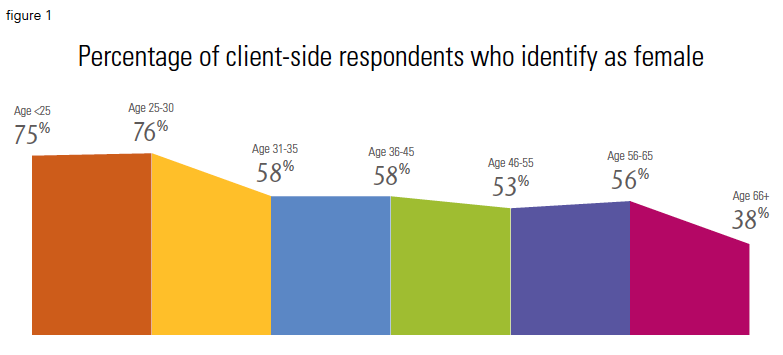
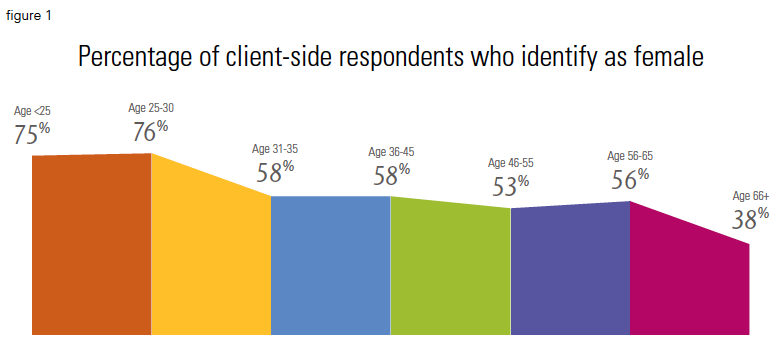
As previously mentioned, Quirk’s 2018 survey found that 58 percent of client-side and 52 percent of supplier-side respondents identified as female. We also noted an interesting pattern when comparing age and gender among client-side respondents. While women make up the majority of respondents at each age level (with the exception of respondents 66+), the percentage begins dropping significantly starting with the 31-35 age group, as shown in Figure 1. Supplier-side respondents show a similar age pattern.
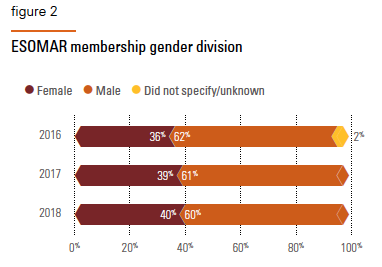
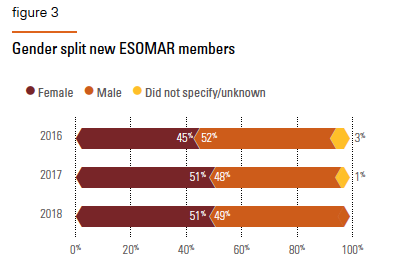
We also reached out to a few MR organizations for demographic data.
In addition to looking at the stats, I contacted a number of researchers – both on the client and supplier side – to conduct short Q&As discussing MR and gender equality. Several client-siders were required to speak anonymously due to internal policies but the general tone was that marketing research is on par with other industries, if not a bit better in terms of overall female representation and leadership opportunity. Christina Jenkins, director of business marketing, North America, Twitter, says, “The market research industry is reasonably balanced in my opinion. As with many industries, we have to continue to work hard to ensure there is balance in leadership positions and women often have to work harder to compete with men in leadership positions in any industry.”
Denise Offutt, manager, market research, at Epson, also shared her thoughts on the role of women in MR and notes several changes since she began working in the industry. “In the larger firms, women have much more opportunity in sales/account management opportunities now,” says Offutt. “When I began work, there were very few women in those positions.”
When asked about gender diversity, Brin Moore, partner at market research recruiting firm Trusted Talent, says, “One of the things that strikes me about our industry is that all the way up the ladder, there are very talented women.”
It seems to be obvious that there is no shortage of capable women in MR. While discussing gender and marketing research leadership roles, Patricia Houston, chief operating officer and founder of MMR Live and member of the WIRexec group, says, “I’d argue that the middle- to entry-level positions in our industry are somewhat female dominated and that flexibility might play a role here.”
The challenge for the industry is now shifting to improving opportunities for women in the way of senior-level positions.
Disparity in promotions
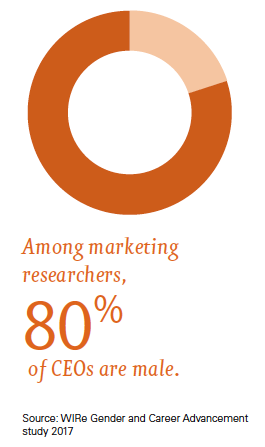
A study by PayScale.com, State of the Gender Pay Gap 2018, found that, “over the course of their career, men move into higher-level roles at significantly higher rates than women. By mid-career, men are 70 percent more likely to be in executive roles than women. By late career, men are 142 percent more likely to be in VP or C-suite roles.”
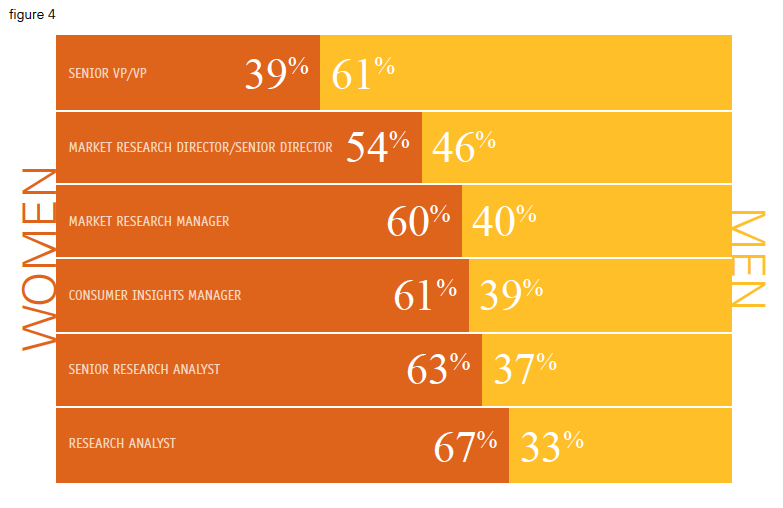
Quirk’s data shows that women are dominating many roles within marketing research, with the exception of VP/C-suite. Quirk’s 2018 survey shows that on the client-side, 39 percent of senior VP or VP respondents were female, compared to MR director/senior director at 54 percent female and MR manager at 60 percent female, as shown in Figure 4. Forty-six percent of senior VP or VP respondents on the supplier side were female and 42 percent of respondents that selected president/CEO/COO were female.**
The pay gap
In 2017, women earned 82 percent of what men earned, according to a Pew Research Center analysis of median hourly earnings of both full- and part-time workers in the United States. Research shows that much of this is linked to the disparity in promotions.
WIRe’s 2017 study looked at the pay gap within the MR industry as compared to its 2012 study and found that the gender pay gap is shrinking at the senior level. In senior roles, the gender difference dropped from $20,000 in 2012 to $8,000 in 2017. The overall pay gap has seen more progress outside of the U.S. with men making 4 percent more than women (all occupation levels) outside the U.S. compared to 21 percent in the U.S. Small firms have further to go to close the gap, with men making 24 percent higher salaries than females (all occupation levels) in 2017.
It should be noted that research shows that the promotion/pay disparity isn’t simply from a lack of trying on the part of women. Women do ask for raises. According to a 2014 study by Harvard University, which was conducted in Australia where employers keep detailed records of employee-asking behavior, women who asked for one obtained a raise 15 percent of the time, while men got their increases 20 percent of the time. (The study examined 4,600 randomly selected employees across 800 workplaces.) This really adds up over a lifetime.
What we can do about it
While there are many people throughout the research industry taking steps to further improve the general outlook of women’s roles in the industry, there is a need for more action.
When I reached out to client- and supplier-side researchers to discuss ways we can all promote diversity in the workplace, they offered a variety of tips:
Find (or become) a mentor. When talking to client-side researchers, WIRe was often mentioned as a way to connect with women and men at all levels. As Twitter’s Christina Jenkins says, the group can become a “part of your trusted circle of advisors.”
Join the conversation. Jenkins also recommends taking to social media to speak up and join the diversity conversation. “It only takes one voice or a single tweet to create a movement,” she says. “#HereWeAre is a great way to connect with other female leaders and become an outspoken ally and advocate of female empowerment.”
Know your worth. When it comes to salary and compensation, do the research and be your own best advocate. “About four years into my first real job, I learned that my pay was about 30 percent less than the product managers who I considered my equals. I dug into the compensation details for the Los Angeles market and made my pitch with charts and statistics,” says Epson’s Denise Offutt. “My director supported my position, spoke with the division president and within 30 days, my pay increased – dramatically! Use your research skills to collect data and make the case.” Offutt also says she always participates in market research salary surveys as the “data can be crucial” for everyone in the industry.
Participate. Practice being assertive by consistently participating in conversations in the workplace. When I asked Patricia Houston about strategies for asserting ideas in the workplace she said her personal mantra is, “If you don’t raise your hand, you’ll never get ahead.” Jenkins echoed this sentiment saying, “Practice, practice, practice and look for champions to help elevate your ideas.”
Seek diversity. Jenkins observes that men and women must seek diversity within their teams and management. “Hiring policies are one of the most effective ways to ensure diversity. Make sure you see people of all backgrounds and genders during the recruitment process and make sure the panel of interviewees is diverse as well,” she says. Houston adds that you can make an impact even without being directly in charge of hiring. “Seek out other opportunities to bring in gender-diverse viewpoints,” says Houston. “Schedule a women executive speaker or start a mentor program.” And remember, diversity goes beyond gender. One client-side researcher I spoke to said the lack of diversity and inclusion of women of color in MR may be the true elephant in the room.
Demand equality at the top. Men and women must consistently push for and seek out diversity in leadership. Sima Vasa, CEO, Infinity Squared Ventures and founder, chief evangelist, Paradigm Sample, says, “Women specifically in the MR industry need to sit on more corporate boards, fill C-suite positions, invest in businesses and/or be more entrepreneurial. This is when we will see the biggest change and movement for gender equality.”
Network. Don’t underestimate the value of old-school networking and personal recommendations. Work to build quality professional relationships – and take steps to keep positive office relationships alive even after you leave a company. “My best advice, irrespective of gender, is to network,” says Offutt. “Do good work, treat people well, develop a reputation as reliable, hard-working and skilled. The opportunities will come to you as there will always be a shortage of good researchers who can solve problems and answer questions.”
I’d like to end with the one tip shared by almost every researcher I spoke to: constantly look for ways to champion your female colleagues. Jenkins provides a great example from her past on why this is vital.
“I encountered a situation once where I jointly worked on a presentation with a male colleague and we were co-presenting at a number of meetings,” says Jenkins. “Several times I was interrupted by the male colleague and no one else in the meeting spoke up. After, I pulled a colleague aside to ask if he noticed anything and he had, yet the meeting continued as if nothing had happened. It was normal.”
A solid reminder that supporting your female colleagues and seeking out diversity in the workplace should be normal. Ignoring opportunity gaps should not.
* The 2017 study included 989 interviews conducted globally. Forty-five percent of respondents were male and 55 percent were female. Visit https://www.womeninresearch.org/wire-gender-career-advancement-2017/ to learn more about the study.
** Quirk’s did not receive a substantial number of client-side CEO responses – this mirrors our audience, which primarily includes practicing marketing researchers – so we chose not to look at those numbers as we cannot comfortably claim that they are statistically representative of the MR population. If you’d like to take a look at the full Quirk’s Salary Survey breakdown and crosstabs by job title, please visit http://www.quirks.com/tools/salary-survey.