Q&A with Rose Isaguirre-San Jose
Editor’s note: Nancy Cox is the founder of Research Story Consulting and former CPG corporate researcher. Her work and play include words, sketchpads, cooking (not baking) and the occasional sock puppet.
Passions, hobbies, healthy distractions and even guilty pleasures – discover how the research community plays and how that plays out in their work life. In the Venn diagram of work and play, what happens when they overlap? Research colleagues share their work and play stories in this interview series by Nancy Cox.
Hello Rose Isaguirre-San Jose, Vendor Relations Specialist/Lead Project Manager, Ebony Marketing Systems
What is the “play” in your life?
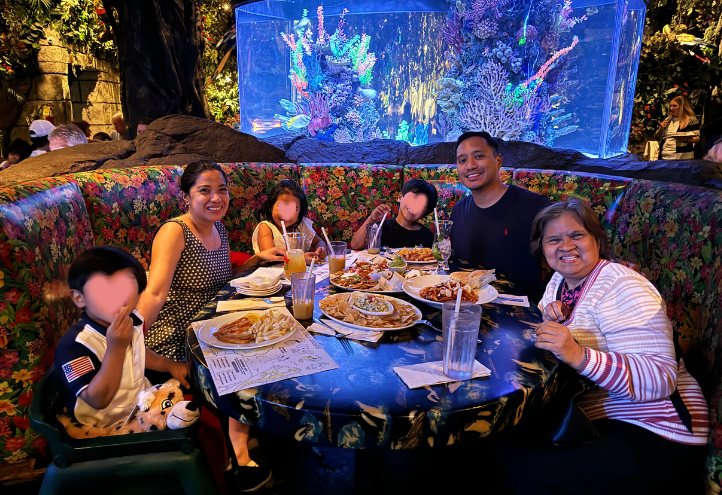
I love to cook for my kids. Because my three kids, ages four, five and seven, are the play in my life. They are my greatest source of joy and laughter. I cook every day because I believe in having a dinnertime together. I grew up in the Philippines, seeing my dad or my mom cooking. Every meal we would all sit down to eat together, my parents, my five siblings and myself. In the United States it’s tough to do that for every meal, so I make sure that at dinnertime we eat together.
I love making Filipino food for dinner. I want my kids to not just be accustomed to American food but also know our Filipino cuisine. An example of a well-known Filipino dish is chicken adobo, chicken stew in a soy-based sauce. Does everyone have their own chicken adobo recipe? Yes and no. Yes, in that when making the sauce, some people boil all the ingredients together while others sauté them first. No, in that there are basic main ingredients of soy sauce, vinegar, black peppercorn, garlic, onion and a bay leaf. It’s adobo sauce if you have those ingredients no matter how you prepare the sauce.
There are some differences in cooking here vs. the Philippines. In the Philippines we cooked rice mainly using a pot and a stove. Here we are spoiled with rice cookers. Rice is not that challenging. Wash the rice then use the same amount of water and rice. I can make rice without any measuring cups. Watching my elders, I learned to use my fingers to measure if the water is enough for the rice. But it’s OK to use the measuring cup! I also rotate with favorite non-Filipino foods like tacos, pasta. We all like those, too!
My children are interested in cooking especially baking together such as banana chocolate chip muffins. My oldest has learned how to make eggs. Now he’s learning how to make sinigang, a tamarind based sour soup. This soup can use any meat – our family version uses beef short ribs or fish. He’s learning to make the base of the soup, and how to prepare the meat but not yet a full-time session of cooking. It does take more time and energy to have children helping with dinner!
Dinnertime is also conversation time in both English and Tagalog – the Filipino language. I didn’t teach my children Tagalog at first as I didn’t want them in ESL, English as Second Language class, at school. Now I am teaching them. I was surprised to find out that they already understand a lot of Tagalog even though they aren’t fluent. They are very good at mixing English and Tagalog in our conversations.
Board games are another important family time with my kids especially chess. I encouraged them to learn chess. My oldest learned all the pieces and all the moves when he was two. It’s easy to plant a seed of learning with children when they are young. They are like a sponge absorbing everything and it will always be a part of them. I am not a chess master, but I can guide my children. Their real chess class starts when they turn five. My children love chess! My oldest, age 7, is a rated player for the United States, now playing in tournaments.
I think chess is more a part of Filipino culture than U.S. culture because we have a board game called dama, similar to checkers, but more like a chess game that only uses the pawns. Playing dama makes it easy to move onto chess. I grew up watching my uncles, cousins and brother playing chess. Then I played more seriously in high school. I was also influenced by my best friend since childhood – his older brother is a chess grandmaster. My friend and I both moved to the United States as young adults, and now he coaches my two oldest children.
How has your play influenced your research work?
Getting dinner on the table every night is definitely like project management! Projects and dinners must be logistically planned. Our dinner also has a firm timeline of 6 p.m. or 5:30 p.m. on chess lesson nights. Same with projects. If deliverables have to be submitted by Sept. 29, then everything needs to be planned and done so the deliverables can be “served” on Sept. 29.
Having children is a big influence on being a project manager. Dealing with kids involves patience and supporting them in their schoolwork and activities. I bring those skills of patience and support into my professional role every day. When I’m managing projects, I have to be calm and patient. I can’t just scream, much as I might like too! Being organized applies as well. I need to be organized so the projects get done. I need to be organized with three kids, each with extracurricular activities such as dance, chess, swimming, basketball and other sports.
My kids reinforce that communication needs clear instructions. Same at work. I need to be clear and instructive with team members, clients and research participants. My work and my play, my time with my children go hand in hand. I am learning from my work and play. Both are rooted within me so I can apply that learning anywhere and everywhere.
What would you tell readers who want to know more about your area of play?
If you have the mind-set that dinner together is how you want to influence your kids, then you will find a way to do it. I do recognize that it can be hard especially when work requires coming home late. I am lucky to have flexibility in working from home full time. My boss, who owns the business, always says, “Family comes first.” It’s part of the company culture that matches well with my Filipino culture. With that support, our team will find a way to cover for each other when focus groups or interviews require a team member during dinner time or when a colleague is taking classes.
I really do use my project management skills for dinnertime. In the morning, I decide what I’m going to have. I don’t wait until dinnertime. What do I need to take out of the freezer? I slice my vegetables in the morning as well. Then I am prepared for when it’s time to cook. On days when I only have 30 minutes to prep for dinner, I rely on my quick meal of pasta with broccoli and some protein. Make it simple and quick.
My biggest motivation is knowing how dinnertime will affect my kids growing up and later in their life. Having a mealtime with my family growing up, I know the impact that had on my life. I want to pass that habit onto my kids. The habit of communicating, the habit of closeness with siblings, with parents. I want my kids to know it’s always family first. And that family time together can also be play!