Editor’s note: Nancy Cox is the founder of Research Story Consulting and former CPG corporate researcher. Her work and play include words, sketchpads, cooking (not baking) and the occasional sock puppet.
Passions, hobbies, healthy distractions and even guilty pleasures – discover how the research community plays and how that plays out in their work life. In the Venn diagram of work and play, what happens when they overlap? Research colleagues share their work and play stories in this interview series by Nancy Cox.
Hello Sue Collin, Senior VP, Director Qualitative Research, RTi Research
What is the “play” in your life?
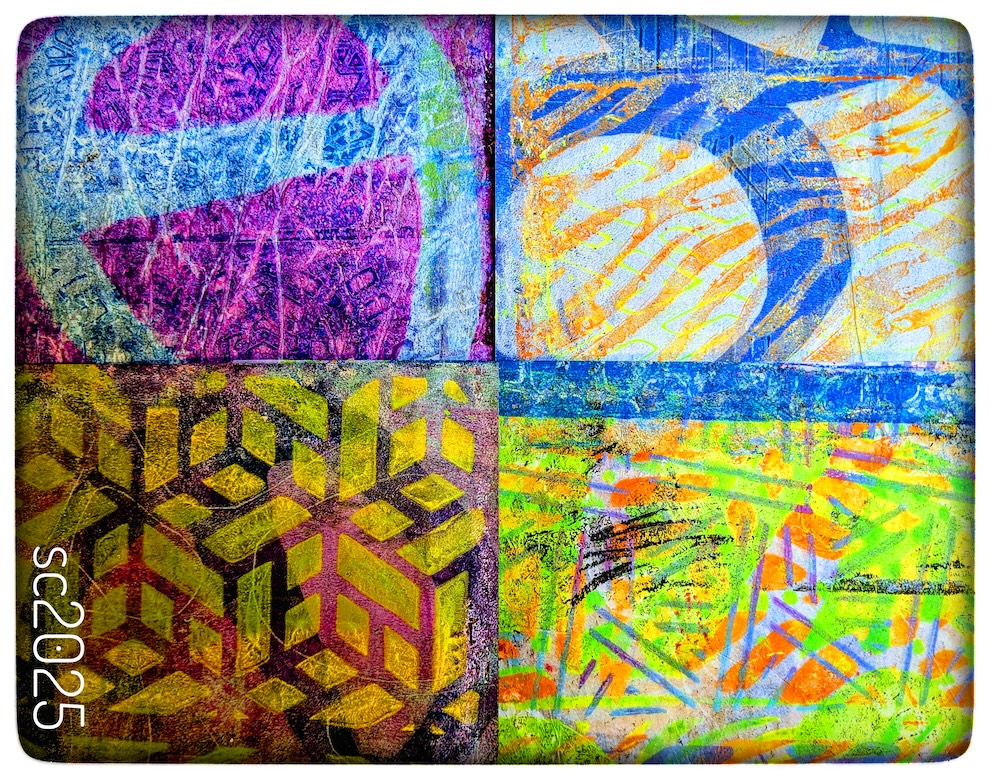
I’m a mixed-media collage artist, a passion and a hobby. After many years of being away from art, I found art again. When I was about seven years old, I was part of a public-school program where I had the opportunity to learn how to draw, use pastels and all kinds of art supplies. And I had a fantastic middle and high school art teacher; I soaked up everything from her. Then I went to college to get my communications degree, and I didn’t touch art for a very long time.
When I moved to New York City, I was inspired to return to art. Every Saturday morning, I studied at a life figure drawing studio, where most of the live models were unclothed. You learn to not judge, to see beauty in all shapes and sizes. Also, we all see differently. Walking around the studio, everyone is drawing the same model yet we all have a different vantage point.
Now I live in Connecticut, where I’ve claimed a small room in my house as my art studio. I wanted to do something different than figure drawing, so I got back to basics. I went to my inner child, somewhere between ages five and 12. Using my hands to move paint around, using all sorts of media from acrylics to water-based to different kinds of crayons and pastels. And lots of collage.
I try to do a collage a week. I use found papers, which can be anything – the inside of an envelope with markings, the menu at a restaurant; take it off the table before you eat! There are still high-quality magazines that have beautiful photography on really nice paper and artistic papers can be purchased at craft stores or on Etsy.
I also make collage papers. I generally take white tissue paper that I’ve bought or that was packing material. Don’t throw out the packing papers! On that paper, I may swirl paint, doodle or stamp. Using tissue paper is like magic! Tissue paper glued down on top of something else makes the white untouched areas transparent leaving only the design added to the tissue. It looks like the designed area is painted onto the collage. When I stamp numbers with black ink on white tissue paper, only the black numbers show up. I use random things to stamp designs — the top of a bottle makes perfect circles. Making papers is very relaxing and if I take time to warm up by making paper, I often get inspiration.
Lately I’ve been turning over a large piece of found or made paper, cutting it into squares. Turning it over before cutting allows you to not focus on the original image. Then I flip over the squares to arrange and rearrange for my collage — seeing new combinations that want to go together. Breaking the pattern to see new patterns.
I layer collages. I might use gesso, an artist’s medium, to cover up some of the pieces. I might put acrylic paint down in different spots even tilting my sketchbook, to drip the paint. I like grungy looking colors like raw umber and white and black for contrast. I make the collage in one sitting, but things may need drying time so part of the process may be coming in and out of the studio. Another way to see things differently – oh, now I want to stencil some flowers on top so there’s a focal point. Then outline the flowers with charcoal or some crayons to give a highlight. In the end, all the papers I glued down as the collage base may be covered up. You may never see them. But that base gave me a starting place, something interesting to look at, something on the page.
At some point, I like the collage. I’m not looking for perfection as it’s about the journey, the joy of making. Going back to being a kid and letting loose. Even if I muddied up something or covered up too much, I learned something. The result may be I’m feeling differently than when I started. I may have begun wanting something calming with a neutral palette, then I got excited, adding bright magenta. I never leave the art room in a bad mood – collaging always lights me up.
How has your play influenced your research work?
My work impacts my art, and my art impacts my work. Collaging is like a puzzle. As a qualitative research moderator, I’m dealing with different personalities with different ways of communicating, different stories to tell. Each interview is like a collage piece. I’ll have customers who are heavy buyers and a similar group of competitive buyers. Which pieces go together and which don’t? I’m layering the interviews as I go. I’m making this analysis collage with mental removable tape – I can always move the pieces around!
Collaging often inspires me to see patterns in my work. Putting down tissue paper with bright doodles next to a menu that has all the colors of the world, it will hit me – how what the heavy buying customer feels fits together with the competitive heavy buyer. The patterns making up the collage of many conversations show up.
I believe that everyone is an artist, everyone is creative. I’m not big on creativity screening questions. I prefer conversational questions. One question I particularly like is, “If you were given a million dollars to write a book on any topic, what would it be on?” That question puts the emphasis on what’s important to that person and it gives you a sense of their talkability in the conversation you’re about to have.
Often in my interviews, respondents declare “I’m not creative but …” then give a story where they’ve created a product or a new way to use a product in rich detail. As the interviewer, it’s a wow moment. We can redefine creativity so that it doesn’t have to include art supplies. What did you whip up for an impromptu dinner party? You’re a nursery schoolteacher, teaching kids how to interact with one another. All of that to me is creativity – it’s just in a different form than a paint brush.
What would you tell readers who want to know more about your area of play?
Get a sense of what you like, the materials you can use and some skill tips by watching collage artists on YouTube. Books can also show you the possibilities. I enjoy Stampington & Company’s “Art Journaling” magazine and “Flow Book for Paper Lovers,” plus the many collage books at the library. Look for inexpensive hands-on classes at community colleges. You can get your feet wet and often supplies are provided.
About supplies – you don’t have to spend a ton of money. Pick up cheap hardware store brushes. Collage in inexpensive school composition books and, all of a sudden, you are art journaling. Catch back-to-school sales or roam the dollar store. The more you collage, you will open to supplies you already have — the bottom of an egg carton as a stamp, saved ribbons and bows, cut up wrapping paper, and bubble wrap to add texture.
Start small. Don’t buy too many things at once as it’s easy to get overwhelmed. One container of supplies, an old tablecloth and you’re good to go! Remember, you’re an artist too!