Editor’s note: Max Cryns is research consultant, and Johanna Azis is head of marketing, quantilope, a New York-based marketing research firm.
Consumers are adaptive by nature. When trends change, they switch the brands and styles they wear. When new technologies are released, they resist, observe a life that can be a little easier or a little better, and they adopt new innovations. And even in the most difficult times, when routines are completely shook they pause – and then adjust spending habits, consumption patterns and how they interact with brands and services that best fulfill new needs and motivations.
This is what quantilope refers to as The Consumer NOW Index – an ongoing series of reactions and adjustments to changing micro and macro events impacting individual lives, families, work, health and a general sense of self.
As a response to COVID-19 and the stay-at-home economy, quantilope has released a weekly tracker for researchers and marketers to stay connected to their consumers' radically changing motivations and needs.*
Impacting consumers
Contrary to expectations about the impact of coronavirus on daily life, consumer sentiment remained relatively positive throughout wave one (March 20-25, 2020) in regards to both current and future outlook. Sixty percent of U.S. consumers reported feeling either very positive or somewhat positive about their current daily life and 69% reported feeling very positive or somewhat positive about their future. However, we’re already beginning to see a decline in positivity among consumers across the board. In wave two (March 27 - April 1, 2020), U.S. consumers who reported feeling either very positive or somewhat positive about their current daily life dropped from 60% to 53% while the percentage who reported feeling very positive or somewhat positive about their future fell from 69% to 63%. As social distancing starts to take its toll, brands should create relatable experiences for consumers and let them know that they are not alone. Sentiment and feelings should be monitored closely as the situation continues to wear on individuals.

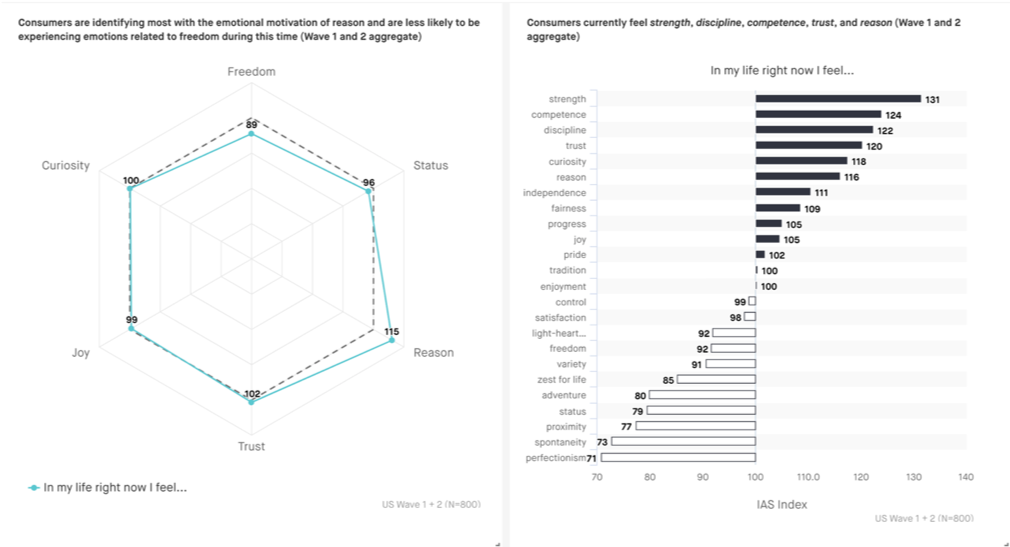
The implicit single association test (SAT) in the index reveals that consumers are identifying most with the emotional category of reason and are less likely to be experiencing emotions related to freedom during this time (waves one and two aggregate). In the SAT, emotional motivations are measured by their implicit association strength. Emotions with an index value over 100 are associated with current feelings at an above average rate, while those with an index score below 100 are less associated with current feelings. With this, we see that consumers currently feel specific emotions of strength, discipline, competence and trust, each with a score over 120 (waves one and two aggregate).
During this time, marketers should focus their communications around rational aspects of a consumers' underlying emotional motivations – it won't feel right for consumers to see messages about spontaneity and adventure. As they live a quarantined lifestyle, consumers are seeking guidance and trust. Leading brands will echo these feelings, while also reminding consumers of the little, rewarding parts of everyday life to keep them motivated.
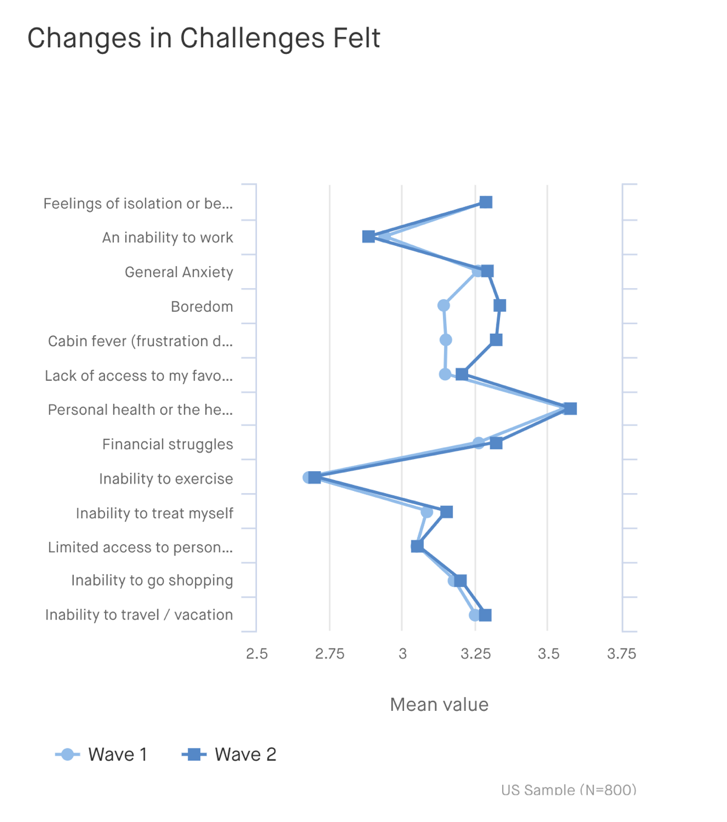
Between wave one and wave two we saw an increase in the extent to which consumers are challenged by boredom and cabin fever. An inability to treat oneself should also continue to be monitored and brands should consider encouraging self-care – it's OK to promote the little things that drive positivity and create distractions from the outside world. As boredom continues to take over, identify the products, technologies and actions that resonate for various groups to alleviate these escalating challenges and make the new normal feel, well ... more normal.
Methodology note:
The Consumer NOW Index tracks 1,200 consumers across the U.S., the U.K. and Germany. Based on neuroscience research, the Single Association Test (SAT) is an implicit research method used to uncover subconscious associations towards a category, brand or product. An SAT measures which items (e.g. qualities, traits, emotional goals) consumers associate with a single brand, category or concept.