Rethinking emotion-led marketing
Editor’s note: Tom Ellis is CEO of insight consultancy Brand Genetics.
For the last decade, the marketing and insights industry has been obsessed with emotion. We have mapped "joy," tracked "surprise” and measured "delight" down to the millisecond. We operate on the belief that if we can trigger the right fleeting emotion, the sale will follow.
But we have been missing the forest for the trees: moods. Moods are the persistent feelings (affective psychological states) that color our lives and shape our daily decisions – from what to eat to what to buy. While we have been analyzing the weather (emotions), we have ignored the climate (moods).
Research at Brand Genetics reveals a critical shift: consumer behavior is increasingly driven by the active desire to regulate these moods. In the era of permacrisis, people are not just buying products and services; they are buying mood management tools.
It is a phenomenon with massive reach: in a study that spanned 23 countries and over 114,000 adults, nearly 80% said they made at least one splurge purchase to lift their mood in the past month. If you are only measuring or marketing to emotions, you are missing a significant part of the decision-making process.
The science of mood: Why emotional marketing isn't enough
To understand the shift, we must first distinguish between two psychological forces that marketers often conflate: emotions and moods.
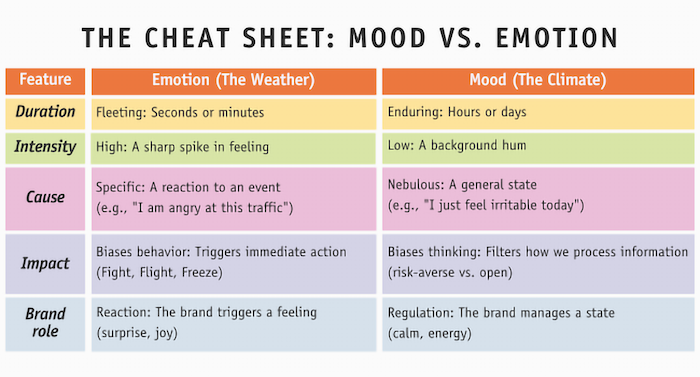
Think of emotions as the weather. They are intense, fleeting reactions to specific events – a flash of anger at a delayed train or a burst of joy at a discount. They happen to us.
Moods are the climate. They are persistent, low-intensity states that hang in the background, often for hours or days. They don't always have a clear trigger; you can simply wake up in a "bad mood" but because they linger, they act as a persistent lens, coloring every decision we make for hours at a time.
While emotions tend to hijack our behavior (we act before we think), moods hijack our cognition (they change how we think, which then changes how we act).
If you are only marketing to emotions, you are waiting for a storm. If you market to mood, you are designing for the season.
The cheat sheet: Mood vs. emotion
If you want to influence behavior, you need to know which psychological lever you are pulling.
The rise of the mood generation
Why does this matter now? We are witnessing a mental health crisis that is having a significant impact on consumption and signals the growing importance of mood management.
Mood disorders – including depression, anxiety and bipolar disorders – are on the rise globally, with recent evidence showing marked increases since the COVID-19 pandemic and especially among younger populations.
In the U.S., a survey found that around half (47%) of Gen Z say they often or always feel anxious, and over one in five (22%) feel depressed regularly. A 2025 study reported that the prevalence of anxiety disorders in the U.K. increased by 55.6% over 12 years, and mood disorders by 80% in some cohorts, with the steepest increases seen in young adults aged 16–25 years (the core of Gen Z).
Allied to this, we have data showing nearly half (47%) of U.S. consumers explicitly admit to "retail therapy" to fix their mood. This creates a new responsibility – and opportunity – for marketers.
The opportunity for brands: Mind the mood gap
Consumers are constantly trying to bridge the gap between how they currently feel and how they want to feel – the mood gap.
Brands that help people close this gap unlock a powerful new tier of relevance. This isn't about emotional benefits; it is about functional mood regulation.
To win, brands must adopt one of two strategies:
1. The shift strategy (repair)
- The goal: Move the consumer from a negative mood to a neutral or positive one.
- The strategy: When people feel anxious or low, they often feel helpless. They crave a sense of agency. Brands need to offer them a sense of control (autonomy) and capability (competence).
- Examples:
- Domino’s (with its Pizza Tracker) and Uber don't just deliver food – they deliver certainty and control in a chaotic world.
- Features like “dark mode” or “do not disturb” are not just user interface design choices; they are tools that give the user the power to shut out the noise.
2. The reinforce strategy (sustain)
- The goal: Help the consumer hold onto a positive mood for longer.
- The tactic: When people are in a positive mood, their psychological aperture widens. They want to share that feeling and explore new things. As such, brands should offer them connection (relatedness) and discovery.
- Examples:
- Brands like TikTok or LEGO succeed here because they provide a playground for shared creativity, prolonging the "high" of connecting with others and discovering something new.
Designing for the mood economy
Moving forward into 2026, we must recognize that "emotional connection" is too vague a brief. Brands that can recognize, respond to or even shape consumer moods stand to gain a competitive edge. To do this we need to get specific about mood mechanics.
- Understand your mood context: Moods follow rhythms: Monday blues vs. Friday highs, morning grogginess vs. evening relaxation. Indeed, the recruitment company, runs ads on Monday mornings because they know that is when job dissatisfaction (mood) peaks.
- Audit your sensory cues: Scent and sound bypass the rational brain and hit the mood centers directly. Every touchpoint needs to set the tone. Are your sensory codes calming a stressed consumer, or overstimulating them?
- Review your promise: Move beyond the functional benefit, and even the emotional payoff to think about the mood shift: Spotify’s curated mood playlists or Magnum’s mood-inspired flavors explicitly cater to this need
Consumer research in the mood economy
We are entering the mood economy. The brands that win will not be the ones that simply make people "feel something" for a fleeting second. They will be the brands that act as reliable partners in the daily struggle for psychological balance – and help them close their mood gap.