Revealing the truth from consumers
Editor’s note: Nitin Sharma is the CEO of Gold Research Inc. Find Nitin on LinkedIn. Greg Tucker is the chief journey mapper at Gold Research Inc. Find Greg on LinkedIn.
As companies design and execute customer journey research, the ability to ask critical questions to uncover the challenges shoppers and customers experience that will illuminate and quantify business opportunities is essential. These questions are likely to differ from traditional questions that are typically asked in market research or through brand trackers.
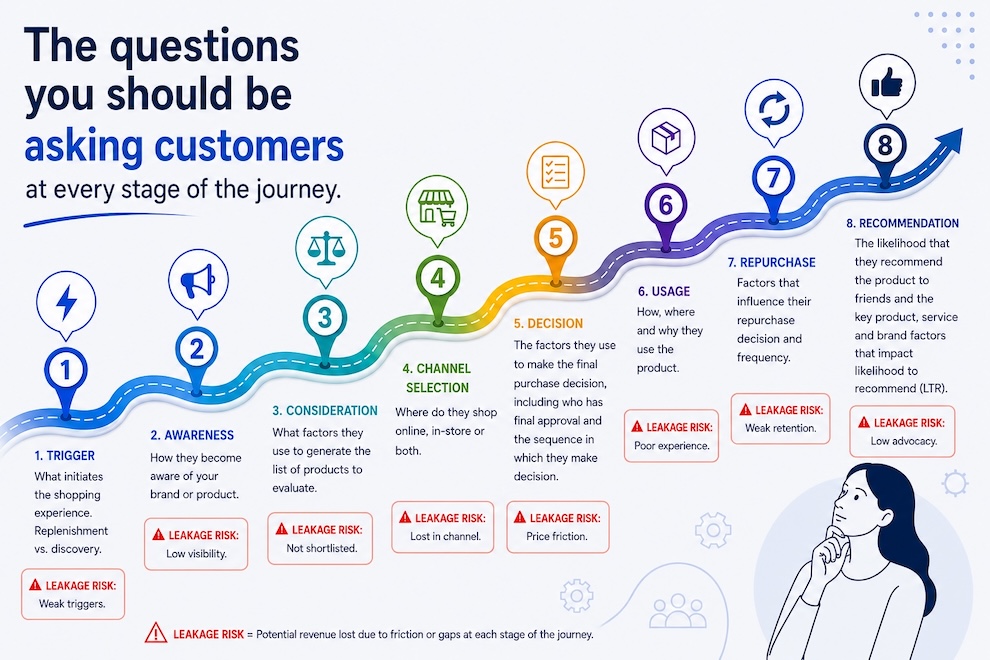
After conducting interviews and research with over 100,000 shoppers and customers, our team identified that they go through eight predictable stages of their journey with any product or brand.
These stages include:
- Trigger – What initiates the shopping experience. Replenishment vs. discovery.
- Awareness – How they become aware of your brand or product.
- Consideration – What factors they use to generate the list of products to evaluate.
- Channel Selection – Where do they shop online, in-store or both.
- Decision – The factors they use to make the final purchase decision, including who has final approval and the sequence in which they make decision.
- Usage – How, where and why they use the product.
- Repurchase – Factors that influence their repurchase decision and frequency.
- Recommendation – The likelihood that they recommend (LTR) the product to friends and the key product, service and brand factors that impact LTR.
In each stage, our research identified specific questions for each stage that can help uncover revenue opportunity for global brands.
The customer journey: Questions that uncover opportunity
Below are examples of questions that have been used to capture critical customer journey insights that have led to uncovering opportunities to service customers better and generate dramatic improvements in revenue and profits. Of course, each of these much be specifically tailored to the company, target customers, products/brands/services and channels.
- Trigger
- What would initiate your plan to shop for or purchase this product?
- Potential responses: Replenishment, always need to have on hand, request by family member/business leader, etc.
- What would initiate your plan to shop for or purchase this product?
- Awareness
- How did you originally become aware of the brand, product or service?
- How do you collect the set of brands or products that you would consider shopping for?
- Potential responses: Online search, social media, talked to friends, guided by recipe (B2C) or by technical specifications (B2B), etc.
- Consideration
- How do you collect and select the set of brands or products that you would consider shopping for?
- What factors do you use for collecting or filtering the brands or products that you would consider shopping for?
- Do you typically have a preferred brand or set of brands?
- Who is involved in informing the set of brands or products for consideration?
- What actions did you take during the consideration process
- Potential responses: Online search for product information, price, competitive products, customer reviews, etc.
- What challenges or friction points did you face during this process? Which of these impacted the products or brands you considered?
- Channel selection
- Where do they shop (in-store or online)?
- Why do you select those options?
- Potential responses: Convenience, past usage/buy again capabilities, preferred service level, best pricing, good selection, location, security, hours, delivery, online ordering and pickup, etc.
- What type of shopping trip(s) do you plan for the purchase of this product or brand?
- Potential responses: Special trip/appointment, part of a larger shopping trip, quick pick-up trip, etc.
- What challenges or friction points do you face in selecting that store or channel?
- Decision
- What actions did you take during the decision process? (online search for product information, price, competitive products, customer reviews, etc.)
- What factors do you use to make the final purchase decision? (List including price, total installed cost, quality of product, packaging, warranty, customer reviews, advice at POS, etc.)
- What challenges or friction points did you face during the decision process? Which of these impacted the products or brands you decided to purchase?
- In what order did you use these factors to make your decision? (No. 1 = made this decision first, No. 2 = made this decision second, etc.)
- Did you decide to purchase the brand you intended before shopping? If not, why did you switch brands?
- Who all was involved in the final decision process? What were their roles?
- Usage
- How did you use the product? (Use a description or checklist.)
- Was the delivery of the product on-time and error free?
- Who all used the products or services?
- What is your satisfaction level with the product? (Scale of 1-5.)
- Did you have any usage issues that required calling service / support?
- What challenges or friction points did you face during product/brand usage?
- Repurchase
- What is your likelihood to repurchase this product, service or brand? (Scale of 1-5.)
- What are the factors that influenced your likelihood to repurchase? Use a checklist response format.
- With what frequency will you likely repurchase the product?
- Recommendation
- What is your likelihood to recommend (LTR) this product, service or brand to a friend (B2C) or business colleague (B2B)? (Scale of 0-10.)
- What are the factors that influenced your LTR? Frame this as an open-ended question.
- By which channels or methods have you recommended products, brands or services similar to this? (This should be a list format, including word of mouth, online reviews, post to social media, professional recommendations, public reference statements/case studies, etc.)