
Enthusiast or Fence-Sitter?
Editor's note: Lloyd Wohlner is executive director at TVG Marketing Research & Consulting LLC, West Norriton, Pa.
So you have a successful product on the market and your R&D people have come up with a new, improved formulation. In most cases, your best prospects to buy the new product are the people who regularly buy the current product. But maybe there are others who might buy it who you’re not currently reaching. And if there are other potential customers for the new product, how do you reach them and what do you tell them about it?
Our client has a market-leading medication and is developing a new delivery mechanism with certain clinical improvements. The firm has already identified target specialist physicians to whom it actively promotes the current brand. It asked us for help identifying the right physicians to whom to promote the new product. Some of the questions that needed answering included:
- Should the firm approach the same physicians it currently targets or are there other prime candidates?
- Where are the target physicians located?
- What is the best way to reach them?
- Are there certain patients who would be more appropriate to use the new product?
These and a host of similar questions come up as part of marketing planning for any product line extension. And one way to answer such questions is segmentation.
Segmentation is frequently used to find subsets of customers who share common product needs and identifiable characteristics. This allows the marketer to select and promote profitably to appropriate target market subsets.
We worked with our client to develop an online survey of specialists, physician assistants and nurse practitioners. The goal of the research was to identify characteristics of prescribers who would be more likely to use the new product, the types of patients they see as most appropriate for the new product and determine where these target prescribers are located and how best to reach them.
Obviously, we couldn’t survey the entire population of prescribers in the U.S., so one key deliverable from the research was a typing tool that sales representatives could use to characterize any physician or physician extender into the more-likely or less-likely segment and then approach them appropriately.
In addition to asking the prescribers to rate themselves on various behavioral and attitude scales, our survey included our Patient Chart Capture methodology. For this portion of the survey, respondents are asked to extract information from the charts of a small number of actual recent patients. In this case for: a newly diagnosed patient; one who was recently prescribed the client’s current product; and one who was recently prescribed the main competitor product.
Using this approach allows us to collect information on patient populations and treatment patterns. It generates a comprehensive dataset that depicts the sequence of therapy events from initial diagnosis to the most recent patient visit. It also collects demographic information that can be compared to treatment choices. It focuses the respondent’s attention on specific patients, actual patient characteristics, actual prescribing behavior and reasons why the treatment decision was made. This helps to control for the likely overstatement of future product use that can happen when asking “What percent of your future patients will likely receive this new medication?”
Importantly from a legal standpoint, this approach retains patient anonymity so HIPAA rules regarding patient privacy are not violated.
Critical measures included
We worked closely with our client to develop the questionnaire so that critical behavioral and attitudinal measures were included. Some of the topics in the questionnaire were:
- general practice profile;
- current patient allocation across competitive products;
- agreement/disagreement with a battery of attitudinal questions on the treatment area;
- physician and (perceived) patient preference for various delivery vehicles for medication;
- perceived differences between current treatment options; and
- Patient Chart Capture information from three recent patients treated for the condition.
The Patient Chart Capture questions included: age; gender; subtype of the condition; current treatment; prior treatment; insurance type; whether current treatment was add-on or replacement; and concomitant treatments for the condition.
After reviewing a profile of the new product, the respondents were asked what they see as its potential advantages and disadvantages, their level of interest in using it and, finally, the likelihood they would consider it for each of the three specific patients they had profiled earlier in the survey.
The client provided us with its current target list of specialists and NPs/PAs; this list was matched against the field service’s panel of prescribers. The survey was fielded initially to the match between current targets and the panel and later opened to the rest of the panel. In this way we could see whether there were potential prescribers of the new product not on the client’s current target list. The final sample yielded a total of 349 respondents, subdivided as shown here.
| Total | Targets | Non-Targets | |
| MD Specialists | 299 | 146 | 153 |
| NPs/PAs | 50 | 11 | 39 |
Identify and profile good targets
The goal of this research was to identify and profile good targets to whom to promote the new product, as well as to find out which types of patients these physicians think are the best candidates to receive the product. To do this, we conducted two segmentation analyses, one on the prescribers and one on the patient profiles.
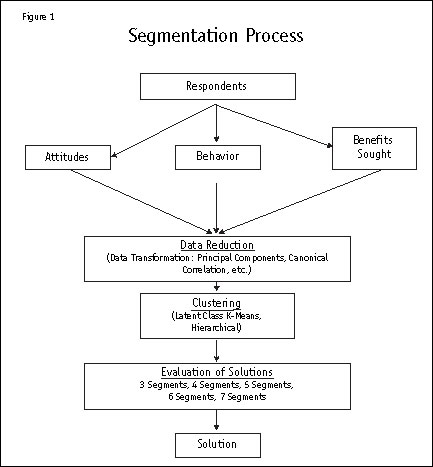
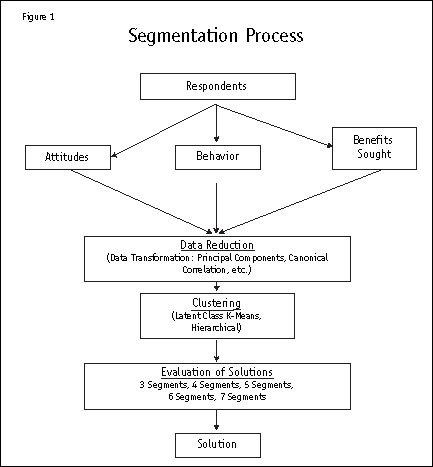
Segmentation is a multi-step process, ideally involving a number of different measures, both behavioral and attitudinal (Figure 1). Some have approached physician segmentation strictly on behavioral variables, usually the share of prescriptions for the various brands in a particular class of drugs. Unfortunately, given the influence of managed care organizations on prescribing, based on which brands the insurance companies will cover, as well as variations in how often the different sales representatives call on the physician, this sort of behavioral measure can change over time rather than define clear, identifiable and stable segments. Attitudes and desired benefits tend to change less over time, hence are more useful in segment identification.
Prescriber segments were identified using K-means clustering; two-, three- and four-segment solutions were evaluated on Bayesian and Akaike information criterion measures; the two-segment solution was found to best fit the data based on these criteria.
Since segmentation is both art and science, several different analyses were run, including and excluding different items from the questionnaire. Questions from the survey were put into the segmentation analysis if they seemed likely to help differentiate groups of respondents and dropped from the analysis if it turned out they did not contribute any differential value. Items that went into the final prescriber segmentation analysis include:
- share of recent patients receiving our client’s current brand;
- answers to a battery of attitude questions;
- role of current brand and a key competitor in practice (e.g., first choice, an option, etc.);
- perception of patient preference for various delivery vehicles;
- level of interest in Product X based on a product profile;
- share of upcoming patients likely to receive Product X;
- likelihood to prescribe Product X for the three specific patients described in Patient Chart Capture.
Substantial number were hesitant
Based on the differences between the two segments, we labeled them as Enthusiasts and Fence-Sitters. Only a few physicians were outright rejectors of the new product but a substantial number were hesitant, both in their overall interest in using the product as well as their likelihood to use the new product for each of the three patients they brought to the survey.
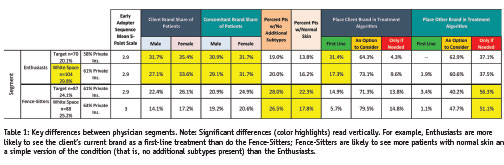
Several factors clearly differentiate the Enthusiasts from the Fence-Sitters; the key differences are yellow-highlighted in Table 1. Note that differences read vertically in the table.
- Enthusiasts are more likely found among “white space” professionals not on the client’s current target list.
- Enthusiasts have a higher share of their patients on the client’s current product; this is important since the target list is based primarily on prescribing volume, not share.
- Enthusiasts also have a higher share of their patients on another brand that is sometimes used concomitantly in treating this condition.
- Enthusiasts are more likely to have patients with complex versions of the condition, patients with more than one subtype of the condition present at the same time.
- Enthusiasts are more likely to consider the client’s current brand as a first-line treatment and are less likely to consider one of the competitor products as an “only if needed” treatment option.
First, note that there are substantial numbers of Enthusiasts among “white space” prescribers, those not currently on the client’s target list.
The survey asked the ZIP code of the respondent’s practice. From this we were able to determine who practices in major cities, the suburbs and smaller cities and towns across the country. Given a finite number of sales representatives, and the extensive geography of some of the sales territories, it’s not surprising many physicians and physician extenders practice in places the sales representative can’t readily reach. Picture a physician in Scotts Bluff, Neb., 400 miles away from Omaha and 200 miles from Denver; it’s highly unlikely a pharmaceutical rep will easily get there. But many Enthusiasts practice in areas like this.
How do you reach these potential prescribers in a cost-effective way? We also asked all the respondents how they like to obtain information about new products. The Enthusiasts, as it turns out, are more willing than the Fence-Sitters to obtain information via e-detailing and mail from the company medical department. Here is a ready-made way reach the Enthusiasts who practice in somewhat remote areas.
Draw a picture
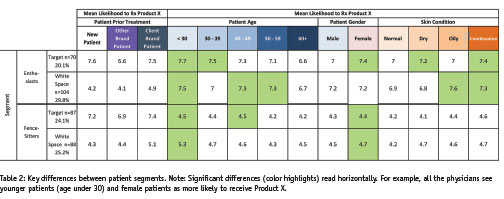
After the respondents had reviewed the Product X profile, they were shown the Patient Chart Capture information they had provided and were asked for each of their own patients how likely they would have used Product X for that patient had it been available the last time they made a treatment decision for the patient. This allowed us to understand the types of patients the respondents themselves see as good or bad candidates. This helps rein in respondents’ tendency to acquiesce and be overly agreeable in their answers.
We were able to draw a picture of what these professionals see as better candidates for Product X, allowing our client to develop sales material highlighting just that type of patient and helping improve the likelihood that prescribers would have a solid idea in mind of a patient and be willing to offer Product X when they see patients like this.
The ideal patient for Product X is a younger woman with combination skin; she could be equally a newly-diagnosed patient, one on the client’s current brand or, slightly less likely, a patient currently using the main competitor brand.
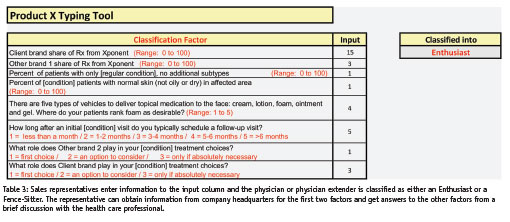
Identifying who is and is not a likely user for Product X among a sample of 350 prescribers is nice but it isn’t any help to the sales representatives who are calling on medical offices around the country. Therefore TVG developed a typing tool, using a small number of items from the segmentation analysis. The sales reps can enter information on the physician or physician-extender they are calling on and determine whether they are talking to a potential Enthusiast or Fence-Sitter. Knowing this, they can adjust their sales message accordingly and either focus on the benefits of the new product or reinforce the beliefs in the current brand.
The typing tool is a simple Excel file; the sales rep enters some information they obtain ahead of time from headquarters on current prescribing in the therapeutic area and gathers additional information from the potential prescriber (usually based on prior discussions about the client’s current brand). The Excel file then indicates whether this person is more likely an Enthusiast or a Fence-Sitter.
Successfully introduced
Along with research on positioning, message platform and creative concepts, our client has successfully introduced its new product to U.S. physicians. Using the results of the segmentation research, the launch material profiles the ideal patient candidate. In addition, there are messages developed to reach out through other media to potential prescribers who aren’t reached by the sales force. We wish our client well as it grows its new product.