
Studies delve into trade schools, helicopter parents, early education and HENRY’s
Editor’s note: John Gerzema is the CEO of The Harris Poll. This is an edited version of an article that originally appeared under the title “Kids Are on Phones Because They Can’t Go Outside, Will Gen Z Turn to Trade Schools? Even the Wealthy Worry, & Parents Now Emphasize EQ to Fight AI.”
More than eight in 10 (84%) of Gen Z say they want to escape their phones to live more in the real world, and they appreciate brands that use tech to make this happen. In tandem, Starbucks is eliminating its Gen Z favorite mobile-only pickup stores, as CEO Brian Niccol noted, “They felt too transactional and lacking the warmth and human connection that defines our brand.”
We have four new stories from our polling this week:
- “To get kids off phones, we need to get them in the real world first,” says Anxious Generation author Jonathan Haidt and the Harris Poll in The Atlantic.
- Trade skills might be better for many Gen Z than college, but they need a better pitch.
- Americans making over $200k+ worry about their retirement in a new Harris study with Nerd Wallet.
- In today’s AI-driven world, parents are shifting their calculus on pre-K education to emphasize creative thinking and social skills, according to Bright Horizons/Harris Poll.
Helicopter parents aren’t helping: Kids want to experience the real world on their own
More freedom in the real world would get kids off their phones.
Background: We talked to a unique group of Americans whose perspectives we don’t always hear from – children (eight to 12 years old).
Digital freedom exceeds freedoms IRL
Three-quarters (75%) of American children ages nine to 12 say they regularly play the online game Roblox, but still, most aren’t allowed to be out in public at all without an adult.
Fewer than half of the eight and nine-year-old’s have gone down a grocery-store aisle alone and more than a quarter aren’t allowed to play unsupervised, even in their front yard. Yet these are precisely the kinds of freedoms that kids long for. More children told us they would rather spend time with friends in-person through free play (45%) or organized activity (30%) over online interactions (25%).
Takeaway: “This digital technology has given kids access to virtual worlds, where they’re allowed to roam far more freely than in the real one. Children want to meet up in person, no screens or supervision. But because so many parents restrict their ability to socialize outside on their own, kids resort to the one thing that allows them to hang out with no adults hovering: their phones. Kids will always have more spare hours than adults can supervise – a gap that devices now fill. ‘Go outside’ has been quietly replaced with ‘Go online.’”
Skilled trades lost on Gen Z
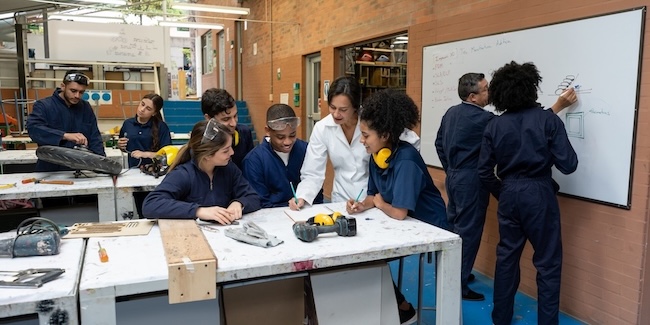
While AI is wreaking havoc on entry-level jobs, today’s younger workers are often misinformed about the opportunities of a trade career. Nearly four-in-10 are bullish on a trade career. Thirty-eight percent of Gen Z believe skilled trades offer the best job opportunities today, and (36%) say that skilled trades offer a faster and more affordable path to a promising career. However, just a fifth (22%) of Gen Z recommend vocational/trade school career paths to high school grads.
Do trades need a better pitch?
The U.S. is facing a severe shortage of skilled tradespeople – especially in the manufacturing and construction sectors where the lack of carpenters, welders, masons, plumbers and electricians takes a toll on project timelines and budgets.
Skilled trades are highly respected as 91% of Americans agree that trade jobs are just as important to society as white-collar jobs; however, almost as many (86%) agree that skilled trade careers are overlooked in schools today. View the full findings here (registration required).
Takeaway: The misperception among younger workers is an issue for employers, who say they need people in skilled trades. Gen Z view these jobs as less prestigious than those requiring a four-year degree. Many lack knowledge about them and have doubts about their pay and, unique to Gen Z, the group is concerned that the jobs offer little security and flexibility.
High Earner, Not Rich Yet (HENRY): Earning well but not succeeding
As tariffs, inflation and career uncertainty dominate public anxiety, even the well-off are not immune. Today, if you make good money, but still worry about falling short in retirement, you might be a HENRY (high earner, not rich yet). Three in 10 (30%) of non-retired HENRY’s aren’t confident they’ll have enough money to retire comfortably, despite their high earner status ($200k+ HHI). HENRY’s have an ill-defined goal: Only four in 10 (41%) of HENRY’s with retirement accounts have a specific retirement savings goal amount.
Holding steady: Only 16% of HENRY’s with retirement accounts decreased their retirement contributions in the past twelve months, while the same number (16%) haven’t changed the investments in their accounts since opening.
Takeaway: “Even though HENRY’s earn above-average money, they often face higher expenses living in costly areas,” says Kate Ashford, investing specialist for NerdWallet. “They also may have higher student loan debt and fewer years in the workforce due to the schooling required to land their high-earner jobs. Combined with lifestyle creep, these challenges can make it harder to save enough for retirement.”
Social skills as important as ABCs: Parents on early education
In today’s AI-driven world, parents are rethinking the role early education plays in preparing their children for lifelong success, as seen in our latest work with Bright Horizons (view here).
Esteem is the new IQ
Eighty-two percent of parents believe that children entering kindergarten with confidence is just as important as reciting the alphabet. Especially as 71% of parents with children under age six worry about properly preparing their child(ren) for kindergarten (given today’s shifting career uncertainties).
In an AI-driven world, parents value creative thinking. Seventy-nine percent of parents feel that developing creative skills will be crucial for children growing up in this environment. Another three-quarters (73%) feel that AI will significantly impact the skills critical for children to develop early in life.
Takeaway: “Parents today are navigating a rapidly changing world and want to do everything they can to set their children up for success,” says Rachel Robertson, chief academic officer at Bright Horizons. “This research makes it clear that parents are looking to preschools not just for academics, but for support in building a variety of both social and emotional skills.”