Emotionally illiterate
Editor's note: Kirsty Bennett is founder of Sixth Sense Studio and co-founder of Parkel Navigation. With three decades in global brand strategy and human insight leadership, she pioneered Qualitative Strategy, a disciplined exploratory approach for decoding hidden emotional and psychological drivers that shape behavior and enable transformative brand strategy. Find Bennett on LinkedIn.
Brands talk endlessly about emotional connection. We map emotional journeys. We track emotional sentiment. We test emotional resonance in messaging. But most of what we call “emotion” in research is not emotion at all. It’s language.
We are not measuring what people feel – we are measuring the words they can access to describe how they feel. And those are not the same thing. This gap matters. Because language is only the shadow of the emotion – and shadows distort. If we mistake emotional vocabulary for emotional experience, we risk designing strategies, communications and brand experiences around the wrong need.
The emotional vocabulary gap
Mental health author and lecturer Brené Brown has noted that most people, even highly articulate ones, can reliably name only a handful of emotions. Not because they don’t feel deeply but because they were never taught to identify and describe their emotional landscape. Neuroscientist Lisa Feldman Barrett has demonstrated that emotions are not fixed, universal signals. They are constructed from bodily sensations, past experience, social context and, crucially, the language we have available to make meaning. If a person doesn’t have the word for an emotional experience, they will reach for whatever is nearest, easiest or socially permissible. And this is where nuance collapses.
As shown in Table 1, the same label can mask multiple emotional realities. These distinctions change strategy. If we treat all “anxiety” as the same emotional state, we risk creating solutions that soothe the wrong tension. If we code “loneliness” as lack of social interaction, but the emotional truth is loss of identity, we solve for the wrong outcome.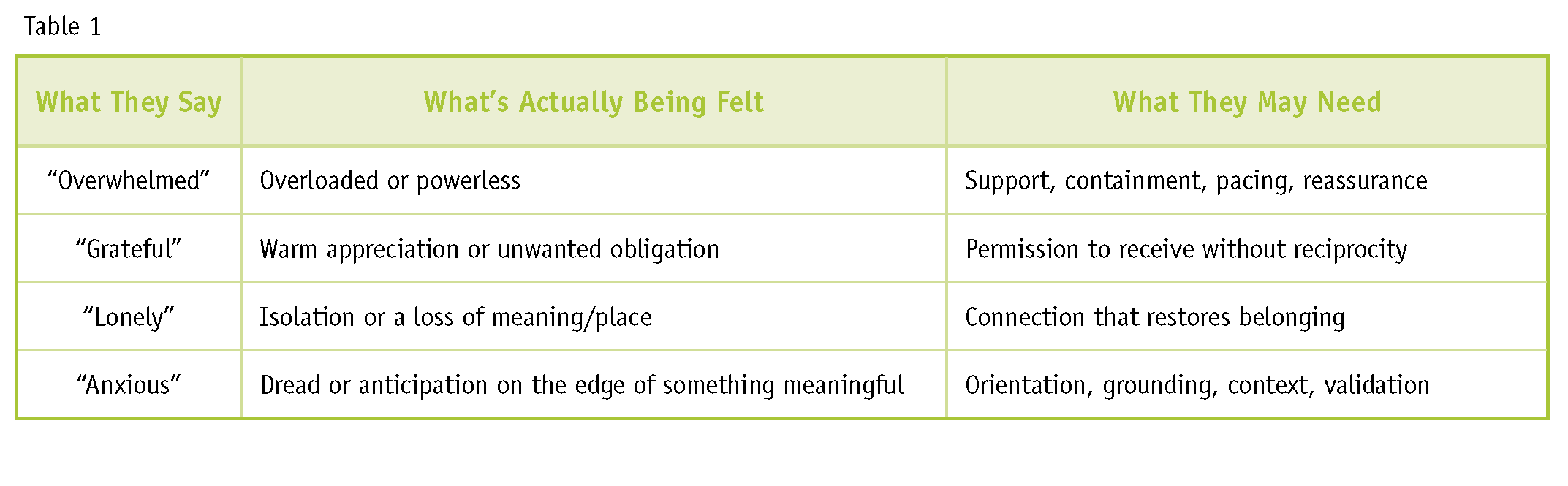
Emotions are layered, not linear
People rarely experience a clean, singular emotion. A parent at graduation may feel pride, grief, awe, disorientation or relief – all at the same time. A job promotion may bring excitement, fear of exposure, imposter anxiety or satisfaction.
Emotions also vary in: intensity (sharp vs. warm vs. dull); duration (fleeting vs. persistent); after-effect (what lingers once the moment is over). If we capture only the label, we lose the architecture of the experience. And when we lose the architecture, we misinterpret the meaning – and therefore the behavior.
The science has advanced. Our methods must catch up. Take the field of affective neuroscience, for example, which has undergone a profound shift in just the last decade. Researchers like Barrett, Kristen Lindquist and Batja Mesquita have shown:
- Emotions are not universal “codes” to crack.
- They are shaped by culture, memory, language and social meaning.
- Emotional expression varies dramatically across contexts.
This is active, frontier research, propelled by advances in imaging technology and interdisciplinary study. As science becomes more nuanced, so must our insights practice.
Why does this matter for brands? Well, when emotional nuance is lost, brand strategy suffers. We misread consumer needs. We design messages that don’t resonate. We solve for symptoms instead of causes. We mistake emotional politeness for emotional truth.
But when we get it right – when we correctly identify the felt emotional state – we unlock strategy that: builds authentic intimacy; drives creative leaps; produces loyalty rooted in recognition; and makes the consumer feel, “Yes – that’s me.” This is how brands become meaningful. Not through personalization; through precision of understanding.
A simple example: the weglow
It happens in small, fleeting moments. A stranger flashes headlights to warn you of a police speed trap ahead. You quietly do the same for the next driver. It isn’t gratitude. It isn’t joy. It isn’t politeness.
It is the warmth of being seen, even briefly, by another human. A flicker of we.
I call it weglow – and it deliciously combines: recognition; solidarity; micro-belonging; a tiny lift of moral elevation and human decency; and the impulse to pass it forward.
These moments are real. They are emotionally consequential. And they never show up in brand trackers. Yet they are the foundation of trust.
Emotional truth
Master-level qualitative work is not simply “moderating.” It is the disciplined pursuit of emotional truth. A master qualitative strategist does not enter the room to extract answers but to create the conditions in which people can discover themselves.
We are not collecting opinions. We are witnessing meaning in the moment it forms. This requires: curiosity without intrusion; empathy without projection; structure without constraint; intuition without assumption. And then, the work of forensic interpretation – tracing emotional signals across tone, language, gesture, metaphor and silence to understand not just what is said but what is meant.
It is closer to facilitated insight than interrogation. The participant leaves the conversation clearer than they entered – which is what makes the insight real and valuable. In other words, we do not find insights; we help them reveal themselves. And this is where mastery matters.
The techniques above are only entry points. To uncover the emotional truths that shift understanding – the ones that make someone say “Yes … that’s me. I’ve never had the words for that, but that is exactly how it feels.” – requires a level of qualitative mastery that is not commoditized, scripted or easily replicated.
It demands emotional co-regulation (helping participants feel safe enough to feel deeply); somatic inquiry (reading breath, tempo, tension, release, micro-hesitation); cognitive plus affective inference (hearing what is implied, not only what is spoken); pattern recognition across narratives and contexts; and the ability to sit inside uncertainty, without rushing to closure or simplification.
This is not simply asking questions. This is facilitated self-discovery. A master qualitative strategist is part scientist, part ethnographer, part psychologist, part storyteller – but, most importantly, a decoder of the human psyche. This work allows participants to recognize emotions they have felt but could never previously articulate.
And once an emotion is named with precision, it becomes: thinkable, shareable, influenceable and strategically actionable. That is where transformational insight is born. That is where brands gain the opportunity to connect with people in ways that make them feel genuinely seen, understood and valued.
The call to the industry
If brands want to build real emotional connection, they must invest in: emotional literacy; qualitative mastery; and time, space and skill to help consumers uncover what they cannot yet articulate.
Because consumers are not trained to analyze their emotional lives. They are not hiding the truth – they simply don’t have the language for it. We are the ones who must help them find it. When we can name what people feel, we can design for what they truly need. And we can finally teach our data systems and AI models to track emotion correctly – instead of scaling emotional misunderstanding at speed.
Because the future of brand strategy will be built on whatever emotional truths we choose to recognize – or ignore – right now.