
The getting of wisdom
Editor's note: Michael Allenson is senior strategic consulting director in the Chicago office of MaritzCX.
Though customer experience (CX) management practices such as measuring a Net Promoter Score, creating hot alerts, customer journey-mapping and many others have become standard procedures in many businesses over the last 20 years, most have not produced the success that companies want. In 2015, research by the Temkin Group found that less than one-third of companies rate their CX efforts as “good” or “very good” at “making changes to the business based on insights.” 1
A new study by MaritzCX explains why so many very capable CX professionals are struggling and identifies a formula for success that a small number of companies have used to achieve outsized business success.
Beginning in 2015, this large global study of nearly 5,000 companies was used to develop a CX maturity framework known as the CXEvolution, with the goal of helping CX professionals in a wide range of industries chart a course to greater success at driving business outcomes with an improved approach to customer experience. Participants answer questions about how CX fits within their organization and impacts business outcomes. The results serve as a benchmark to help companies assess their CX maturity level and compare themselves against others in their industry and to CX leaders across industries. The study also sheds light on the state of CX and has helped to uncover core truths and best practices.
Key findings include:
CX programs are an operational priority in a majority of the companies surveyed, yet making CX a priority does not necessarily reap business results. According to the study, 56 percent of the companies surveyed have a formal CX program, with airlines, consumer packaged goods, breweries, apparel and supermarkets leading the pack. Yet, only 28 percent of CX professionals reported their CX programs to be “very successful.”
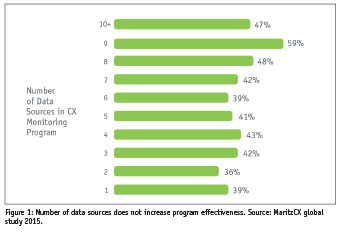
More data does not necessarily lead to program effectiveness. The CX Evolution study suggests that too many organizations think they can improve CX simply by adding more listening posts and collecting more data. While this provides more feedback, in and of itself, more feedback doesn’t help organizations achieve successful business outcomes.
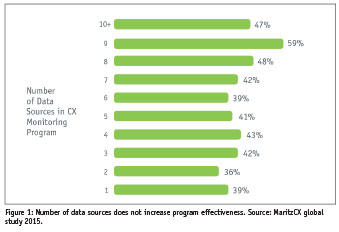
In the early days of CX, organizations were focused on measurement to get feedback at the individual contributor level to drive performance improvement. Over time, more listening posts were added to expand the ability to get feedback from many different channels, such as Web sites, customer service call centers and help desks. CX programs then began to include relationship studies and customer loyalty metrics. Some organizations even attempted to link CX activities to business results. However, as Figure 1 shows, according to the participants in the CXEvolution study, more measurement in and of itself does not equal more direct impact on business results.
The choice of the primary metric used to measure CX success is largely inconsequential. Since NPS was introduced in 2003, we have heard that it is “the one number you need to know.” NPS has been promoted as a simple, elegant way to measure customer loyalty in a way that can be correlated with business outcomes. Since that time, numerous competing metrics have been introduced by industry consultants, all of which have been validated based on their correlation with business outcomes.2 This alphabet soup of CX metrics has led to much debate over which metric to use in a CX program to measure loyalty and drive business results.
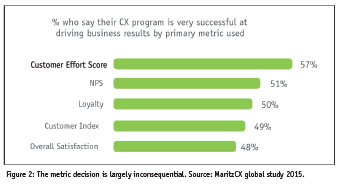
The truth of the matter is: It doesn’t matter. As the chart in Figure 2 shows, the choice of metric – such as NPS, Customer Effort Score, overall satisfaction, etc. – has little to no impact on whether the CX program is successful at driving business outcomes. If anything, one could argue that Customer Effort Score is slightly better. However, the results suggest that organizations that choose that metric are inherently more customer-centric to begin with.
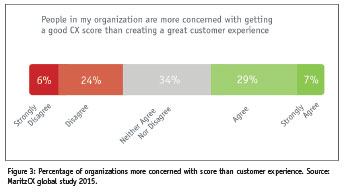
Additionally, focusing on metrics can be counterproductive, especially if teams are rewarded for reaching a specific target score on the chosen metric. The emphasis on score-chasing often leads to unwanted behaviors such as giving away merchandise or outright asking for a score. The end result: Employees believe their companies are more interested in the score than on really improving the customer experience (Figure 3)!
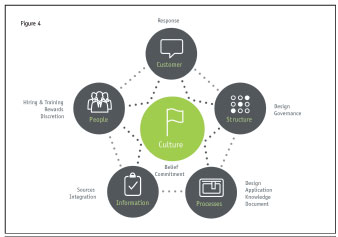
A successful formula for CX entails maximizing customer-centricity across 14 specific core competencies that comprise six organizational dimensions of CX (Figure 4), all of which have a direct impact on CX performance and business success. MaritzCX validation research shows that the 14 competencies distinguish between the companies that simply want to drive business outcomes with CX and those that actually do. The study found that companies that excel in CX, such as Amazon and USAA, have actually made huge investments in 14 customer-impacting competencies, ranging from operational process documentation to employee hiring and training programs.
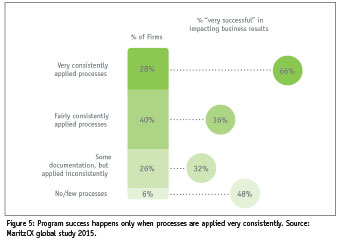
For example, when it comes to process documentation – one of the 14 core competencies – only 25 percent of the study respondents say that their companies document customer-related processes very consistently. However, two-thirds of those folks who report very consistent documentation say that their CX programs have been very successful at impacting business results (Figure 5). The data also suggests that doing something half way may, in some cases, be worse than doing little or nothing at all.
Companies can be evaluated along a developmental or maturity scale based on specific things they do relative to the implementation of CX programs. Findings from the CXEvolution study and the validation against business results have resulted in a framework that can be used to assess an organization’s current level of CX maturity. This framework allows companies to understand the maturity of their CX efforts and determine how they compare with others in the industry as well as those at a similar stage of CX maturity across all industries.
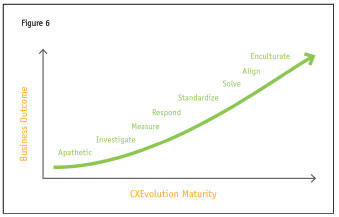
The framework and underlying competencies give companies a foundation upon which to develop a prescriptive road map for how they can evolve and advance. This is an important step, as the CXEvolution study found that even incremental gains in CX maturity yield significant results (Figure 6).
High maturity in core competencies is strongly linked with business outcomes. CX leaders are three times as likely to have experienced significant improvement in retention and year-over-year financial outcomes as their counterparts that have not invested in these competencies. As seen in Figure 7, companies that are at the highest level of maturity are three times more likely to have improved financial results and retention as compared to those in the lower half of the maturity curve.
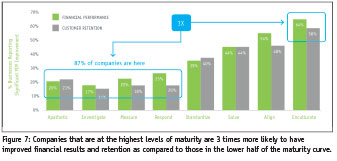
For those organizations at the bottom four stages – which account for 87 percent of companies in our benchmark study – one or more of the 14 CX competencies may be holding them back. The research explains why some companies that have invested heavily in CX may not be seeing the results they hoped for. A company’s CX maturity level is determined by its weakest link among the 14 CX competencies.
Move to the next stage
The study also found that most CX pros probably think they know how their organization is doing in terms of CX maturity but they may not know what specific competencies are holding them back – and what specific actions they can take to realize better business outcomes. The guide below describes each stage of the maturity curve and provides a general idea of what defines companies that are in each stage as well as what it takes to move to the next stage.
Companies at the apathetic stage have no listening posts, few customer processes and a CX organizational structure that is basic and not well-defined. Customer focus is subordinate to other business imperatives like profit generation or supply-chain efficiency. These organizations may be delivering a good customer experience but it’s not an area of deliberate focus.
Key to moving up: Take the time to understand what you’re missing by not focusing on CX.
Companies at the investigate stage have created some customer-focused processes but typically don’t apply these processes consistently across the organization. Information collection is ad hoc or anecdotal and customer focus is sporadic. In most cases, this inconsistent approach to CX is worse than doing nothing at all. By only dipping their proverbial toes in the water, these organizations often set customer expectations they can’t meet.
Key to moving up: Institutionalize successful “guerilla” CX tactics and ensure consistent application.
At the measure stage, the organization’s CX knowledge and application are still inconsistent but customer processes are clear and documented and the organization has begun to see financial results. There is likely centralized oversight in frontline decision-making but no guiding customer strategy. Functional groups are often at odds and executive support can be lackluster, causing the fervor of a few to fizzle out.
Key to moving up: Deploy a transactional measurement program with ongoing metrics.
Companies in the respond stage have well-documented processes and a strong focus on service recovery. Case management systems greatly mitigate negative word-of-mouth but they are typically not connected to more integrated CX systems. Management support and customer metrics in employee performance goals are on the rise but autonomy on the front line is still lacking.
Key to moving up: Empower employees with integrated customer data and build customer metrics into performance evaluations.
The standardize phase is the phase at which most organizations peak. Processes are standardized and formative data integration leads to customer metrics and incentives for meeting them. Frontline employees have some discretion to resolve customer issues and behavioral standards are put in place. A chief customer officer may be named but the position often carries limited power and influence.
Key to moving up: Extend focus on resolving individual customer problems to resolving larger, more systemic issues.
Organizations in the solve stage are focused on understanding and resolving root causes. Employees are hired based on their customer skills in addition to traditional qualifications. Customer data from multiple sources is integrated and processes are designed to balance customer focus with efficiency. The pursuit of a CX “score” gives way to a more holistic approach that links behavioral metrics, outcomes and incentives.
Key to moving up: Centralize customer experience in a single governing body and empower them with integrated data and predictive analytics.
For organizations in the align stage, customer experience becomes a centralized function that touches all parts of the organization. Rather than tying incentives to scores, customer focus is universally understood to be good business. This “customer-first” focus permeates process design and all employees understand their role in enabling it. Data is consolidated and disseminated to anticipate and prevent problems before they occur.
Key to moving up: Focus on hiring employees who have an innate understanding of CX and leverage technology not only to prevent tomorrow’s problems but to spark tomorrow’s innovations.
At the enculturate stage – the pinnacle of CX maturity – customer focus is ingrained in the very fabric of the organization and customer data drives organizational decision-making and innovation. Technology is used to connect customer metrics and anticipate what will delight customers. Customers are often involved in measuring the organization’s progress and the need for a centralized function to oversee customer efforts diminishes.
Key to moving up: The enculturate stage is a journey and not a destination. To keep growing and improving, these organizations should focus on CX innovation and make sure their organizations are flexible enough to adapt to an ever-changing world.
Develop a more holistic approach
Organizations that want to be effective in their CX efforts must move beyond a measurement-driven approach and pass through distinct stages of development. As part of this evolving process, they develop a more holistic approach to CX, one that weaves CX into the very fabric of their company.
Findings from the MaritzCX global CXEvolution study indicate that organizations should realize that their CX will not change through implementing measurement and technology programs alone. Rather, they should take time to look themselves in the mirror, understand which operational competencies are most critical to their customer strategy and invest intelligently.
More than ever, CX is a strategic priority for companies. CX improvement is the result of targeted organizational change in certain core competency areas. To get the right customer experience, companies must take steps to mature their CX programs and efforts. All else will follow.
REFERENCES
1 Temkin Group State of the Voice of theCustomer Programs, 2015
www.prnewswire.com/news-releases/voice-of-the-customer-programs-are-successful-but-not-yet-mature-according-to-new-temkin-group-research-300166622.html
2http://excafe.maritzcx.co/time-for-a-more-strategic-approach-to-cx-management/