
Editor’s note: Dave Fish is founder of Rogers, Ark.-based blog CuriosityCX and senior vice president, consumer strategies at ORC International.
In the thick fog of the anesthesia the last thing I remembered my surgeon saying was, “You may receive a survey after this procedure, I hope you will give me a 10…”
I saw him wink and then I fell unconscious, terrified.
OK, OK. That didn’t really happen but the statement is made every day in other contexts. Grocery stores, department stores, car dealerships, restaurants, moving companies and many others have created a Net Promoter Score (NPS) token economy.
The NPS was meant to be the one number you needed to run your business. The idea was noble – make stakeholders accountable for customer experience and make it simple to understand. While NPS is the most notable metric out there, there is an alphabet soup of other scores promoted as the metric du jour for customer experience.
Taking a page out of sales motivation schemes, customer ratings were substituted for sales numbers. This practice is now widespread. According to ORC International’s 2017 CX Transformation Study, nearly two-thirds of companies with CX programs today tie executive compensation to achieving a score.
Coaching customers
Any student of human behavior knows that when people have a goal with consequences they will find a way to achieve that goal, usually in the most efficient way possible. In most cases coaching (or coercing) customers for a number is much easier than changing the customer experience.
In many instances NPS is wasting millions of dollars by creating a quid pro quo economy of scores for swag or relief from the stress of providing a bad score. Estimates vary on the severity of the problem but it is widespread. There are even how-to guides on using customer surveys as leverage for a better deal. This issue is not limited to the for-profit world; it is also an issue in public sectors such as education.
Evidence of this is not hard to find. For example, a home improvement store in Texas is encouraging customers to complete a customer survey in a certain way by promising winning big by providing top box (see photo below, courtesy of Todd Blickenstaff).

More innocent practices also exist that encourage customers to contact the provider if they can’t achieve a certain score. While admirable, this messaging seems to show that they are more interested in receiving a 10 than your happiness.
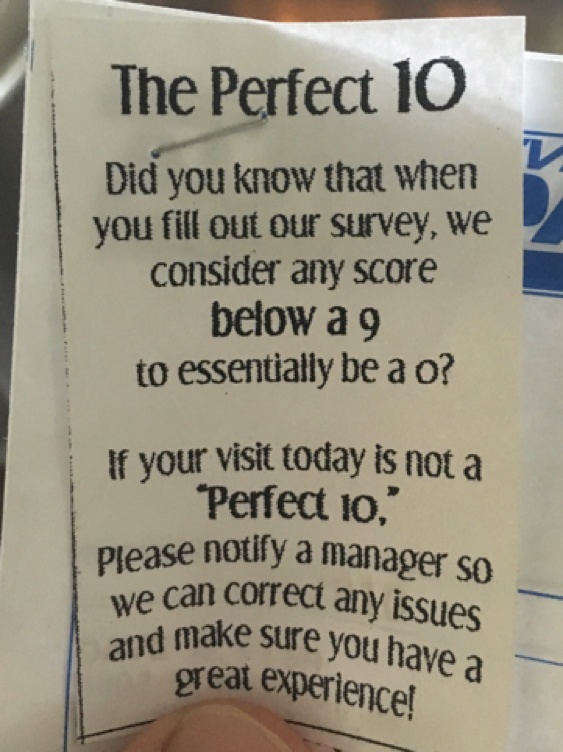
This token economy can be taken to the point of the absurd. For example, I heard of an incident where a car dealer refused to sell a vehicle to a specific customer for fear of getting a low score and losing their bonus money.
I posted the Perfect 10 photo (above) I took earlier this year on LinkedIn and I believe John Robison of JD Power and Associates addressed the situation best in his comment on my post:
“In an industry notorious for false realities, surveys are the biggest waste of energy and resources in the [automotive] business. Any time scorecards are directly tied to incentives and the goal is chasing a number rather than legitimate customer delight, the costs associated with gathering, monitoring and incentivizing is money squandered … dealers can get back to focusing on WOWs instead of chasing a random nonsensical number. As a customer, I don’t have to be creeped out by the scorecard speech [at the dealership] and as a dealer I can’t be blackmailed by a buyer making unreasonable demands using the threat of a low score as leverage.”
Clearly there is something wrong here. But is it bad to tie compensation to customer experience measures?
It depends on how you do it.
Behavioral modification programs can be very effective when executed correctly. It is how the following principles are applied that separates the disasters from the successes. Setting up effective incentive schemes revolves around two key aspects: how they are designed and how they are implemented.
Design
Designing incentive systems transcends just establishing a metric goal and publishing it. There is a large body of literature illustrating best practices in goal setting and mitigating malfeasance. Here are some tips for designing a system that is impactful and diminishes cheating.
- Tie goals to improvement, an external benchmark or a business outcome. Statistically, linking your internal CX metrics to important business outcomes has the benefit of real-world predictive validity. That is, if you achieve a certain CX goal then that will drive the business outcome making for a virtuous reinforcing cycle.
- Avoid single metric goals. By only having an NPS as the metric to hit you are putting large amounts of pressure on employees. It is better to have a blended metric, ideally composed of both behavioral (i.e., volume, retention) and attitudinal measures. One note of caution is not to make it overly complex. You must balance robustness and simplicity.
- Have stated policies on cheating and enforce them without exception. Clearly state what is and what is not acceptable. For example, one rule of thumb suggested by my colleague David Ensing of MaritzCX was that cheating is defined by “encouraging and coercing customers to respond in a way that is not reflective of their actual experience.” Whatever policy you arrive at make sure it applies to everyone. Giving a second chance to that high-volume retailer will destroy the integrity (and motivational value) of the entire program.
- Include some surveillance mechanisms. While this may show a lack of trust, I believe in the Reagan-esque policy of “trust but verify.” Look for duplicate phone, address and IP address information in ferreting out survey shenanigans. More advanced technology partners also provide device ID for online and mobile feedback mechanisms. You can identify cheater suspects rather easily with that methodology. Finally, it is always informative to look at the open-ended comments in your CX program. People will often mention bad behavior in survey comment boxes. Look for words like “threatened,” “top box” and “failing grade” to help identify suspect returns.
- Avoid “all or nothing” payout schemes. This puts a tremendous strain on the metric to get over the line at all cost. It is much better (and more motivational) to have partial payouts in terms of compensation for partial completion. All or nothing means that those being incentivized will go to extreme lengths to get to the score.
Implementation
Once a system is designed you must now focus on implementing for a positive impact. We should never lose sight of the end goal of incentive programs: to modify behavior. Here are some simple rules:
- Goals must be clearly communicated and understood. If you don’t understand what your goal is, how it is created and how to affect it the motivational value of that goal is slim to none. Clear and simple communication is the key to gaining understanding and buy-in.
- Gain buy-in from participants by having goals that are agreed to. Cascading goals that come from on high are viewed as lacking context and buy-in from those who are supposed to be motivated by them. This is much like forcing a goal on an athlete. Having a coach work with him or her to do more based on an agreement – not a forced goal – will ultimately result in higher success rates.
- Make goals S.M.A.R.T. This old chestnut has never lost its wisdom. S.M.A.R.T. stands for creating goals that are specific, measured, attainable, relevant and time-bound.
- Ensure the goals are within the participants’ locus of control. Locus of control is the degree to which people believe they have control over an event or outcome.[1] For example, sales can be altered by many factors but if a salesperson believes in your program it will be effective. It is understanding and ensuring that belief is present that is important. If participants don’t think they can influence a metric it won’t be motivational to them.
- Provide regular feedback. I am often prompted to do a double face palm by incentive programs that don’t reveal metrics until the end of the payout period. That is akin to taking a class and having no idea what your performance level is until your grade is posted at the end of the semester. Regular feedback helps people understand how they are doing relative to CX goals, allowing them to adjust accordingly. One note of caution: posting CX scores too frequently can result in day-trader-type behavior and put more pressures on achievement. You must find a balance. Operant conditioning research shows that there is a strong connection between behavior and outcome (i.e., reduce latency) and finding the appropriate balance will result in strengthening the behavior.
Part of the culture
There are some organizations that have very mature customer experience programs and don’t need to incentivize. Customer experience is already a part of the company culture. Employees know that treating the customer right will result in good business outcomes. Rewarding based on CX metrics in this context can even backfire by deflating the intrinsic motivation.
Organizations that are not that far along in their CX maturity can use CX scores to create effective incentive programs. That’s probably why so many organizations employ the tactic. However, there are pitfalls that can turn a powerful motivational force into one that can negatively impact the customer experience. Some programs designed to improve customer experience make the experience worse. We are still a long way from extinguishing the token quid pro quo economy that exists today. However, through thoughtfulness in design and consistent implementation the programs can be a powerful force of change.