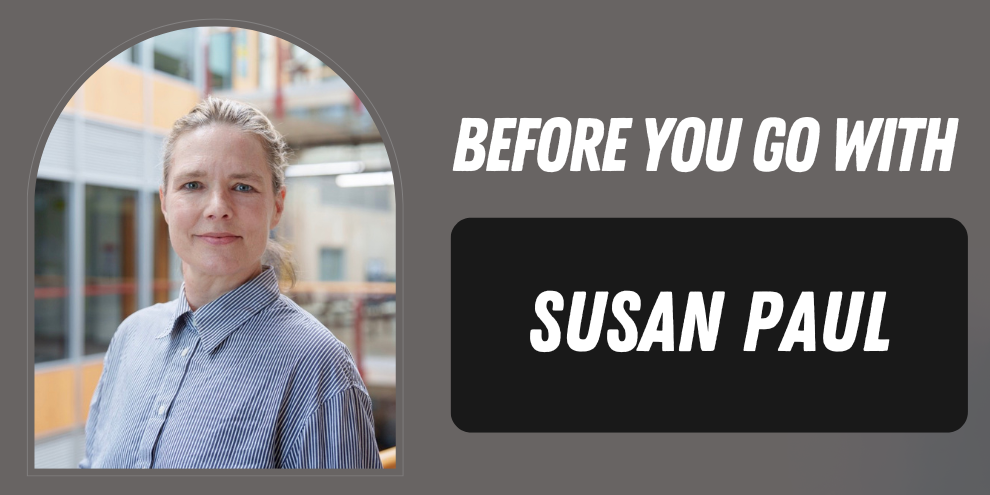
Q&A with a client-side researcher
Editor's note: If you're an end-client researcher and interested in participating in a Q&A with Quirk's, please e-mail me at emilyk@quirks.com.
How did you first become interested in marketing research and insights?
Like a lot of people in marketing research, I didn’t grow up dreaming of it. I kind of stumbled into it. I started my career in food product development, wearing a white coat and working in labs and test kitchens. It was fun and fascinating, but it didn’t take long for me to notice that the real drama and decision‑making was happening on the marketing side.
After about five years, I went back to school to do an MBA with a marketing focus. When I joined a large research agency straight out of grad school, I thought of it as a short stop on the way to a more traditional marketing role. Instead, I found my thing.
I loved the mix of structure and creativity, the problem‑solving, the pace and the constant exposure to different businesses and questions. I liked that it rewarded both analytical thinking and good instincts and that no two projects were ever quite the same. It just fit. Fifteen‑plus years later, I’m still here, still curious and still genuinely enjoying the work. What started as a stepping stone turned out to be the job I didn’t know I was looking for.
How do your experiences as both an agency- and client-side researcher impact your current role at Sheridan College?
Having worked on both sides of the research relationship has made me very focused on one thing: making sure research actually gets used.
On the agency side, I learned how to design strong studies, work fast and tell a compelling story under pressure. On the client side at Sheridan, I really see what happens after the deck is delivered. I’m much closer to the teams who use the research, which means I can see how findings are interpreted, where things land clearly and where they don’t. In hindsight, I wish I’d had this perspective earlier in my career because it would have made me a better consultant and partner much sooner.
One of the biggest shifts for me has been how I think about communication. I joined Sheridan during the pandemic, when fatigue was very real and attention was scarce. People didn’t have the time or energy to wade through long reports, even well-crafted ones. That forced me to become much more ruthless – in a good way – about clarity, conciseness and tailoring insights to different audiences. Rewriting research for how people actually consume it became just as important as the analysis itself.
Working in an academic environment adds another layer. Stakeholders bring varying levels of statistical familiarity, so I have to be thoughtful about how I explain advanced analytics – e.g., segmentation or conjoint – without defaulting to technical debates, keeping the focus on meaning and implications.
Being on the client side has also broadened my skill set. Agency-side, advanced analytics were handled by specialized teams. At Sheridan, if I want to go deeper into the data, I do it myself. That’s pushed me to sharpen my analytical muscles again, with tools like Displayr playing a big role. I’ve also found myself being more entrepreneurial than I expected, building internal demand, finding projects and growing research capability across the team.
Ultimately, my agency- and client-side experience has shaped how I approach my role at Sheridan: practical, audience-first and always grounded in the question, “What will someone actually do with this?”
Over the next five years, how will client-side insights leaders need to evolve as expectations for strategic influence grow?
The idea of the insights leader as a strategic partner isn’t new. We’ve been talking about it for years. What has changed is the context. When data was harder to come by, influence came from access and analysis. Today, data is everywhere. The real challenge isn’t getting more of it; it’s understanding what we actually need to know to move a decision forward.
As expectations for strategic influence grow, insights leaders will need to spend less time generating data and more time framing the problem. That means being comfortable challenging the brief, asking “What decision are we really trying to make?” and occasionally pointing out that more data might just be a very respectable form of procrastination.
In a data‑saturated world, synthesis and judgment become the differentiators. Influence comes from distilling complexity into a small number of clear implications; not from showing every chart we could produce. The goal isn’t to prove how much we know, but to make the path forward obvious.
This is also where the client-side researcher has an advantage. Being closer to the business makes it easier to shape questions upstream, understand constraints and see how insights actually get used. Strategic partnership becomes less aspirational and more practical, grounded in day‑to‑day decisions.
Ultimately, the insights leaders who will have the most influence over the next five years won’t be the ones with the most data, but the ones with the clearest judgment about what matters and the confidence to help their organizations focus on solving the right problems.