

Marketing research and fact-based decision-making
Editor’s note: Richard M. Klass is president of research firm 2CY Inc., Weston, Fla.
Market research should play a pivotal role in shaping domestic and foreign policy through an informed electorate. This is our opportunity to educate those who care about the facts rather than the entertainment provided by media opinion hosts who focus on driving viewership or readership. In this article, I will share an example using data from the U.S. Energy Information Administration.
The impact of small analytical omissions
Public excoriation of Russian oil imports is currently center stage. Misconceptions about U.S. petroleum production and our import and export positions are pervasive. Unfortunately, stretched small facts or analytical omissions for political theater result in public outcries and legislative/executive leadership mistakes.
Data from the U.S. Energy Information Administration (EIA) is excellent; it is current, detailed, easily accessible and provides independent statistics and analysis. It is fertile ground for researchers, reporters and policy makers to support fact-based decisions.
1. The shift from Saudi Arabian to Russian petroleum imports.
Data shows the assassination of Jamal Khashoggi was a watershed event that shifted imports from Saudi Arabia to Russia. The assassination occurred in October 2018 (Figure 1). A possible contributing goal was an executive branch preference for geopolitical realignment.
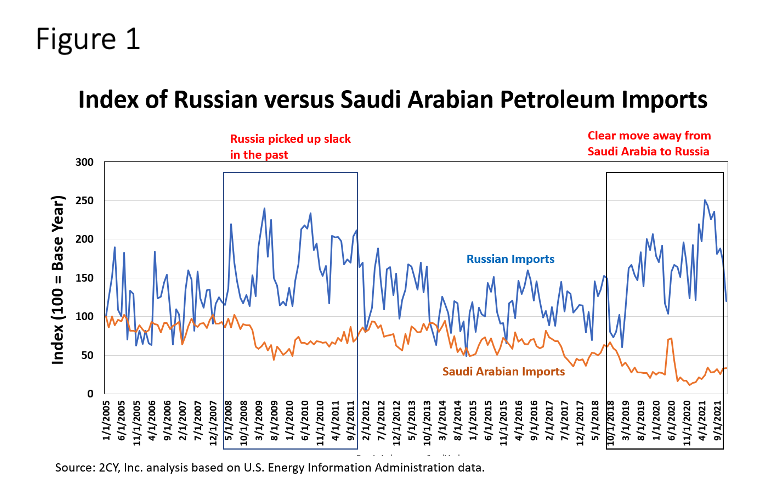
There was a shift to Russian oil imports in the 2009-2010 timeframe. The Organization of the Petroleum Exporting Countries (OPEC) cut production by 4.2 million barrels a day (MMb/d) to drive up prices. Russia was not a part of OPEC, filled consumption demand and counterbalanced OPEC’s market power. As a side note, in 2016, Russia and Saudi Arabia drove an alliance between OPEC, Russia and other oil-producing countries to manage the oversupply of petroleum due to increased U.S. production.
2. Dependence on petroleum imports.
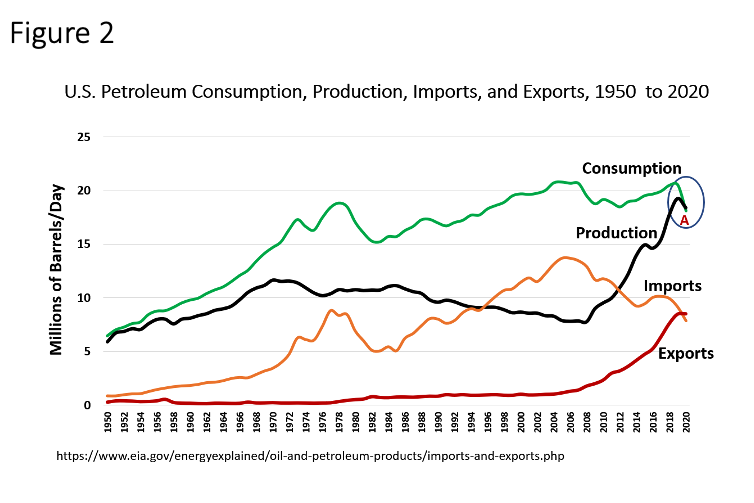
Longitudinal data (Figure 2) dating back to 1950 from EIA shows a rapid rise in U.S. consumption over the past seven decades. Increased imports filled the thirst for petroleum until fracking technology ignited U.S. production.
In 2020, the U.S. exported 8.51 MMb/d and imported 7.86 MMB/d. Better a net exporter than importer. However, our improved position was the result of consumption falling faster than production. Consumption dropped 12% to 20.5 MMb/d versus 18.1 MMb/d in 2019 due to COVID-19’s adverse economic impact (Figure 2, A).
Energy imports will continue to play a significant role in fueling our economy. Unfortunately, our history was choosing energy suppliers that are either “bad actors” or real enemies.
The challenge for our profession is to effectively use the many available vehicles to promote our value as truth-tellers to all stakeholders that influence and make policy decisions.