The unexpected synergy between artificial intelligence and design thinking transforms insights-based innovation
By Niels Schillewaert, Ph.D., head of research and methodologies at Conveo
 At first glance, artificial intelligence and design thinking appear incompatible. One represents computational precision and algorithmic processing; the other embodies human empathy and creative exploration. Yet this apparent contradiction masks one of the most transformative ways of working emerging in consumer insights today. This was recently demonstrated through a groundbreaking Unilever product innovation trajectory that achieved what traditional methods struggle to deliver: two "superstar" product concepts developed through an accelerated process that compressed a year's worth of conventional research into efficient, iterative cycles.
The question facing innovation leaders is no longer whether AI and human-centered methodologies can coexist but rather how to harness their combined power to drive breakthrough results.
The contradiction that is not one
Design thinking has established itself as a proven methodology for developing products that genuinely resonate with consumers. Its foundational principles remain essential (see https://designthinking.ideo.com/ and https://www.interaction-design.org/literature/article/5-stages-in-the-design-thinking-process):
- Human-centeredness: placing consumer understanding at the core of decision-making.
- Empathy: deep comprehension of motivations and needs through qualitative exploration.
- Problem definition: precise challenge framing–recognizing that well-defined problems are more than half-solved.
- Divergence and convergence: generating multiple options before focusing on optimal solutions.
- Iteration: continuous refinement rather than single-attempt
development. - Tangible solutions: practical, actionable outcomes for
implementation.
These principles have guided successful innovation for decades. What's transforming the landscape is the scale, speed and depth at which they can now be applied through AI augmentation as well as enabling opportunities for doing things that were previously impossible.
Modern generative AI platforms such as Conveo offer end-to-end capabilities that seamlessly align with design thinking principles. Rather than replacing human insight, the Conveo platform amplifies it, transforming “artificial intelligence” into “augmented intelligence.” The reframing is crucial: AI doesn't supplant the human elements of design thinking; it supercharges them.
Consider how Conveo’s AI capabilities map directly to design thinking tenets. Video-based ethnography enhances human-centeredness by capturing authentic real-world context. Behavioral and emotional analysis bridges the gap between stated preferences and actual behavior, deepening empathy. AI-assisted synthesis helps teams define challenges with greater precision. The technology's ability to rapidly diverge (generating multiple concepts) and converge (screening and optimizing) mirrors design thinking's natural rhythm. And continuous iteration becomes not merely possible but practical at enterprise scale.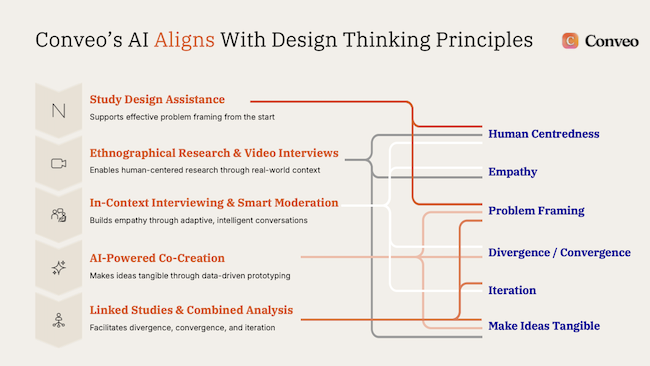
The innovation challenge
Unilever's consumer and market insights team faced a challenge familiar to innovation leaders across industries. The objective required simultaneously achieving multiple critical outcomes: understanding genuine consumer tensions, creating differentiated solutions that consumers would actively purchase, and – perhaps most challenging – generating true brand incrementality rather than merely cannibalizing existing product lines.
In today's volatile market environment, achieving all these objectives through traditional research methods presents significant resource and timeline constraints. The business challenge required an approach that maintained real humans at the heart of the process from inception through optimization and validation, with continuous engagement of a matched consumer cohort across four rounds of iterative testing – all enabled by AI-powered capabilities.
This perfectly fits the Double Diamond framework.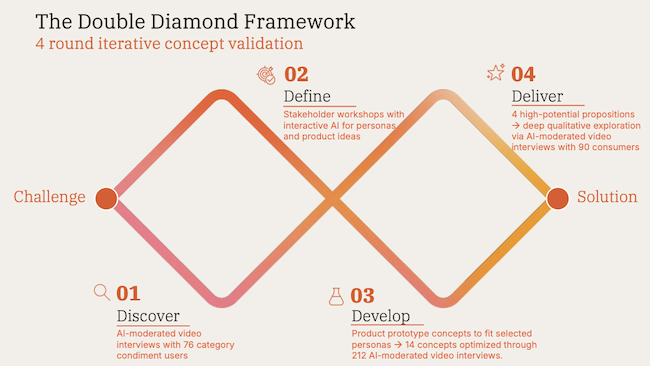
Phase 1: Discover – Mapping foundational consumer needs
The innovation journey began with fundamental consumer understanding: exploring actual category usage patterns, benefits sought, underlying tensions and core motivations. Through 76 AI-enabled video interviews of 30 minutes, the research mapped consumer needs while in people’s real-life contexts.
From this rich dataset, three distinct, data-driven personas emerged, representing authentic consumer segments with validated behavioral patterns.
Phase 2: Define – Human-AI collaborative ideation
An innovative aspect of the methodology emerged in the ideation phase. Rather than simply presenting persona data to stakeholders through static reports, our approach integrated human expertise with AI capabilities in real-time collaborative workshops.
The Conveo platform distilled the interviews from phase one into responsive personas capable of evaluating concepts, answering strategic questions and providing consumer-grounded feedback instantaneously. Marketing and innovation teams interacted and collaborated with the personas. All stakeholders learned about their market in, generated insights that stuck and co-created solutions in an engaging and empathic way.
Stakeholders could develop solution concepts and iteratively query the AI-powered persona: e.g., Does this address the identified tension? What concerns might arise? How do we optimize the idea? The system provided evidence-based responses drawn from actual consumer data, keeping ideation grounded in market reality while maintaining creative momentum.
The results proved remarkable: 14 viable product concepts emerged from a single three-hour workshop. The efficiency gain didn't come from rushing creativity but enhancing it, and the ability to bring the consumer into the boardroom, close to decision makers.
Phase 3: Develop - Intelligent product prototype optimization
Fourteen product concepts presented a strategic challenge: identifying the most promising candidates without prematurely eliminating ideas that possessed potential but required refinement. In this phase of product development, there was often no place for research due to time and resource constraints. Managers relied on gut feel to reduce the list and hardly enhanced the concepts; often, concepts got killed that may have been category winners with proper development.
Our approach employed AI-enabled qualitative concept optimization among 212 consumers and applied quantitative KPIs e.g., brand fit, appeal, believability, purchase intent – within a qualitative research context. Concepts were presented (sequential) monadically to ensure a clean experimental assessment limiting bias.
This hybrid method revealed concepts with immediate strength, which required further development and which faced fundamental barriers. With that input, by prompting the interview data and co-creating with Conveo’s AI engine, the team further refined the portfolio to four high-potential concepts warranting optimization.
Phase 4: Deliver – Optimization high-potential propositions
The final iteration focused on refined product concept optimization: eliminating extraneous messaging, strengthening reasons to believe and identifying the most compelling benefit claims. The research tested identical concepts with single-claim variations to isolate the impact of specific benefit statements, as well as pack and price perceptions. We finalized four concepts with 90 consumers.
This refinement process yielded two polished concepts ready for quantitative validation through NIQ Bases testing. Both concepts achieved Superstar status in the test – the highest possible ranking in quantitative assessment and an uncommon outcome.
The success rate was not coincidental. The iterative approach, continuous consumer engagement and AI-enabled depth of analysis created concepts genuinely aligned with consumer needs and motivations. The methodology didn't just accelerate innovation; it improved innovation quality.
Platform capabilities enabling transformation
Conveo’s AI occupies a strategic position in the insights research toolbox that lies in a middle ground between quantitative breadth and qualitative depth – delivering qualitative richness at quantitative scale, a combination previously unattainable.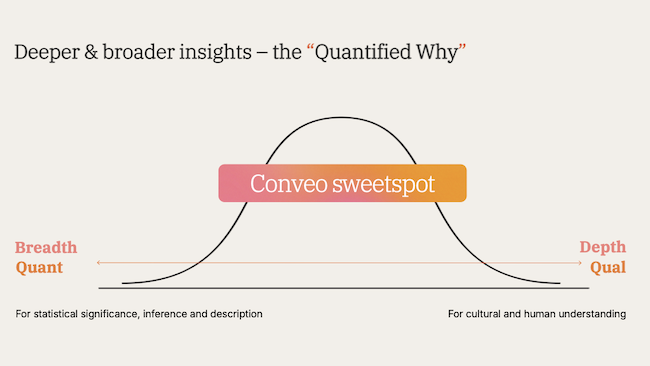
Several specific AI platform capabilities proved essential to this outcome and design thinking journey:
- Cross-study knowledge integration: the system mines insights within and across multiple research initiatives, enabling teams to build on previous learning rather than starting fresh with each project. Existing personas can be uploaded and augmented with new information, creating compounding knowledge assets.
- Automated behavioral recognition: computer vision identifies products, brands and consumer actions that participants don't explicitly mention, capturing the full behavioral context that verbal responses alone miss.
- Interactive persona systems: the ability to query synthesized consumer intelligence transformed static research findings into dynamic strategic tools. Workshop participants could test concepts against consumer reality in real time, maintaining human-centeredness throughout ideation rather than losing it in the creative process.
- AI-powered concept co-creation: the platform generates product concepts complete with target audience definitions, the friction points being addressed and reasons to believe – all grounded in actual interview data. It produces multiple visual representations that can be refined through iterative prompting, accelerating the concept development cycle.
- Emotional intelligence: facial expression analysis, vocal tone assessment and non-verbal cue recognition provide psychological depth beyond surface-level verbal responses, revealing authentic emotional reactions to concepts and stimuli.
Strategic transformation beyond efficiency
While time compression represents an obvious benefit, the methodology's strategic impact extends far deeper. The traditional approach to this scope of research would have required approximately six to 12 months and substantial agency investment. The AI-augmented approach delivered superior results in a fraction of the time and cost. In addition, AI does more than remove tedious tasks – it starts to act as a true co-creation sparring partner.
More fundamentally, the methodology transformed how innovation teams approach product development itself. Organizations have historically limited qualitative research due to time and budget constraints. The AI-enabled approach removes these barriers, enabling continuous qualitative engagement throughout the innovation lifecycle.
The ability to "revert back to the data" – to continuously query accumulated consumer intelligence – creates connected insights rather than isolated research projects. Each study builds on previous learning, creating institutional knowledge assets that appreciate over time rather than depreciating after project completion.
This all represents an opportunity gain: conducting research in contexts where teams previously couldn't justify the investment, while maintaining knowledge in-house rather than outsourcing it to external agencies. The result is both cost efficiency and strategic capability building.
Implications for innovation leadership: The essential coalition
Despite sophisticated AI capabilities, human judgment remains central to innovation success. The technology doesn't solve all insights challenges – it amplifies human capacities to make them better and more effective.
This reflects the true nature of augmented intelligence: technology serves human requirements, continuously evolving to address emerging challenges.
The platform provides what might be termed "innovation superpowers" – the ability to scale research capacity without proportional headcount increases, to conduct investigations that would otherwise be impractical, to iterate continuously rather than in discrete project phases. But humans define the problems, interpret nuanced findings, make strategic choices and ultimately create innovations that resonate with other humans.
Yes, AI handles the tedious, time-consuming aspects of research – freeing human researchers to focus on strategic interpretation, creative application and business integration. But AI also helps improve human decision-making. This coalition of labor optimizes both human and machine capabilities.
The future of insights-based innovation isn't human or machine – it's human and machine, working in integrated partnership to create products that genuinely resonate with consumers. What initially appears counterintuitive proves perfectly complementary in practice.
For organizations willing to embrace this augmented approach, the results demonstrate clear competitive advantage: more concepts, faster development cycles, deeper consumer understanding and ultimately, breakthrough innovations that drive measurable business growth. The question is no longer whether to integrate AI into innovation processes but how quickly organizations can build the capabilities to do so effectively.