
Gen Z struggles to break into the insights industry
Editor’s note: Tracy H. Bills is principal research consultant at TBills & Associates and a director of research on research for the Insights Career Network, Austin. Bills holds a B.S.B.A. in marketing from the University of Central Florida and has more than 30 years of experience in consumer insights and data-drive business decision-making. She is a two-time recipient of the EO Experience Craft Excellence Award. Aditi Tandon is currently consumer insights consultant at I-Genie.ai and a director of learning and research for the Insights Career Network. She holds an MBA in marketing and strategy and has more than 15 years of experience.
Gen Z is called many things – digital natives, fast learners, endlessly adaptive. But the Insights Career Network’s (ICN) 2025 industry-wide member survey, a pulse study capturing the lived realities of nearly 500 insights professionals, reveals a quieter truth: The youngest members of our profession are facing the narrowest entry ramp our field has ever seen, with 48% of them actively job-seeking (vs. 46% overall seekers).
The paradox
This generation is the most fluent with emerging research tools; they build dashboards instinctively, grasp automation workflows and switch between platforms faster than many of us can bookmark them. Gen Z cares deeply about inclusion, ethics and representation. They grew up interpreting culture at algorithmic speed.
And yet, breaking into insights has become harder for them than for any generation before.
Cengage Group's report spotlights 2025 as the toughest entry-level job market in five years, with only 30% of grads securing field-relevant roles and nearly half feeling unequipped – exposing a widening skills gap where employers demand job-specific proficiencies that new grads rarely possess.
The story isn’t about entitlement. It’s about a labor market that quietly and rapidly shifted beneath them.
Gen Z in insights: High potential, low access
ICN data reveals the micro-patterns shaping Gen Z’s early career journey – and why their pathway into insights feels so narrow.
Gen Z professionals cluster almost entirely in early career roles. They show the strongest appetite for mentorship (68%) and structured skills training (71%), signaling a generation eager to learn rather than stall. Yet their emotional landscape is distinct – confident in their curiosity but discouraged when traction is slow.
Identity adds another layer.
One in three Gen Zers identify as non-white, which often means fewer informal networks and reduced access to warm introductions – accelerators that help early career candidates move from application to opportunity. And while Gen Z is the most open to relocation (33%), even that flexibility hasn’t translated into smoother entry.
What emerges is not unprepared workers but prepared ones waiting for an industry still learning to welcome them.
Understanding Gen Z strengths
Here’s where the hopeful turn begins: Gen Z brings exactly the capabilities the future of insights demands.
They are tool-native, quick to learn new platforms and strong in visualization, automation and research operations. They bring fluency in digital culture and instinctive curiosity about ethics and representation – all essential for interpreting modern consumers. Many prefer hybrid or on-site work for mentorship and belonging, a notable contrast to stereotypes that younger workers only want remote roles.
And their contributions aren’t hypothetical – they fill real gaps that senior professionals cannot easily replicate.
The skills and experience paradox: When entry-level isn’t entry-level
For Gen Z, the entry point into insights has quietly shifted. Roles once built for learning now resemble mid-level jobs.
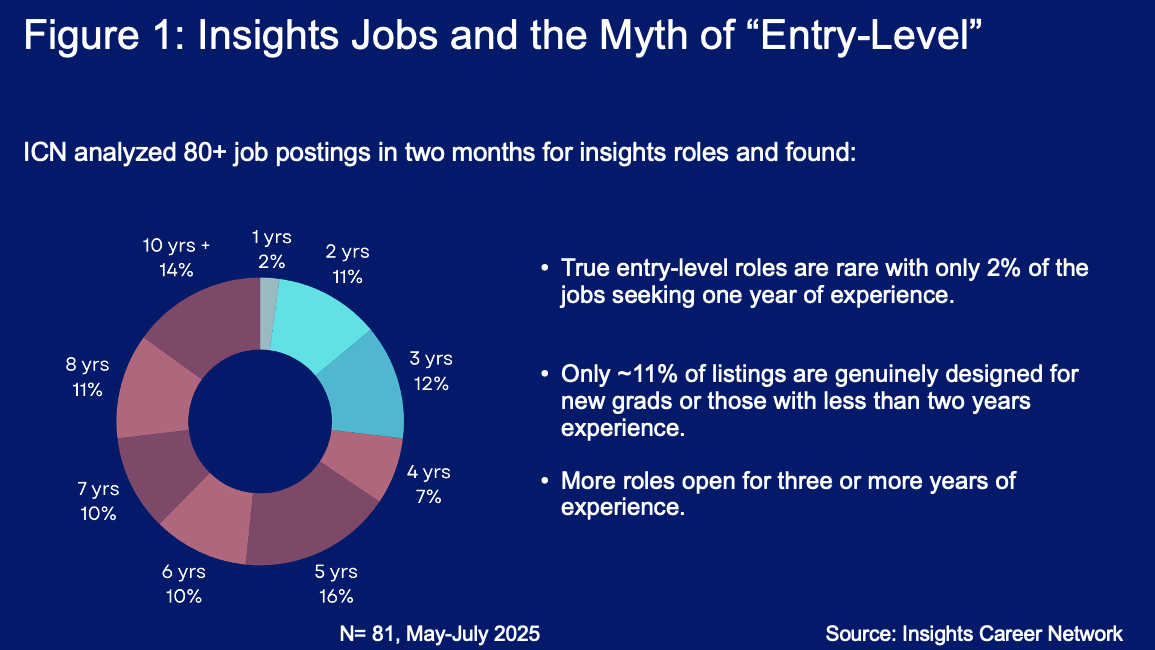 An ICN analysis of 80+ LinkedIn postings found only 2% of roles were truly entry-level, while most required two to three years of experience, multi-platform tools, methodology expertise, dashboard fluency and analytics or AI exposure. LinkedIn’s “Workforce Report” (2024) shows 35-45% of entry-level jobs require prior experience, driving 44% of candidate rejections.
Gen Z isn’t underprepared. They’re being evaluated against experience they haven’t had the chance to gain. The starting line keeps moving – breeding doubt.
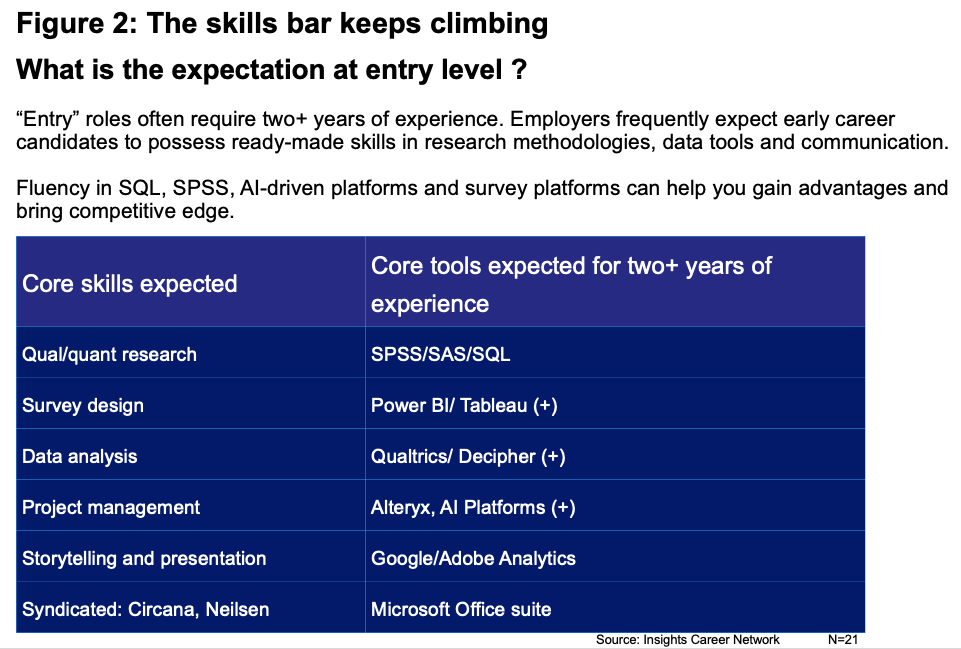
ICN data shows a clear skill confidence gap. Only 3% of Gen Z report comfort with programming or AI tools, far below the overall 8%, even as these capabilities are expected in entry-level roles.
From career delay to crisis of confidence
Because the entry point is so compressed, the emotional cost of trying to break in is steepest for those just beginning.
Gen Z are the most likely to feel distressed about unemployment and to disengage from activities (38%) – networking, outreach, applying – that could help them regain momentum. Nearly half (48%) report low job satisfaction, describing stalled searches, financial stress and a fear of falling behind before their careers even begin.
Their voices echo the gravity:
- “Being unemployed is the worst feeling.”
- “It’s frustrating that employers are not willing to take a chance.”
- “I feel incredibly stuck.”
This emotional erosion echoes broader findings. Gallup finds that younger workers experience the highest levels of workplace anxiety, and prolonged job searches intensify feelings of inadequacy and isolation. When early career candidates lose momentum, they don’t just lose confidence – the industry risks losing them altogether.
The early career landscape: What’s holding Gen Z back?
Gen Z’s challenges are rooted not in motivation or talent, but in three structural realities shaping the early career landscape:
- Broken entry-level pipelines.
Internships were cut during layoffs, apprenticeships never returned and many junior roles now expect prior experience instead of offering it. The result is an entry point so narrow that even strong candidates struggle to access it. - Opaque and burdensome hiring processes.
Multiple rounds of interviews, unpaid take-home projects, long periods of silence and inconsistent feedback disproportionately disadvantage candidates without financial buffers or strong networks. Even capable applicants lose momentum in systems not designed for beginners. - Uneven access to networks.
Early career professionals who are people of color, first-generation or international often don’t have the same access to informal networks that can speed up job opportunities. These aren’t gaps in talent; they’re gaps in access.
Gen Z isn’t being picky. The industry is failing to maintain a coherent, equitable on ramp.
The AI question: Why losing Gen Z would damage the entire profession
A common argument is that AI will shrink entry-level demand – that fewer junior researchers will be needed. The data suggests the opposite.
As automation accelerates the technical side of our work, the competitive edge shifts toward cultural fluency, ethical judgment, contextual interpretation and the ability to question assumptions – strengths Gen Z brings in abundance. If the industry assumes automation replaces early career talent, we risk building a pipeline with no future researchers capable of synthesizing, challenging or humanizing AI-generated outputs.
AI doesn’t eliminate the need for young researchers. It amplifies their importance.
Gen Z’s early insights career needs
The ICN survey highlights four needs that consistently shape Gen Z’s early career experience – needs that would strengthen the field for all talent, not just early career entrants.
- Mentorship – not just training.
They thrive when someone helps them connect the dots rather than handing them a list of tools to master. - Clear early career pathways.
Defined ladders, realistic job descriptions and growth trajectories that don’t rely on job-hopping help them visualize a future in the field. - Opportunities to build real portfolios.
Certificates are everywhere; proof of impact is rare. Small projects, internships, volunteering and shadowing build confidence and credibility. Cengage reports 87% of recent graduates in degree-relevant jobs say their internship helped them get the role. - Fair access to networks.
Warm introductions and structured community support help level an uneven playing field.
Meeting these needs creates a competitive advantage.
Creating a sustainable talent pipeline for the insights industry
The insights industry must rebuild the on ramp by creating entry-level roles, streamlining hiring and investing in learning and mentoring to develop early career talent. These efforts are essential for a sustainable talent pipeline.
Gen Z isn’t asking for shortcuts; they’re asking for a fair first step. Employers must step up by crafting insights training that leverages their unique gifts, not expect mid-level experience.
Sources
ICN Census Survey. “Insights profession and membership state of the industry measure.” Insight Career Network, 2025.
LinkedIn Workforce Report. “LinkedIn Workforce Report: U.S. labor market trends.” LinkedIn Corporation, 2024.
Gallup. “State of the Global Workplace 2023: Stress and well-being among workers.” Gallup, Inc., 2023.
LinkedIn Talent Insights. “Experience Gap Report: Why candidates are rejected.” LinkedIn Corporation, 2024.
Cengage Graduate Employability Report. “Cengage Group’s 2025 Employability Report Reveals Growing Gap Between Education and Employment.” Cengage Group, 2025.