
Managing inherent bias
Editor’s note: Giovanni Legrottaglie is an account executive at Cint, London, with three years of experience in brand measurement and ad effectiveness across EMEA. Having previously worked at Happydemics, he brings expertise across both probabilistic and deterministic sides of media measurement to help brands and media owners accurately quantify campaign impact. Find Legrottaglie on LinkedIn.
In the hypercompetitive world of modern ad tech, panel-free measurement has become a compelling pitch. It promises seamless programmatic scale, rapid turnarounds and a way to evaluate brand lift "in the wild" without the friction of managed research communities.
To its proponents, it sounds like the solution to user fatigue. To skeptics, it raises fundamental questions about data integrity.
But if we strip away the marketing rhetoric on both sides, we remember that no measurement system provides an unvarnished, bias-free ground truth. Whether you utilize a marketplace panel or an open-web programmatic intercept model, you are relying on statistical inference. Traditional panels navigate challenges with conditioning and recruitment, while open-web intercepts face steep selection and non-response biases.
The goal for enterprise brands allocating millions to CTV, digital and social is to understand the correctability gap: Which system's biases are observable and mathematically correctable? Which are more difficult to directly observe and validate?
The core differentiator between these two models isn't the presence of bias, it is where your inference begins.
The architectural evaluation matrix
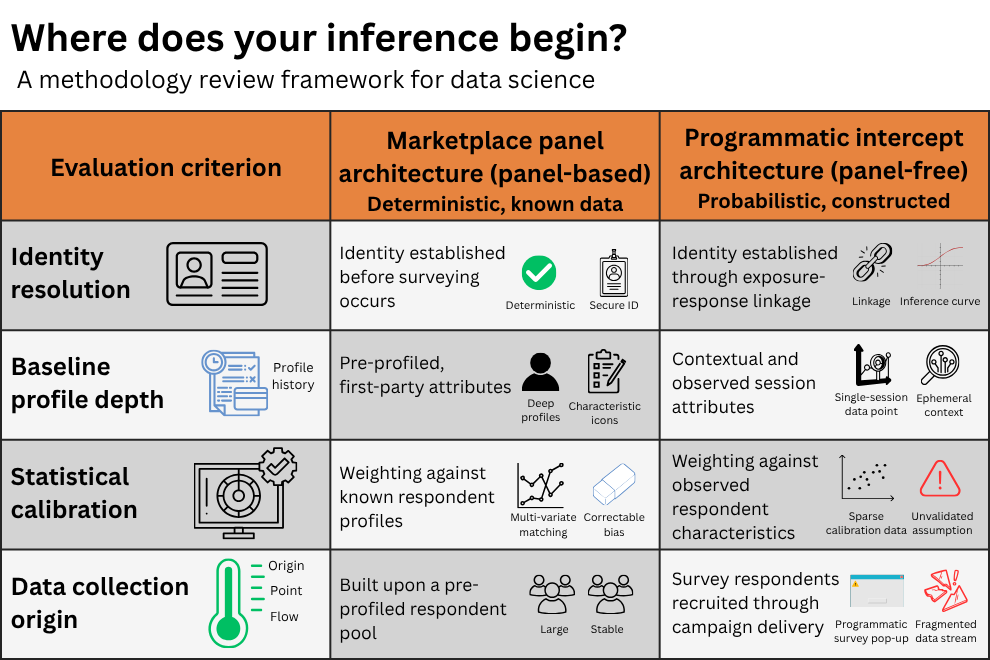
By examining the structural paths, the underlying technical trade-offs of each system become clear. Let us evaluate how these architectural differences manifest across live campaigns.
1. Identity resolution: Known baselines vs. compounded inference
The foundation of any upper-funnel measurement study is matching ad exposure to the survey response. If you cannot verify with statistical confidence that a respondent had the opportunity to see your ad, your control vs. exposed framework introduces structural error.
The intercept model:
When a measurement system tracks ad exposure via a pixel without an underlying user database, it faces a fundamental data-stitching challenge. Serving a survey programmatically across fragmented publisher networks in a cookie-depleted environment without incentive requires an architectural reliance on external signals, often utilizing varying combinations of identity graphs, device linking and probabilistic matching.
The structural implication here is that inference enters the measurement chain at different stages depending on the architecture. For open-web intercept systems, statistical modeling may be required at multiple stages of the exposure-to-response chain, depending on the availability and strength of the identity signals. While identity accuracy varies significantly based on geography, platform and signal availability, deterministic identity resolution generally provides a stronger validation framework than purely probabilistic matching because the linkage is directly observed rather than inferred. When signal loss increases, purely probabilistic methods face an elevated risk of baseline variance, introducing greater uncertainty into the control group.
The panel model:
Marketplace panels operate on first party, logged-in identity resolution. Because the respondent is a known, consented individual within a managed ecosystem, matching exposure to response minimizes identity leaps.
To be clear, panels are not a magic bullet for exposure tracking. Panels must navigate shared household devices, cross-device fragmentation and walled-garden blind spots, often requiring exposure modeling of their own. However, the architectural advantage remains distinct: In a deterministic panel, inference regarding the respondent's baseline characteristics begins after their identity is known. In an open-web intercept system, inference begins before the respondent's identity can be established.
2. The correctability gap: Observable vs. unvalidated assumptions
A classic debate in survey methodology centers on selection bias. Proponents of open-web intercepts argue that observing consumers in their natural environment avoids the artificial nature of research panels, where panel conditioning and "professional respondents" can skew results.
This is a legitimate methodological challenge that panel providers must constantly audit. However, the open-web alternative introduces a different, structurally complex bias pattern.
When surveys are served programmatically as standard ad units across the open web, participation is entirely optional and without incentive. Published industry benchmarks often report low, single-digit response rates for open-web survey intercepts without incentives, although outcomes vary substantially by implementation, format and publisher environment. In survey methodology, a low response rate does not automatically guarantee high bias, but it significantly increases the risk that respondents differ systematically from non-respondents. The fraction of the internet population that optionally halts their browsing to fill out a banner ad survey without incentive may over-index on specific behavioral and attitudinal characteristics that are not fully observable to researchers.
This brings us to the core thesis of enterprise data quality: As bias becomes less observable, correction becomes increasingly dependent on untestable assumptions.
Modern intercept platforms are not completely blind; they can observe contextual signals like geography, browser type, device and publisher domain. However, compared with pre-profiled panel environments, open-web intercept systems typically have access to fewer respondent-level historical attributes prior to survey completion.
Because a marketplace panel holds deep, historical demographic and behavioral data on its users before they take a survey, data scientists possess a rich baseline dataset to weight, stratify and balance the sample. Having more calibration variables does not automatically guarantee lower total error or eliminate non-response bias, poorly designed weighting schemes can increase variance in any methodology. However, establishing a baseline pool of known respondent attributes provides data science teams with a significantly broader empirical foundation to diagnose, test and calibrate for observed skew.
With anonymous open-web intercepts, very little is known about most of the non-respondents who skip the ad-unit survey. Without knowing the baseline characteristics of the people ignoring your study, true statistical calibration becomes increasingly dependent on assumptions that cannot be independently validated.
3. Mid-flight optimization: Modeling from wealth vs. modeling from scarcity
Modern media buyers demand mid-flight optimization. To shift budget between individual creatives or publisher lines while a campaign is live, you need granular sample sizes to achieve strict statistical significance (p-values).
Every modern measurement system uses statistical modeling, weighting and imputation to deliver real-time dashboards. The question for a data scientist is not if a platform models, but what data is powering those models?
- The intercept model (modeling from scarcity): Because open-web programmatic surveys face low baseline response rates, gathering large, raw sample sizes for highly specific media slices early in a campaign is difficult. To deliver a real-time dashboard despite this data sparsity, these architectures may place greater reliance on statistical estimation and extrapolation when granular sample sizes are limited. You run the risk of optimizing your live media mix based on what an algorithm assumes is happening based on a highly constrained data pool.
- The panel model (modeling from wealth): By accessing a massive, pre-profiled pool of respondents from day one, a global panel marketplace delivers a deep volume of observed respondent data across your target demographics. When modeling, weighting or calibration occurs, it is applied to a robust foundation of verified identity profiles. You are optimizing from a position of data wealth, not data scarcity.
Industry case studies, such as joint research conducted by Adelaide Metrics and Lucid, illustrate how panel-based measurement can support live, mid-flight optimization workflows (e.g., measuring an average +40% lift in ad recall and a +28% lift in brand familiarity). While performance outcomes always remain dependent on specific implementation, campaign design and creative variables rather than architecture alone, this application underscores a clear industry trend: access to large pools of pre-established respondent data provides a broader empirical foundation for ongoing campaign adjustments.
The defensible choice for enterprise media
Open-web intercepts have their place in the measurement ecosystem: they are agile, cost-effective tools for quick, macro-level consumer sentiment pulses.
But for organizations making high-stakes media allocation decisions across complex, cross-channel environments, an important architectural consideration is whether the key sources of uncertainty can be directly observed, measured and stress-tested during the calibration process.
The ultimate lesson of measurement science is that when respondent identities and attributes are known before fielding, more sources of uncertainty are directly observable and available for calibration than in open-web intercept environments without incentive. If your goal is statistical defensibility to the C-suite, you need a measurement architecture that minimizes identity uncertainty and expands the information available for calibration. Traditional marketplace panels remain one of the most established infrastructures for transforming raw consumer feedback into statistically defensible business intelligence.
References
- Mironov, Daniel. “Cookieless Attribution: Methods, Accuracy Benchmarks, and Implementation Roadmap (2026).” Updated July 14, 2026.
- Lensym Team. “How to Calculate Survey Response Rate: AAPOR Formula.” Lensym.com. January 19, 2026.
- Lensym Team. “Survey Completion Rates: Benchmarks, Drop-Off & 7 Fixes.” Lensym.com. January 21, 2026.
- Nizolek, Kaitlin. “Lucid & Adelaide Prove Attention Metrics Drive Better Brand Outcomes Than Traditional Metrics.” Adelaidemetrics.com.