
Key takeaways from Quirk’s Event – New York 2025
Editor’s note: Kevin Cowan is an audience research manager at BBC News, headquartered in London, United Kingdom. This is an edited version of an article that was originally published under the title “Quirks NYC 2025.” All images were provided by Kevin Cowan.
It was another packed Quirk’s Event – New York and, with six sessions running at once, it was impossible to catch everything. So, if you couldn't make it, or missed a few talks, here's a quick roundup of the sessions and themes that stood out for me.
The Next Normal
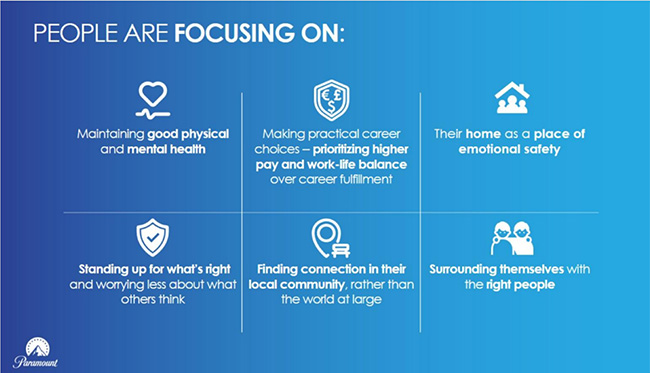
A theme in a number of presentations was growing global uncertainty. In “The Next Normal 2025,” Christian Kurz, SVP global streaming research and insights at Paramount, shared the latest, and first since the pandemic, installment of Paramount’s survey measuring the thoughts, feelings, hopes and fears of people around the world. The study showed that amidst growing uncertainty and rising stress people are increasing focus on the present.
People were prioritizing their well-being, mental health and financial security. There were lots of standout facts, many of which reflected people focusing more on things within their control and closer to home. A small taster:
- Activities like smoking, watching music videos, entertaining and reading are not the mood boosters they used to be.
- Trust in others has been shaken in recent years – not just institutions, but declining trust in parents, siblings, romantic partners, children, doctors and other family members.
- People have fewer close friends – down from five in 2017 to 2.7 in 2024.
The Value Crisis
Andrew Ho, chief strategy officer at BAMM, moderated a great panel titled, “Value: What it means and the future for brands,” with Natalie Accari, division vice president, GM convenience and RTD at Pernod Ricard; Cherie Leonard, senior director, head of North America insights at Colgate-Palmolive; and Tina Tonielli, U.S. and North America lead, consumer business insights and analytics at Haleon, on the Value Crisis
Consumers feel prices have gone up and quality has gone down. It is not as simple as just trading down, it is trading smart. “Good enough is pretty good,” is the view for many customers.
There are six pillars for value.
- Purpose and fit were rated highest (79%): Is it high quality? Durable? Will it last a long time?
- Fair price (73%).
- Ease (65%): In a world post COVID-19 mental crisis – remove mental load.
- Gives me savings (63%): Gives the consumer long-term savings that they feel good about.
- Brings me delight (58%): Brings the consumer joy, makes them feel good.
- Social cache (44%): Makes them feel cool.
These speak to the whole human. There is a need for simplicity because of so much cognitive burden.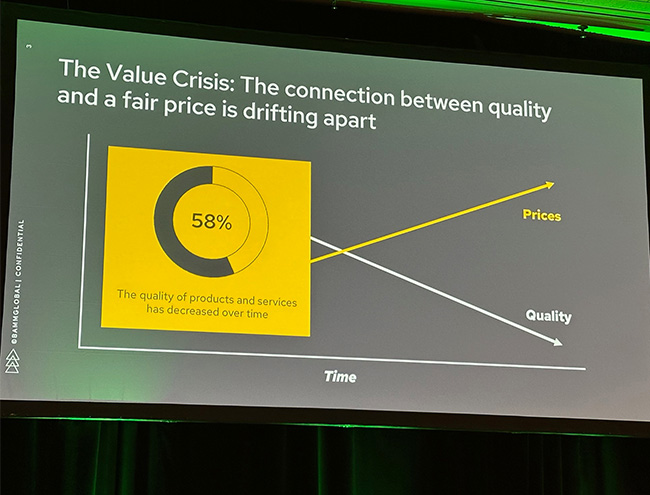
It’s time to unf*ck market research
Jason Talwar, principal VP, methods and innovation at NewtonX, and Kim Kardash, head of strategy, consumer advocacy at Guardian Life, hosted a thought-provoking session titled “It’s time to unf*ck market research,” on the state of the market research industry.
These are the five areas Talwar and Kardash think the industry need to address.
- Data quality: If your sample is suspect then your findings are fiction with a negative ROI.
- Validity: Insight without reproducibility is just a story. Up to 70% of survey findings are not reproducible.
- Manipulation: Twisting research develops mistrust. Research is used to prove a case, not illuminate one.
- Value creation: Good enough can win. You are still f*cked with poor quality data. Your stakeholders aren’t looking for perfection, they are looking for good enough to make the decision. Warning – AI chatbots can be good enough!
- Tradition: The old ways are no longer working. When prices are high, disruption will follow. Market research jobs are on the line. Demand for market research jobs, according to Revello Labs, is down 1.94 times.
The key advice was, “Be brief, be useful, be market smart.”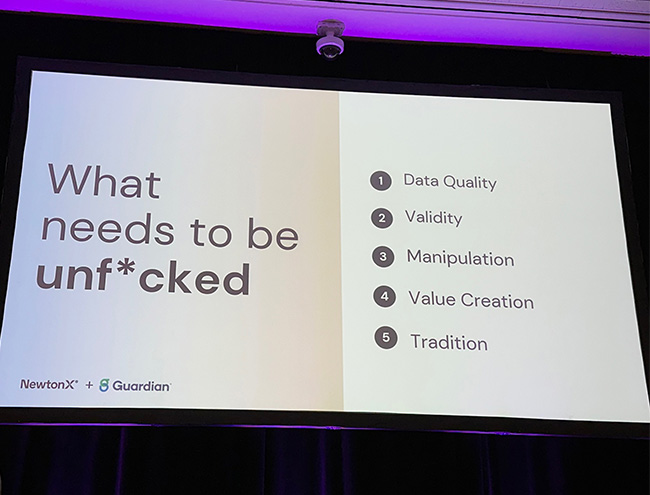
Methodology is evolving – fast
Several sessions showcased how research is becoming more empathetic, behavioral and AI-augmented.
- Sekisui House and inca | Nexxt Intelligence explained how conversational AI was used to build emotionally resonant segments – no batteries of statements, just open-ended stories in the session, “Segmentation reimagined: Learn how Sekisui House leveraged conversational AI to build empathetic, consumer-led segments to drive meaningful home design differentiation.”
- PepsiCo and Nailbiter emphasized behavioral diagnostics, capturing irrational moments of decision-making in real time during the session, “New Product Pulse (NPP): Cracking the code on in-market innovation success.”
- AARP and Intuify explained how to reframe research around Jobs-To-Be-Done to identify unmet needs like simplifying health information for older adults during the session, “Solving what matters: Using JTBD to uncover how older adults want AI to show up.”
The common thread? Less interrogation, more conversation. Less about what people say, more about what they feel and do. 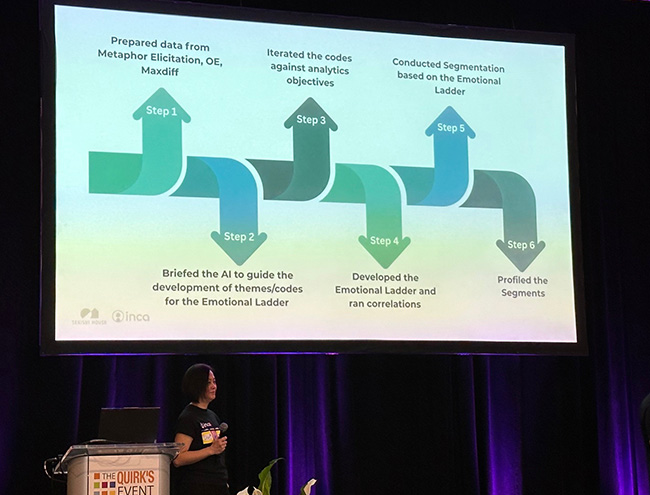
From discovery to execution
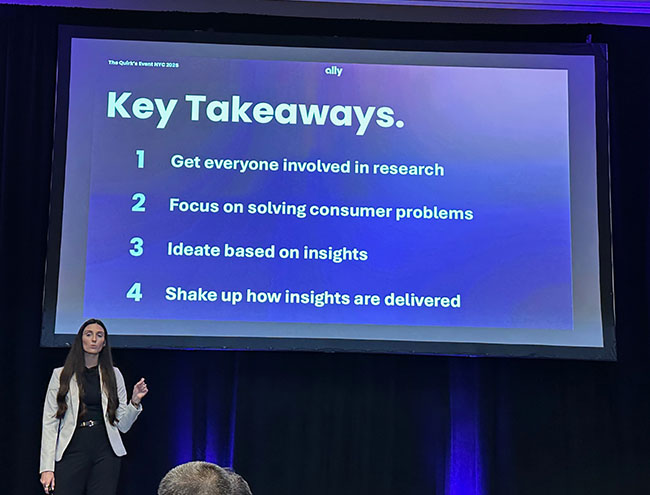
Taylor Hobgood, consumer insights and innovation manager at Ally, showed how insights-driven innovation transformed customer experiences at Ally Bank in a session titled, “From discovery to execution: Driving innovation through research.”
The business question they were asked was, “How might we increase customer engagement beyond offering a competitive rate?”
After research and empathizing with consumers they found the real problem was people had multiple savings, one account for holidays and another for savings. People were essentially disorganized.
Ally hosted cross functional ideation sessions. People from across the business came together, ideating from a place of insight.
The result, Savings buckets – sub accounts people can use to allocate money, has helped the business grow. The team is not trying to create new ideas that might fail. They want consumer validated concepts.
Tips that can be applied in any organization:
- Democratization: Host a listening session and have an analysis session after with stakeholders. Invite them in to help design the questionnaire.
- Bias to action mind-set: How quickly can we go from an idea to having something in front of consumers.
- Challenge your stakeholders: Ask if we are solving the right problem. Centers around humans.
- Act on your insights: Empowers you and your stakeholders.
- Creative insight delivery: Demo where we are. Can be a whiteboard because it gets them more excited.
The art of storytelling
Sandeep Das, founder of Building Leaders for Tomorrow, hosted a great session titled, “The art and science of storytelling.”
He showed the anatomy of a compelling story as a problem, tension and a resolution. The key? Don’t rush to the solution. Let the tension breathe.
Principles of storytelling:
- The brain does not value an experience by the length but by the end
- Anecdotes are always better than numbers
- Rule of three – three parts of the problem, three key insights, three key actions.
Applications:
- Show not tell: The problem is people focus their pitch on the resolution. A story is good when the tension is really good. When the villain (i.e. Joker) looks good, the hero looks good.
- Symbolic storytelling: Client was saying change the company, but client was the problem. The image below was used to drive this difficult message.
- Paint the future: Show as a simple conversation between two people today versus tomorrow.
The takeaway: Data doesn’t move people, stories do. 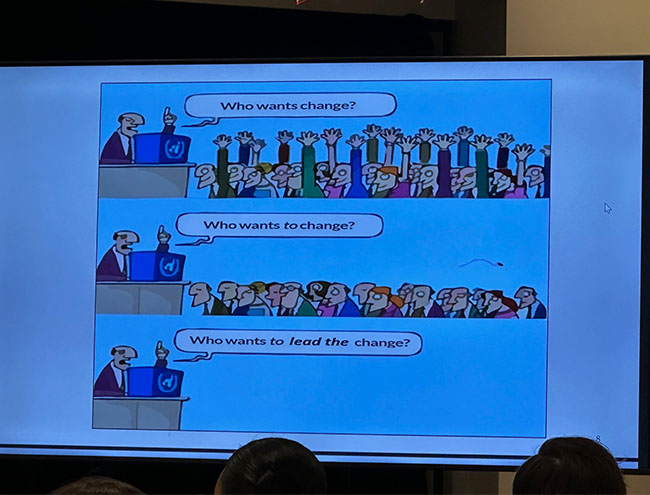
Overall Quirk's Event – New York themes
If the main theme at Quirk’s in the past few years was about embracing AI, this year it was about reclaiming the human – and doing it together.
Across sessions, there was a clear call for collaboration between insights and marketing, researchers and stakeholders and even between humans and machines. The most impactful work came from cross-functional teams, co-creation and shared ownership of insight.
At the same time, the backdrop to all of this is growing uncertainty, in the world and within our industry. From declining trust in institutions to the erosion of traditional research methods, the ground is shifting.
But rather than retreat, the best sessions leaned into this ambiguity. They reminded us that insight isn’t about having all the answers. It’s about asking better questions.
As Sandeep Das put it, “Tension comes from human pain, human suffering – AI can’t replicate that.”