
The authenticity advantage
Editor's note: Jenny Dinnen is president and co-owner of MacKenzie and Next Gen Collaborative. She can be reached at jdinnen@mackenziecorp.com.
If you’ve ever watched “Succession” or “Yellowstone,” you know family businesses make great TV dramas. But beyond the screen, family businesses are far more than entertainment; they form the backbone of the U.S. economy, accounting for 59% of private-sector jobs and over half of GDP.
Despite their economic impact, public understanding of family businesses is often vague, outdated or downright wrong. A new national study conducted by MacKenzie and Next Gen Collaborative set out to explore how Americans perceive family businesses today and why these perceptions matter more than ever.
As a second-generation family business owner and insights professional, this topic is deeply personal to me. My sister and I just celebrated 40 years in business at MacKenzie, having watched our dad and team build something incredible. I’ve also been involved with local and national business groups for over 15 years, conducting research focused on understanding their unique needs and challenges. From firsthand experience, I can tell you that most family businesses look nothing like what we see on TV.
I’ve long championed family businesses and often say my goal is to “change the perception of family businesses in the U.S.” Recently, my sister (and co-owner) challenged me with a simple but powerful question: “What is the current perception of family businesses?”
That question became the spark for this project.
As we remind our clients: If you really want to know what people think, you must ask them. We can’t rely on assumptions, especially when we’re so close to the topic. And we can’t simply look inward while ignoring the people we serve.
In partnership between MacKenzie and Next Gen Collaborative, we conducted a nationwide panel survey with 1,300+ U.S. adults to understand what they think, feel and believe about family businesses. Alongside perceived strengths, our findings uncovered significant gaps between public perception and reality. We believe these gaps directly impact brand reputation, workforce attraction and competitiveness for family businesses.
For both family-owned and non-family businesses, the insights from this study highlight an important truth: Public perception, whether accurate or not, shapes your reality.
My goal in sharing these findings is to motivate business leaders to actively shape their narrative. By understanding how we’re perceived, we can communicate our value more effectively and connect with the audiences who matter most.
Value-driven traits
Our study showed that respondents associate family businesses with value-driven traits like honesty (57%), dedication (55%) and passion (50%). This aligns with Edelman’s 2023 Trust Barometer, which reports trust in family businesses at 66%. In a time when trust is a prized commodity, this is a major win and something family businesses should be leaning into.
But the picture isn’t all rosy. Far fewer respondents associated family businesses with social responsibility (29%) or charitable giving (27%). That surprised me. In my experience, family businesses are deeply rooted in their communities, sponsoring local events, supporting nonprofits and giving back in countless ways. Yet these efforts often go unnoticed by the broader public.
Closing this gap isn’t about seeking applause. It’s about telling our stories in ways that resonate. Consumers and employees increasingly make decisions based on shared values and family businesses have a huge opportunity to shine by highlighting their social impact.
This matters. Edelman’s data shows that 63% of consumers buy or advocate for brands based on shared beliefs. Deloitte’s Gen Z & Millennial Survey reveals that younger generations are far more likely to work for and stay loyal to companies that demonstrate social responsibility. Without visibility into these contributions, family businesses risk being overlooked by the very people who care most.
Generational differences provide direction
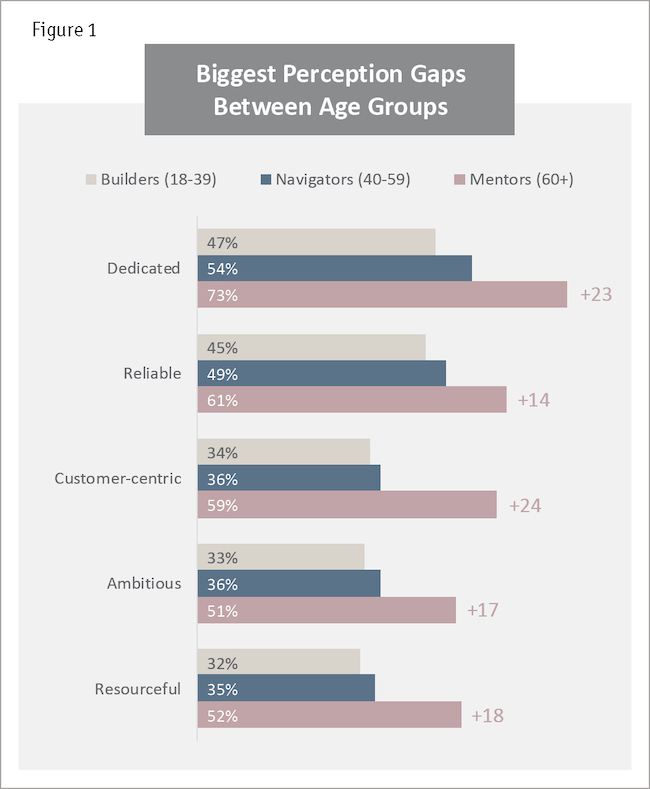
Beyond overall trends, we segmented survey respondents into three life-stage-based groups to get a deeper view (Figure 1):
The Builders (18-39): Digital natives seeking authenticity and purpose.
The Navigators (40-59): Career professionals who prioritize reliability and trust.
The Mentors (60+): Legacy-focused consumers drawn to reputation and tradition.
Unsurprisingly, Mentors rated family businesses highest across nearly every positive trait, reflecting their deeper experience with family-run companies. For instance, 73% of Mentors said “dedication” described family businesses well, compared to 54% of Navigators and 47% of Builders.
The takeaway? While older consumers may already be advocates, there’s huge opportunity to engage younger audiences by focusing on themes that matter most to them – like purpose, transparency and community impact.
We didn’t just want to understand family businesses in isolation, we wanted to see how they stack up against private and public companies. That’s where things get interesting.
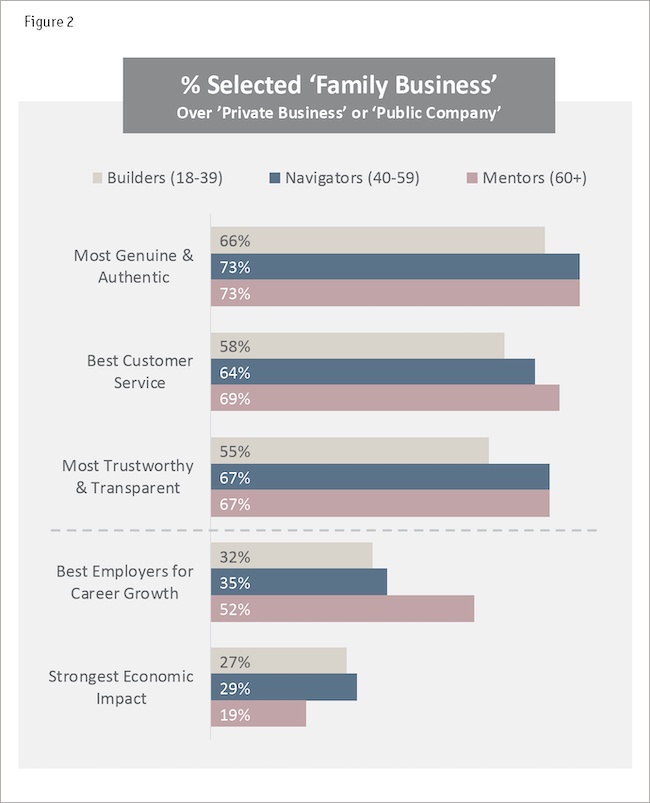
Where family businesses shine (Figure 2):
- Genuine and authentic: 70% of respondents saw family businesses as the most genuine and authentic.
- Best customer service: 62% rated them the highest level for customer care.
- Most trustworthy and transparent: 62% gave family businesses top marks here as well.
These results validate what many of us in the family business community already know: Our close-knit structures allow for deep customer relationships, agility in service and a values-driven approach that often feels more personal than transactional.
This authenticity is a clear competitive advantage, especially as trust and personalized experiences become bigger drivers of consumer choice.
Economic impact and career growth
The data also showed that public companies were seen as stronger in career growth opportunities at 40%, compared to 33% for private businesses and just 27% for family businesses (Figure 3). Public companies also came out on top for being known for the strongest economic impact at 48% compared to both private and family businesses at 26% each.
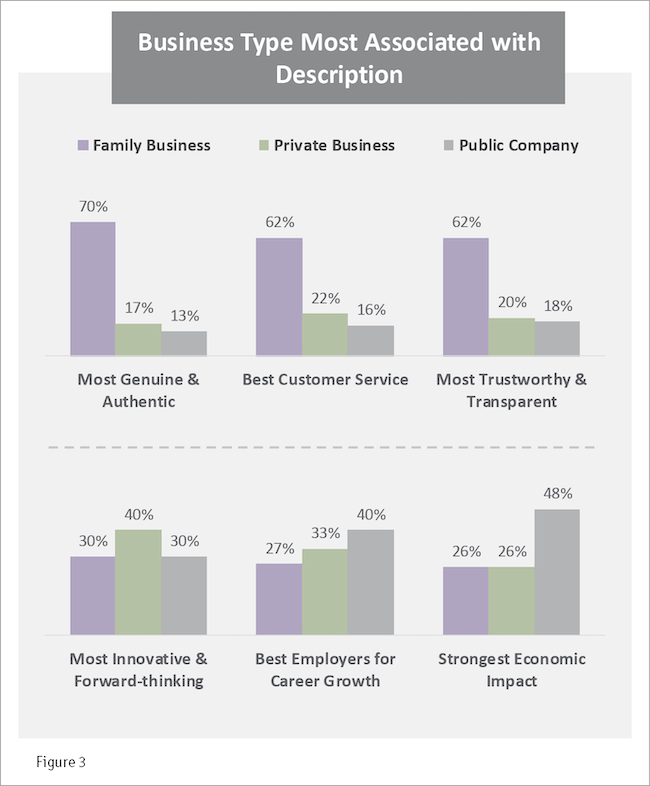
This gap is significant. In an era where younger generations are seeking both personal growth and purpose at work, failing to showcase career development and advancement opportunities can hinder recruitment and retention. It also limits broader brand recognition and credibility in competitive markets.
These perceptions may stem from seeing family businesses as smaller or less sophisticated, but do they reflect reality? We asked respondents to estimate the percentage of U.S. jobs and GDP generated by family businesses. Most selected 25-50%. In reality, family businesses account for 59% of private-sector jobs and 54% of GDP is far more than many realize.
Encouragingly, younger respondents showed more optimism: 31% of Builders believe family businesses are the best employers for career growth, compared to 27% of Navigators and just 19% of Mentors. This may reflect shifting expectations, today’s younger workforce prioritizes authenticity, well-being and having a voice in company decisions. These are areas where family businesses can shine if they lean into their strengths.
The opportunity
Family businesses have room to grow their messaging around scale, innovation and upward mobility. For example, spotlighting leadership development programs, employee success stories and the unique flexibility that smaller or mid-sized firms can offer would help close this gap.
Additionally, many family businesses are at the forefront of sustainability, innovation and tech adoption but they don’t always get credit for it. By leaning into proof points, like digital transformations or thought leadership in their industries, family businesses can challenge outdated perceptions that they are "small-time" or "old-fashioned."
No matter what the business type, challenges are part of the game. But when we asked, respondents felt that family businesses are more likely to face specific challenges: 84% believe family businesses are resistant to change; 82% believe family businesses are behind the curve on tech with outdated technology; and 79% think family businesses face more internal conflict.
These perceptions echo classic stereotypes: that family businesses are bogged down by tradition, slow to innovate and hindered by family dynamics. And while there’s a kernel of truth – tradition can slow adaptation and family ties can blur professional boundaries – these challenges are hardly unique to family enterprises.
Change management: The assumption is that long-standing family ties and legacy processes create resistance to change. Yet, many family businesses excel at pivoting quickly because decision-making is concentrated in a few key people.
Outdated technology: While budget constraints can play a role, many family businesses are increasingly investing in tech-forward solutions, from e-commerce to supply chain automation, to remain competitive.
Leadership struggles: Yes, family dynamics can complicate succession, but we've seen high-profile power struggles in large public companies too. What’s critical is having governance structures in place that ensure professionalism and clarity.
These stereotypes, accurate or not, impact how customers, job seekers and even policymakers view family businesses. If we don’t actively challenge these perceptions, they can limit growth opportunities and erode trust over time. For family business leaders, that means owning the narrative by demonstrating adaptability, innovation and professionalism. Sharing case studies, investing in public-facing tech upgrades and being transparent about leadership succession are all ways to proactively combat these outdated ideas.
A roadmap for action
Our goal with this study wasn’t just to gather stats, it was to create a roadmap for meaningful action. Public perception influences everything: who wants to work with you, who buys from you and even who advocates for you in the policy world. The study is available for free download (registration required) at https://nextgencollaborative.com/family-business-report.
For researchers, this is a reminder that perception studies must go beyond the surface. It’s not enough to know what people think, we need to understand why they think it. That’s the only way to design strategies that shift mind-sets and behaviors in lasting ways.
As someone who grew up in and now leads a family business, this project is especially close to my heart. I know many in the marketing research and insights community are part of family enterprises themselves. My hope is that these results fuel new conversations, new strategies and a renewed commitment to telling the real stories of family businesses – the stories that reflect their true value, impact and potential.