
••• education research
Coughing up college costs
Tightening budgets don’t derail higher education plans
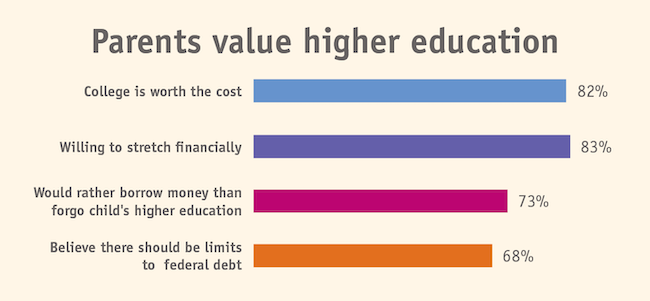
When asked about post-graduate plans as part of a recent survey, 95% of American high school students say they plan to continue their education. Ipsos and student loan company Sallie Mae surveyed over 2,000 respondents online and found that 90% of families believe higher education is an investment in their students’ future. Over eight in 10 (82%) say it’s worth the cost. A similar number of parents surveyed (83%) say they are willing to stretch financially for the best higher education opportunities.
A surprising 73% of families say they would rather borrow money than have their child forgo attending higher education. Most families (68%) agree there should be limits to how much debt federal student loan borrowers can take on (only 10% disagree).
Sixty-four percent of families say they have a plan to pay for higher education, a 10% increase from 2020. On top of this, 44% of high school students who plan to pursue college are already planning for graduate school. The level of savings in these families has increased significantly, with 60% of families considering higher education indicating they have saved on average $42,307 compared to $26,266 in 2020, driven primarily by higher-income families. Most families saving for higher education continue to rely on general savings accounts (53%) over tax-advantaged 529 college savings accounts (39%).
 Things have changed in the past few years in terms of college financial planning. While 77% of high school families considering higher education in 2020 said they were taking steps to prepare, in 2026, 85% say the same thing. More than half of students (55%) claim to have at least a general idea of the field they want to pursue, although only 38% of families say they have discussed key outcomes of higher education. Even fewer (28%) have conversed about the potential earnings compared with the cost of education and career placement rates.
Clarity about paying for college is still needed for families. Forty percent feel they are on their own when it comes to planning and paying for college. Nearly half (48%) believe scholarships are only available to students with exceptional grades and only 37% know that families often pay less than the advertised price of college. Only about one in five (22%) know when student loan interest typically begins to accrue.
How America Plans for College 2026 is based on 2,010 online interviews conducted by Ipsos from January 21-27, 2026, among 1,005 U.S. parents of high school students and 1,005 U.S. high school students ages 14-18.
••• parenting research
Motherhood’s mental challenges
Misunderstandings about postpartum lead to isolation
Postpartum recovery is, of course, physically challenging, but a recent survey also highlights the profound mental health impact of early motherhood. In a survey of over 1,000 mothers, therapy practice Octave found that 40% cited mental health impact as the most misunderstood part about early motherhood, compared to only 21% who cited physical recovery. Almost all (96%) mothers who reported struggling with their mental health reference emotional isolation as the primary factor in postpartum mental health concerns.
Mothers who report struggling with their mental health in the first year of motherhood cite a host of negative feelings including emotional isolation (96%), overwhelm (82%), fear (59%), sadness (56%) and guilt (44%).
Despite expectations of a deeply connected experience in motherhood, many think the opposite. Living with a romantic partner and co-parent doesn’t prevent feelings of isolation, as about 40% of partnered mothers still experience frequent isolation. This means that isolation is not about being physically alone but about feeling unsupported not just by their partner but also by friends, family and community during this time.
This exposes the paradox of early motherhood. Joy and overwhelm often coexist for mothers, creating a layered emotional experience that is rarely discussed openly. Only 5% of mothers described their mental health as “thriving” during the first year postpartum. Most reported existing in the gray space in between, with 31% “managing” and 44% experiencing some level of struggle.
Eighty percent of employed mothers experienced work-family trade-offs on some level. Almost seven in 10 employed mothers (69%) minimized their parental identity at work at least sometimes. Over half of co-parenting mothers (56%) reported moderate-to-high resentment about division of responsibilities. A similar amount (55%) said body image negatively affected their mental health.
Among those surveyed who wanted mental health support, the primary barrier isn’t cost or insurance coverage; instead, it’s not knowing where to start. Thirty-six percent also cited “lack of time” and 30% cited “childcare challenges,” with 13% of mothers citing both.
These are findings of an Octave Therapy survey, with data collection provided by a market research firm, conducted in April 2026. A sample of 1,007 U.S. female-identifying people between the ages of 20 and 45 who gave birth to their first child between 2021 and 2026 and refer to themselves as “Mother” or “Mom” were surveyed online. The sample was randomly drawn from online panel sources and does not rely on a population frame in the traditional sense.
••• education research
Expanding education to the trades
Alternative classes offer viable careers for an AI-focused future
As artificial intelligence raises new questions about the future of work, a new national survey finds strong demand for the expansion of skilled trades education in U.S. public high schools, giving students earlier access to hands-on learning that can lead to meaningful careers in fields such as construction, welding, electrical, automotive technology, manufacturing and other essential trades.
The survey of more than 6,000 U.S. voters, parents and public high school students shows strong bipartisan support for growing career-focused options as part of high school curriculum.
Nearly four in five voters say it’s a major problem that public high schools have reduced or eliminated trades classes entirely, contradicting the urgency of expanding opportunities. Almost all voters (95%) on both sides of the political spectrum agree that more opportunities to study skilled trades in high school would better prepare students for careers. Eighty-four percent support increased government funding for skilled trades education.
Politically, 74% of Democrats, followed closely by 65% of both independents and Republicans, say they are more likely to support candidates who back increased funding. Voters even ranked skilled trades as the top elective funding priority for high schools – higher than STEM, business, healthcare, arts and physical education.
Only 30% of high school students report having taken a skilled trades class with 40% of those students having taken multiple. On top of this, about one-third of students who want to take a trades class have been unable to do so.
About half of parents surveyed (49%) are extremely or very concerned that AI will limit their child’s job opportunities and eight in 10 say having more opportunities to study the trades in high school will make their child more prepared for a career.
Trades classes can increase confidence in and out of the classroom. Compared to students who have never taken a trades class, students who have done so are more likely to say they enjoy school, believe they are receiving a high-quality education and have developed the skills and knowledge necessary for college. Fifty-nine percent of students who have taken a skilled trades class say what they learn in school is “useful for life after high school,” compared to only 38% of students not in these classes agreeing with this sentiment.
About seven in 10 (69%) of voters agree it is important for the government to fund career training in fields that are less likely to be impacted by AI.
NORC surveyed more than 2,000 U.S. voters, more than 2,000 parents of U.S. public high school students and more than 1,700 U.S. public high school students between Dec. 9, 2025 and Jan. 21, 2026.
••• food research
What a friend we have in cheeses
Americans value the taste and convenience of cheese in all its forms

While most Americans are fond of cheese – seeing it as a tasty and convenient source of protein – in a survey conducted by Talker Research, 52% of those polled took it up a notch, self-identifying as “cheese-obsessed.”
Sixteen percent of participants say they’re “constantly” eating cheese as a part of their daily routine, with 61% consuming it often or sometimes. A mere 3% say they never eat cheese.
Cheese is also considered a highly versatile food: 82% of Americans say it’s one of their overall favorite foods, 91% say it’s a favorite to add as a topping or ingredient to a meal and 77% say it’s a snack-time favorite. Respondents reported adding cheese to just about everything from ramen to apple pie and even oatmeal. Nearly three-quarters of Americans (73%) always or often buy cheese when grocery shopping.
Interestingly, Wyoming ranked highest for cheese enthusiasm (61%), followed by Illinois (59%), Alaska, Louisiana and Oregon (each at 58%).
There are also generational differences in cheese fandom. Younger generations like Gen Z and Millennials have higher rates (61% and 57%, respectively) than Gen X and Baby Boomers (54% and 44%, respectively).
In terms of favorite cheeses, cheddar tops the list at 77%, followed by mozzarella (74%) and Parmesan (64%). But taste isn’t the only reason Americans love cheese. More than half of those who eat cheese (54%) seek it out as a source of protein.
The top four reasons Americans turn to cheese are taste (74%), comfort (51%), convenience (49%) and the way it helps make meals feel more satisfying or filling (46%).
The survey 5,000 Americans (100 from each state) was commissioned by Dairy Management Inc. and administered and conducted online by Talker Research between Nov. 7 and Nov. 17, 2025.
••• sports research
You can bet on it
World Cup expected to juice online gambling

Sports betting is an increasingly popular form of entertainment. Online mobile payment and identity verification company Jumio conducted its 2026 Online Identity Study and found that online sports betting will take center stage during the World Cup.
Sixty-three percent of respondents say they worry about minors using sports betting apps to gamble during the World Cup. About three-fourths (74%) believe that preventing underage betting is the responsibility of online platforms and their technology providers and only 7% disagree that this should be a critical priority for the gaming industry.
About one in three adults globally plan on engaging in sports betting as part of their World Cup celebrations. By country, Mexico leads the charge with 43% saying they plan on betting, followed by the U.K. (33%), Singapore (29%) and the U.S. (26%).
Forty-seven percent of fans say betting is an important part of how they plan to enjoy the World Cup and 46% plan to socialize around the bets they place.
On a broader scale, global consumers love online sports betting. Over half (55%) would prefer to use an online platform to place their bets and 20% will interact with an online gaming platform for the first time during the World Cup. Forty-three percent of respondents already have a sports betting account that they plan to use during the World Cup, and 37% expect to juggle between multiple platforms to place bets during matches.
The Jumio 2026 Online Identity Study surveyed 8,003 adult consumers evenly distributed across the U.S., U.K., Singapore and Mexico. Censuswide fielded the survey between April 14 and April 27, 2026.
••• healthcare research
Aging out of pediatrics
Young adults struggle to transition to adult medical care
Young people are shockingly underprepared for the switch from pediatrics to the adult healthcare system. A survey conducted by biopharmaceutical company Ipsen suggests that extra attention is needed on this transition for young adults.
About seven in 10 (71%) of youth aged 14-26 find the adult healthcare system confusing, with two-thirds saying they would have benefited from more preparation for the transition. Healthcare providers tend to agree with this feeling. About nine in 10 primary care providers (89%) and pediatricians (93%) agree that the U.S. does not adequately prepare teens and young adults to navigate the adult healthcare system.
This gap in knowledge can have tangible consequences for a young person. Forty-three percent of youth who made the switch from pediatric to adult care experienced a time without a primary care provider after leaving pediatric care. Almost one-third (28%) had a health issue that went untreated and 26% increased their use of the emergency room. Three in 10 said their health was worse after switching.
There are serious gaps that may lead to this need for support in young people. Eighty-two percent of the surveyed youth say making appointments and meeting with healthcare providers can be intimidating. Forty-six percent say they often leave medical visits confused by the terminology used.
There are four main deficits identified by healthcare providers in young adults changing from pediatric to adult primary care: overreliance on parents, inability to accurately share their own medical history, uncertainty around how to ask providers questions and a lack of understanding of health insurance basics. These gaps can limit their confidence to make the transition to adult healthcare.
Three in 10 youth surveyed have been diagnosed with a chronic condition, making a seamless transition out of pediatric care even more critical. Ninety-one percent of primary care providers and 94% of pediatricians agree handling the handoff from pediatrics to adult care is more important for youth with complex needs. The vast majority of parents (92%) agree that youth with chronic conditions need extra support during the switch as well.
Almost everyone surveyed agrees that more resources are needed for this critical transition. Eighty-one percent of youth and 84% of parents wish there were more resources to support young people who are navigating the change from pediatric to adult primary care. Eighty-eight percent of pediatricians and 79% of primary care providers agree there are not enough resources available to support teens/young adults during this shift. Eighty-four percent of youth and 92% of parents say healthcare providers should approach care for teen and young adult patients differently, recognizing they may need a different level of support. Nine in 10 parents and 83% of youth believe adult providers could make simple changes to better support young patients.
The Healthcare Shift Survey was conducted online in the United States by The Harris Poll on behalf of Ipsen among 1,514 youth (teens and young adults aged 14-26) and 1,502 parents (adults aged 18+ who are parents to teens and young adults aged 14-26). Both audiences were U.S. residents who saw (or whose child saw) either a primary care provider or pediatrician. The survey was conducted January 30 through February 13, 2026. The healthcare providers survey was conducted among 200 primary care providers and 200 pediatricians. Both audiences were aged 18+, physicians (MDs or DOs) who practiced in the continental U.S., were duly licensed, had at least 25% of their patient population aged 14-26 and at least 15% of those patients managed a chronic condition. The survey was conducted Jan. 29 through Feb. 11, 2026.
••• healthcare research
Take as directed – by yourself
Americans routinely combine both OTC and Rx meds
A new, nationally representative study published in the medical journal JAMA Network Open provides a detailed picture of U.S. adults' use of over-the-counter (OTC) and prescription (Rx) medications. The study finds that 46% of U.S. adults surveyed reported the use of an OTC medication during the past seven days, often to address everyday, self-treatable healthcare. Nearly two-thirds (62%) reported using at least one medication of any type (OTC or Rx) in the past seven days.
Rather than focusing on prescriptions written or medications taken at any point during an individual's lifetime, the study, “Prevalence of over-the-counter and prescription medication use in the U.S.,” captures a snapshot of recent, self-reported use. Within a seven-day period, OTC and prescription medicines were reported at nearly identical rates, reflecting the co-use of different types of medicines within the same week to address distinct health needs.
"Usually, medication evidence comes from prescriptions dispensed by pharmacies or products sold," says Jody Green, principal investigator of the study, "but in this study we focused on what people actually used in the past seven days, which provides a clearer picture of how American adults manage their health conditions in daily life."
Adults often manage multiple health concerns at once, using more than one medication during a given week. The study evaluated recent, self-reported use of OTC and prescription medications across a range of common conditions, including both single-ingredient and fixed-dose combination products.
No information was collected on the care settings in which medications were taken or on health outcomes. The findings reflect how U.S. adults report managing their individual health needs through the use of both OTC and prescription medications. Prescription medications are commonly used for more serious or longer-term conditions, while OTC medicines are frequently used to manage short-term and everyday ailments.
The published study identified the most commonly used Rx and OTC medicines reported by U.S. adults in the past seven days. The list includes familiar OTC products alongside widely used prescription medicines for chronic conditions, reflecting the mix of self-care and clinician-directed treatments people report using in everyday life. This mix underscores an important reality: healthcare is not an either/or proposition. It is a continuum in which consumers responsibly combine self-care and clinician-guided treatments to meet their needs.
"It's also notable that several of the most commonly used OTCs on the list were once only available by prescription," says Scott Melville, Consumer Healthcare Products Association president and CEO. "Over the years, OTC medications – like naproxen, omeprazole, cetirizine and loratadine, to name a few – went through FDA's Rx-to-OTC switch process to change their status from prescription-only access to OTC. Their appearance on the list among the most commonly-used medicines is a great example of how smart regulatory changes can expand consumer access to safe and effective treatments for better self-care."
Notably, the four most commonly used medicines overall – acetaminophen, ibuprofen, aspirin and naproxen – are all available over the counter, with the top three unchanged from patterns observed in national medication use surveys conducted approximately 25 years ago.
One of the key findings of the study is the extent to which OTC medicines are used for self-treatable health concerns. Overall, six of the 10 most commonly used medicines identified in this study are available, or primarily available, as an OTC medication.
These findings provide context on how Americans use both Rx and OTC medicines as part of everyday health management. By documenting recent medication use rather than prescriptions written or products sold, the study offers relevant data to inform ongoing discussions about self-care, access and the appropriate role of nonprescription medicines within the broader healthcare landscape.
Using a sample size of 21,000 U.S. adults, researchers conducted the large, nationally representative survey of U.S. adults from June 2023 through April 2024, asking participants to report all prescription and OTC medicines they had used in the previous seven days. Responses were statistically weighted to reflect the U.S. adult population.
••• food research
Frozen is hot
Industry data shows frozen food user base growing
Frozen food has moved from a backup option to a core element of meal-planning for a growing share of American households, according to findings in the fourth edition of the Power of Frozen in Retail report from the American Frozen Food Institute (AFFI) and FMI – the Food Industry Association.
As the national conversation about food, health and affordability is intensifying, the research finds millions of families seeing practical answers in the frozen food aisle. Among the report's significant findings:
The base of core frozen food consumers is increasing. Consumers who use frozen foods every few days or daily now represent 40% of shoppers, up from 35% in 2019. Nearly one-third (30%) plan to buy more frozen food, the strongest purchase intent measured in years. And 77% now purchase frozen foods with a specific meal or day in mind, up from 71% in 2023; a clear sign that frozen is a key component of meal planning.
Frozen food is helping families stretch their food dollars and reduce waste. Consumers report responding to economic concerns with an increased interest in at-home cooking, meal planning and food waste prevention – all needs which frozen food can meet. Plus, 37% of consumers use frozen food specifically as a way to reduce food waste.
Frozen is meeting the needs of today's families. Consumers appreciate the time-saving benefits of frozen food and also find that the category is meeting their evolving expectations for taste, quality and better-for-you attributes. The top-three purchase drivers identified among shoppers are ease of preparation, price and taste. At the same time, 96% of shoppers believe the frozen food aisle has better-for-you options and 71% report looking for frozen items they haven't bought before.
It's frozen and fresh, not frozen or fresh. Three-in-four consumers (76%) now combine fresh and frozen ingredients in the same meal. Households are not choosing between the freezer and the refrigerator. They are using both.
The insights follow the recent release of the 2025-2030 Dietary Guidelines for Americans, which call for increased consumption of fruits, vegetables and nutrient-dense foods. "Shoppers seeking value are willing to pay more for health, convenience, enjoyment and entertainment – which can all be found in the frozen food aisle," said Andrew Brown, senior manager of industry relations at FMI, in a press statement. "Food retailers can build loyalty with shoppers by showcasing the ways frozen food options can help families eat well, save time, waste less and provide quality meals that they will enjoy."
The fourth edition of the Power of Frozen in Retail study was conducted by 210 Analytics, with a Circana sales data overlay. The national consumer survey was conducted in October 2025 among 1,560 frozen food consumers who have at least 50% responsibility for grocery shopping.