

How to identify and test the messages that drive action
Editor’s note: Lilah Raynor is CEO and founder, and Maribel Castañeda is senior research manager, at Logica Research.
When developing or refining messaging and communications, it’s essential to move beyond surface-level insights to identify what drives appeal and action among an audience. But how can you effectively get to the messages that will resonate most? Traditional rating scales often fall short when testing a large set of ideas or messages. Participants tend to rate everything as “very important,” which limits the ability to distinguish which messages will have the greatest impact.
A MaxDiff approach addresses this by asking respondents to make trade-offs that produce clearer preference structures. However, real-world communications are often composed of bundled messages, i.e., a core claim supported by additional points. Combining MaxDiff with on-the-fly bundling, which constructs message bundles dynamically at the respondent level, allows researchers to test both individual and combined message performance. This approach produces insight into message appeal and how combinations influence effectiveness.
What the MaxDiff approach delivers
MaxDiff presents small sets of items, usually four or five at a time, and asks respondents to select the most and least appealing options. Repeating this task across many sets generates relative importance scores showing how each message performs compared with the others. This design helps surface meaningful differentiation, even when testing a large number of messages.
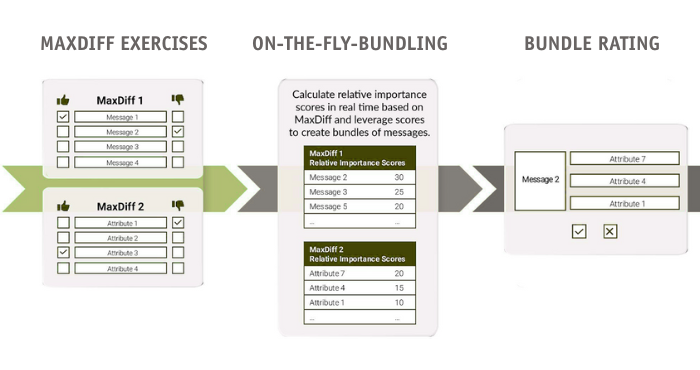
Depending on the messaging framework, researchers may use one or multiple MaxDiff exercises. A single MaxDiff works well when identifying high-performing messages intended to stand alone in market communications. When a strategy includes a primary message supported by secondary points, two MaxDiff exercises may be used – one for main messages and another for supporting elements such as benefits, proof points or reasons to believe. Once the top-performing main and supporting messages are identified, on-the-fly bundling can be applied to test how these messages perform together in combinations that reflect how they will appear in use.
How on-the-fly bundling adds value
Audiences encounter groups of messages, not isolated statements. Researchers can extend MaxDiff findings by combining top-performing messages into bundles that represent real-world communications, such as a core message paired with two or three supporting points. Respondents then evaluate the bundle as a whole.
On-the-fly bundling uses the relative importance scores from MaxDiff to create message combinations within the same survey and in real time. Once respondents complete the MaxDiff exercise, their scores are calculated and the survey system assembles bundles tailored to each respondent. Participants then evaluate these bundles on measures such as appeal, clarity and likelihood to take action. Some messages that perform moderately alone may gain appeal when paired with stronger ones, while others may lose effectiveness when combined.
From message testing to real-time personalization
For example, we can look at a financial services company preparing to launch a new product. A set of potential messages are developed: five focused on the core value proposition and eight highlighting supporting benefits and proof points.
Step 1: Define the message sets.
Organize ideas into two groups: main messages that convey the primary value proposition and supporting messages that provide reasons to believe, benefits or proof points.
Step 2: Run MaxDiff on the main messages.
Respondents are shown small sets of main messages – typically four or five at a time – and asked to choose the most and least appealing. Repeating this across multiple combinations generates relative importance scores identifying which core messages resonate most.
Step 3: Run MaxDiff on the supporting messages.
A separate MaxDiff exercise ranks the supporting messages to determine which benefits or proof points are most persuasive.
Step 4: Calculate scores in real time.
Once respondents complete both MaxDiff tasks, relative importance scores are calculated within the same survey.
Step 5: Create bundles on the fly.
Using real-time scores, dynamic bundling assembles personalized message combinations for each respondent, such as pairing the top-performing main message with three supporting statements.
Step 6: Test contrasting bundles.
Each respondent evaluates at least two bundles. Here is a theoretical example set:
- Bundle A: The top-scoring core message plus the top three supporting messages.
- Bundle B: The top-scoring core message plus a mix of mid- and lower-scoring supporting messages.
Step 7: Collect bundle-level evaluations.
Respondents rate each bundle on overall appeal, clarity and likelihood to act, and may provide open-ended feedback about which elements stood out.
Step 8: Analyze results across both levels.
The research team compares bundle performance with individual MaxDiff results to identify patterns. Some benefits that scored moderately in isolation may strengthen a core message when combined, while others that tested well individually may reduce the overall appeal of the bundle.
Step 9: Translate findings into messaging strategy.
Insights from both exercises guide which core messages and supporting points to emphasize, how many elements to include and which combinations to avoid.
Turning insight into action
MaxDiff identifies the messages that matter most to an audience, and dynamic bundling shows how those messages perform together. The combined approach provides an evidence-based framework for developing and refining messaging that reflects real-world communication and audience response.